
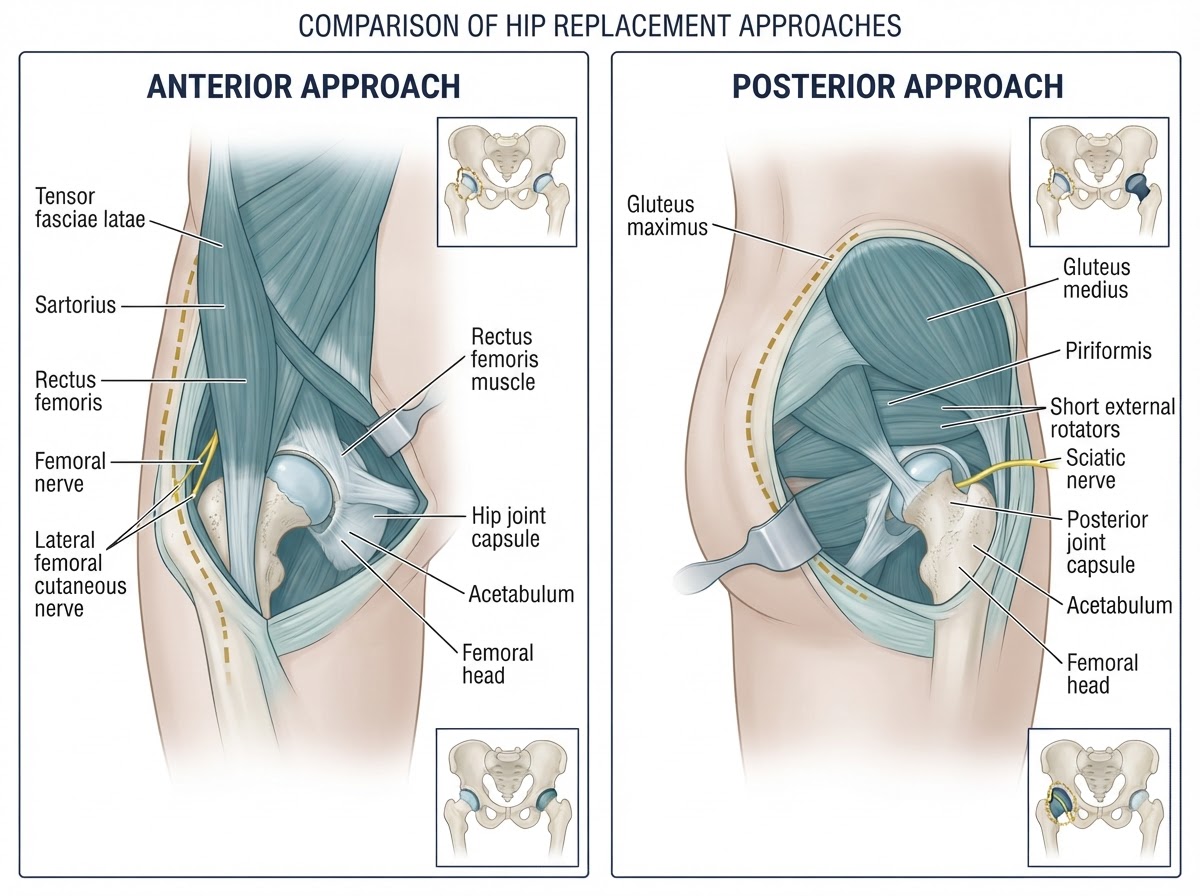
Total hip replacement is one of the most successful operations in orthopaedic surgery, and it can be performed through more than one surgical approach. The two most discussed are the direct anterior approach and the posterior approach. Patients often ask which is better, but the honest answer is that neither is universally superior: each is an established technique with its own characteristics, and the right choice depends on your anatomy, your clinical circumstances, the surgeon's expertise and individualised planning. This article explains the differences between anterior and posterior hip replacement honestly — covering surgical technique, potential advantages, risks, recovery and the scientific evidence — without claiming that one approach is automatically better for everyone.
Understanding hip replacement surgery
Total hip arthroplasty replaces the damaged surfaces of the hip joint with an acetabular component in the pelvis and a femoral stem topped by a prosthetic head, separated by a bearing surface. It relieves pain and restores function in advanced hip disease, most commonly osteoarthritis. Different surgical approaches exist because surgeons can reach the hip joint from more than one direction, and each pathway passes through different soft tissues, has different technical characteristics and carries different considerations. Understanding that approaches exist — rather than assuming there is a single best technique — is the first step to understanding why hip replacement is individualised. The anterior and posterior approaches are the two most widely discussed, and both are established, reliable techniques when performed by an experienced surgeon.
What is a surgical approach?
A surgical approach is the route the surgeon takes to reach the hip joint and place the implants. It matters because the hip is surrounded by muscles, tendons, the joint capsule and neurovascular structures, and each approach passes through a different combination of them. The approach influences surgical exposure — how well the joint can be seen and instrumented — soft-tissue handling, capsular management, implant positioning and the postoperative precautions that follow. It is not simply a matter of the incision on the skin; the approach describes the entire pathway through the soft tissues. Approach selection is part of surgical planning because it interacts with anatomy, implant choice, the patient's body habitus and the surgeon's experience, and it can influence the early recovery experience and the specific risks that need to be managed.
The direct anterior approach
The direct anterior approach reaches the hip from the front. The patient is usually positioned supine on a specialised table that helps expose the joint, and the incision is made on the front of the hip. The approach uses an intermuscular and internervous interval — a plane between muscles that are separated rather than cut — to access the hip joint, and the capsule is opened to visualise the femoral head and acetabulum before the implants are placed. It is often described as muscle-sparing because it works between muscles, though it still involves surgical disruption of soft tissues and anatomical structures: the interval, the capsule and the exposure all require surgical handling. The approach has specific technical considerations, including a learning curve for the surgeon and particular attention to femoral exposure, and it is one of several valid options rather than a universally superior one.
The posterior approach
The posterior approach reaches the hip from behind through a posterolateral incision, with the patient usually positioned in the lateral decubitus position. Access is gained through the posterior soft tissues, including division of the short external rotators and opening of the joint capsule to expose the femoral head and acetabulum for implant placement. At the end of the procedure the posterior structures — the capsule and short rotators — are repaired to restore the posterior soft-tissue envelope. Contemporary repair techniques have meaningfully influenced postoperative stability compared with earlier methods that did not repair these structures. The posterior approach is one of the most widely used and established approaches in hip arthroplasty, offering excellent exposure and flexibility in complex reconstruction, and its track record and outcomes are well documented.
Anterior vs posterior: key differences
The clearest way to understand the difference is to compare the two approaches directly. The table below summarises the main features; it is educational, not a recommendation of one approach over the other. | Feature | Direct anterior | Posterior | |---|---|---| | Surgical access | Anterior | Posterolateral | | Muscle interval | Intermuscular interval | Posterior soft-tissue exposure | | Patient positioning | Usually supine | Usually lateral decubitus | | Visualisation | Approach-specific | Approach-specific | | Learning curve | Relevant | Established approach | | Specific complications | Approach-related risks | Approach-related risks | | Patient selection | Individualised | Individualised | The key message is that the two approaches differ in how they reach the joint and in their specific considerations, but neither is automatically better. The decision is individualised after assessment, taking into account the surgeon's experience and the patient's anatomy.
Potential advantages of the anterior approach
The direct anterior approach is often discussed in terms of potential advantages related to its intermuscular surgical interval. Because it works between muscles rather than through them, it may be associated with differences in early recovery and early postoperative function, though the size and consistency of any difference varies between studies and patients. It is usually performed with the patient supine, which some surgeons find helpful for intraoperative assessment of leg length and stability. There are also approach-specific considerations, including no need for some posterior precautions in selected protocols. It is important to distinguish theoretical or anatomical advantages from demonstrated clinical outcomes: the fact that an approach is muscle-sparing does not guarantee a faster or better recovery for every individual, and the evidence is more supportive of possible early differences than of long-term superiority.
Potential advantages of the posterior approach
The posterior approach's strengths lie in its familiarity and widespread use, excellent surgical exposure and flexibility in complex reconstruction. Because it is one of the most established approaches, the long-term outcomes are very well documented, and many surgeons are highly experienced with it. The exposure it provides can be particularly useful in complex or revision surgery where visibility and access matter. Contemporary techniques — including careful repair of the capsule and short external rotators — have improved postoperative stability. The approach should not be dismissed as outdated; it remains a standard, reliable technique. That said, not all surgeons or all clinical situations are equivalent: approach advantages are real but context-dependent, and a technically well-executed posterior repair compares favourably with other approaches in experienced hands.
Risks and complications
Some complications are common to hip replacement regardless of approach: infection, dislocation, leg-length discrepancy, thromboembolic events, periprosthetic fracture, implant loosening and nerve injury. Their overall likelihood depends on patient characteristics, surgeon experience, surgical technique and other factors. There are also approach-specific risks. The anterior approach can be associated with lateral femoral cutaneous nerve symptoms (numbness or discomfort on the outer thigh), wound complications in selected patients and technical difficulties with femoral exposure, and it carries a learning-curve consideration for the surgeon. The posterior approach is associated with posterior soft-tissue handling, a consideration for sciatic nerve risk and dislocation, though contemporary capsular and rotator repair have reduced dislocation rates substantially. No approach eliminates risk, and complication rates should be discussed individually rather than assumed from general statistics.
What does the scientific evidence say?
The evidence comparing anterior and posterior approaches comes from randomised controlled trials, systematic reviews, meta-analyses and large registry studies. Some studies report differences in early postoperative pain, early functional recovery and length of hospital stay, with the anterior approach sometimes showing earlier advantages. However, these early differences are not consistently found across all studies and tend to diminish over time. For longer-term outcomes such as dislocation, revision surgery and implant survival, the evidence does not show a clear and consistent superiority of one approach over the other; long-term outcomes are generally influenced by multiple factors including implant selection, fixation, bearing surfaces, surgical technique and patient characteristics. The honest reading of the evidence is that some early differences may exist, but no approach should be claimed as universally superior, and the quality of surgical execution and appropriate patient selection matter most.
Who may be suitable for each approach?
Suitability for a given approach depends on several factors: body habitus, because very muscular or obese patients can make any approach more technically demanding; hip anatomy and any deformity; previous surgery around the hip; bone quality; and the complexity of the reconstruction required. Surgeon experience is central — the approach a surgeon performs most often and most safely is an important consideration. Complex or revision cases may favour an approach that offers the best exposure. Individual patient needs — activity, expectations, recovery priorities — also play a part. Because these factors combine differently in each person, approach selection should be personalised rather than driven by a general rule. A surgeon who is experienced in one approach may recommend it because outcomes are most predictable in their hands, and that individualised judgement is a legitimate part of the decision.
Recovery after hip replacement
Recovery after hip replacement shares common principles regardless of approach: early mobilisation, walking aids as needed, physiotherapy, progressive return to everyday activities, driving, return to work and long-term rehabilitation. Early mobilisation is encouraged, often on the day of surgery or the day after, and walking progression follows the operating surgeon's protocol. Driving resumes once strength and reflexes allow safe control, and return to work depends on the demands of the job. It is important not to claim that the anterior approach guarantees faster recovery: while some studies suggest possible early differences, recovery varies widely between individuals and depends on many factors beyond the approach. Postoperative precautions may differ — some anterior protocols involve fewer posterior precautions — but every recovery follows the operating surgeon's individualised protocol rather than a generic timeline, and milestones are set after assessment.
Does the surgical approach affect implant longevity?
Implant longevity is not determined by the surgical approach alone. How long a hip replacement lasts depends on implant design, the bearing surface (such as ceramic, metal or highly cross-linked polyethylene), fixation method, component positioning, the patient's activity level and weight, and the quality of surgical technique. Both anterior and posterior approaches can achieve excellent long-term implant survival when the components are well-placed and the surgery is well-executed. A well-positioned implant through either approach can last many years, and a poorly positioned implant through either approach may be at higher risk of problems. This is why implant selection and surgical planning are individualised and why the approach is only one of several factors in long-term durability. A specialist can give a realistic picture for your situation rather than a generic lifespan figure.

Questions to ask your orthopaedic surgeon
A consultation is the right place to understand how the approach decision applies to you. Practical questions include: Which approach do you recommend for my anatomy, and why? How frequently do you perform this procedure? What are your experience and outcomes with each approach you use? What implant will be used, and why? What complications are particularly relevant to my case? What rehabilitation protocol will I follow, and what precautions apply? These questions help you understand the individualised reasoning behind a recommendation, and a surgeon who explains their choice in terms of your anatomy and their experience is giving you the most useful information — not a claim that one approach is universally best.
Conclusion: choosing the right approach
Both the anterior and posterior approaches are established, reliable techniques for hip replacement, and both can deliver excellent results when performed well. The optimal approach depends on your anatomy, clinical circumstances, the surgeon's expertise and an individualised plan — not on a claim that one is universally better. The quality of surgical execution and appropriate patient selection are fundamental to a good outcome, and implant longevity depends on many factors beyond the approach itself. The most useful question is not which approach is best in general, but which is best for you, understood through a specialist consultation that weighs your anatomy, your goals and your surgeon's experience.
The bottom line: the right approach is the right one for you
Both anterior and posterior hip replacement are established techniques. Neither is universally superior, and the optimal approach depends on anatomy, clinical circumstances, surgeon expertise and individualised planning. The quality of surgical execution and appropriate patient selection are fundamental to a good outcome, and implant longevity depends on implant design, bearing surfaces, fixation, positioning, activity and surgical technique — not on the approach alone. A specialist consultation is the way to determine which approach is right for your hip.
References & scientific evidence
- Barrack RL et al.. Current evidence regarding the use of the direct anterior approach for elective total hip arthroplasty.. Journal of Bone and Joint Surgery (JBJS), 2022.Systematic reviewView source
- Tsikandylakis I et al.. Anterior or posterior approach for total hip arthroplasty? A study from the Swedish Hip Arthroplasty Register using propensity score matching.. Journal of Bone and Joint Surgery (JBJS), 2018.Observational studyDOI: 10.2106/JBJS.17.00934View source
- Miller LE et al.. Does surgical approach affect the risk of dislocation after primary total hip arthroplasty? A systematic review and meta-analysis.. Orthopaedic Journal of Sports Medicine, 2020.Meta-analysisDOI: 10.1177/2325967120951834View source
- Higgins BT et al.. Anterior vs posterior approach for total hip arthroplasty, a systematic review and meta-analysis.. Journal of Arthroplasty, 2015.Meta-analysisDOI: 10.1016/j.arth.2014.12.009PMID: 25616586View source
- Post ZD et al.. Direct anterior approach for total hip arthroplasty: indications, technique, and results.. Journal of Bone and Joint Surgery (JBJS), 2014.Systematic reviewDOI: 10.2106/JBJS.N.00880View source
- Matta JM et al.. Single-incision anterior approach for total hip arthroplasty on a regular table.. Orthopedics, 2016.Observational studyDOI: 10.3928/01477447-20160229-04View source
- Petis H et al.. The direct anterior approach in total hip arthroplasty: a concise review of the literature.. HIP International, 2015.Systematic reviewDOI: 10.5301/hipint.5000262View source
- Chow J et al.. A prospective, randomised clinical trial evaluating the effect of surgical approach on early functional recovery in total hip arthroplasty.. Journal of Arthroplasty, 2019.Randomised controlled trialDOI: 10.1016/j.arth.2019.03.020View source
- Tsukiyama I et al.. The direct anterior versus posterior approach for primary total hip arthroplasty: a systematic review and meta-analysis of randomized controlled trials.. Journal of Arthroplasty, 2023.Meta-analysisDOI: 10.1016/j.arth.2023.03.051View source
Frequently asked questions

Dr. Pablo Banchero Lasalvia
Orthopaedic Surgeon · Traumatology Team
- Author:
- Dr. Pablo Banchero Lasalvia
- Medical reviewer:
- Dr. Pablo Banchero Lasalvia
- Published:
- 1 November 2026
- Medical review date:
- 1 November 2026
- ·
- 15 min read
Book Your Consultation via WhatsApp
Request a private orthopaedic assessment with Dr Pablo Banchero to discuss your surgical approach on the Costa Blanca.
Official number: +34 602 99 22 22