
Not every meniscus tear requires surgery. The menisci are important structures within the knee, but a tear seen on imaging does not, by itself, establish the need for an operation. Whether treatment should be conservative or surgical depends on the type of tear, the symptoms, the patient's characteristics and any associated knee conditions such as cartilage damage or osteoarthritis. This article explains how a specialist assessment — rather than an MRI report alone — guides that decision, and why the objective is not simply to remove a torn meniscus but to preserve as much functional meniscal tissue as possible while restoring knee function.
Understanding meniscus tears
The menisci are two crescent-shaped wedges of fibrocartilage — one medial, one lateral — that sit between the rounded end of the femur and the flat top of the tibia. Their principal roles are load distribution, shock absorption, joint stability and protection of the articular cartilage that covers the bone ends. By converting the rounded femoral condyle into a more congruent socket for the tibial plateau, they spread load across a wider area and reduce contact stress. When a meniscus is torn, these functions are partly lost, which is why the consequences of removing meniscal tissue — and the value of preserving it — are central to treatment decisions. A meniscus tear is a structural injury, but its importance is always read in the context of the whole knee, not the fragment alone.
Types of meniscus tears
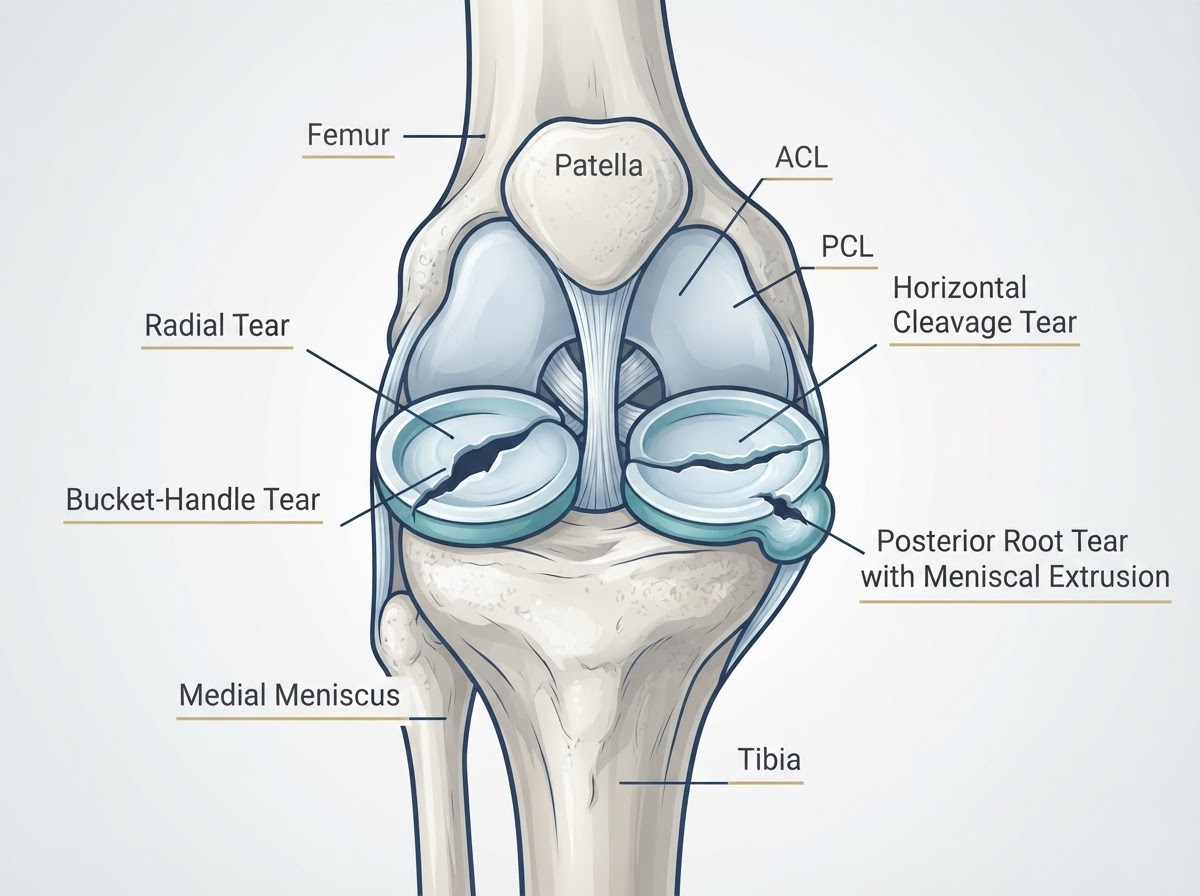
Meniscus tears are described by their shape and location, because morphology and vascularity strongly influence whether a tear can repair, settle or requires surgery. Common patterns include longitudinal tears (running along the length of the meniscus), vertical tears, radial tears (cutting across the circumference toward the centre), horizontal tears (splitting the meniscus into upper and lower layers, often degenerative), complex tears (combining more than one pattern), flap tears and bucket-handle tears (a longitudinal tear whose inner fragment flips into the joint like the handle of a bucket, sometimes causing the knee to lock). Posterior root tears deserve separate consideration because they disrupt the meniscal anchor and the hoop stress that resists load. Tear location also matters: the outer third (red-red zone) has a blood supply and some healing potential, the inner third (white-white zone) is avascular and cannot repair itself, and the middle (red-white) zone is intermediate. For these reasons different tears should not automatically be considered equivalent.
Degenerative vs traumatic meniscus tears
Meniscus tears are broadly divided into traumatic tears — sustained during a specific twisting or loading event, often in a younger knee with otherwise healthy tissue — and degenerative tears, which develop with age and repeated loading in a meniscus already altered by early osteoarthritis. The distinction matters for treatment. High-quality evidence from the ESCAPE trial showed that, in patients with a degenerative tear and mild osteoarthritis, arthroscopic partial meniscectomy offered no additional benefit over physiotherapy and weight management over two years. Traumatic, displaced or repairable tears are a different clinical problem and the evidence for them should not be conflated with degenerative disease. This is also why an MRI finding must be interpreted in clinical context: degenerative meniscal signal and small tears are common in middle-aged knees and frequently coincide with little or no pain.
Symptoms and clinical assessment
Typical symptoms include pain along the joint line, swelling (often gradual rather than immediate), and mechanical symptoms such as catching, locking or giving way. A genuinely locked knee — where the joint cannot fully extend because a fragment is mechanically blocking it — is a different and more urgent problem than subjective clicking, which can be painless and incidental. Reduced range of motion and pain during twisting, squatting or pivoting are common. Clinical assessment combines a careful history with physical examination tests for meniscal and ligament injury, evaluation of alignment, muscle strength and function, and assessment of any osteoarthritis. Imaging is requested when it will change management. The goal of assessment is not to chase an MRI finding but to decide whether the patient's symptoms are explained by a treatable meniscal problem and whether that problem is amenable to repair, trimming or conservative care.
MRI: what does it show?
MRI is the imaging test that best visualises the menisci. It can show tear morphology and location, whether a fragment is displaced, meniscal extrusion (the meniscus being squeezed out beyond the joint margin), root injuries and associated cartilage and ligament pathology. It also grades degenerative change. MRI is valuable, but it is an aid to decision-making, not the decision itself. Degenerative meniscal findings are common in asymptomatic middle-aged knees, so an MRI report of a tear must be interpreted alongside symptoms and examination — a finding alone does not establish the need for surgery. A specialist assessment correlates the scan with the clinical picture; treating the image rather than the patient leads to unnecessary operations.
When can a meniscus tear be treated without surgery?
Many meniscal tears — particularly degenerative and many small, stable, non-displaced tears — can initially be managed conservatively. Non-surgical management includes physiotherapy with progressive strengthening of the muscles that support the knee, activity modification to avoid provoking movements, pain management, and treatment of any associated osteoarthritis. Clinical follow-up confirms whether symptoms are settling. The ESCAPE trial underpins this approach for degenerative tears: a structured exercise programme produced outcomes comparable to arthroscopy for many patients over two years, and conservative care is the sensible first step unless clear mechanical symptoms or a repairable traumatic tear indicate otherwise. Surgery is not inevitable, and for many patients it is not the right first answer.
When is meniscus surgery necessary?
Surgery may be considered when a tear is causing problems that conservative care is unlikely to resolve, or where a structural problem should be addressed promptly. Situations include a displaced bucket-handle tear producing a mechanical block that prevents the knee from fully extending; selected unstable traumatic tears in an otherwise healthy knee; tears that are repairable and in a patient in whom repair is appropriate; persistent symptoms despite an adequate trial of conservative management; and selected meniscal root injuries where restoring the meniscal anchor may protect the cartilage. The decision is individual. The surgeon weighs the tear type and location, vascularity and repair potential, the patient's age and activity, the state of the articular cartilage and any alignment or ligament injury, and the patient's expectations. No checklist can substitute for this assessment, and an MRI report alone is not an indication.
Meniscus repair vs partial meniscectomy
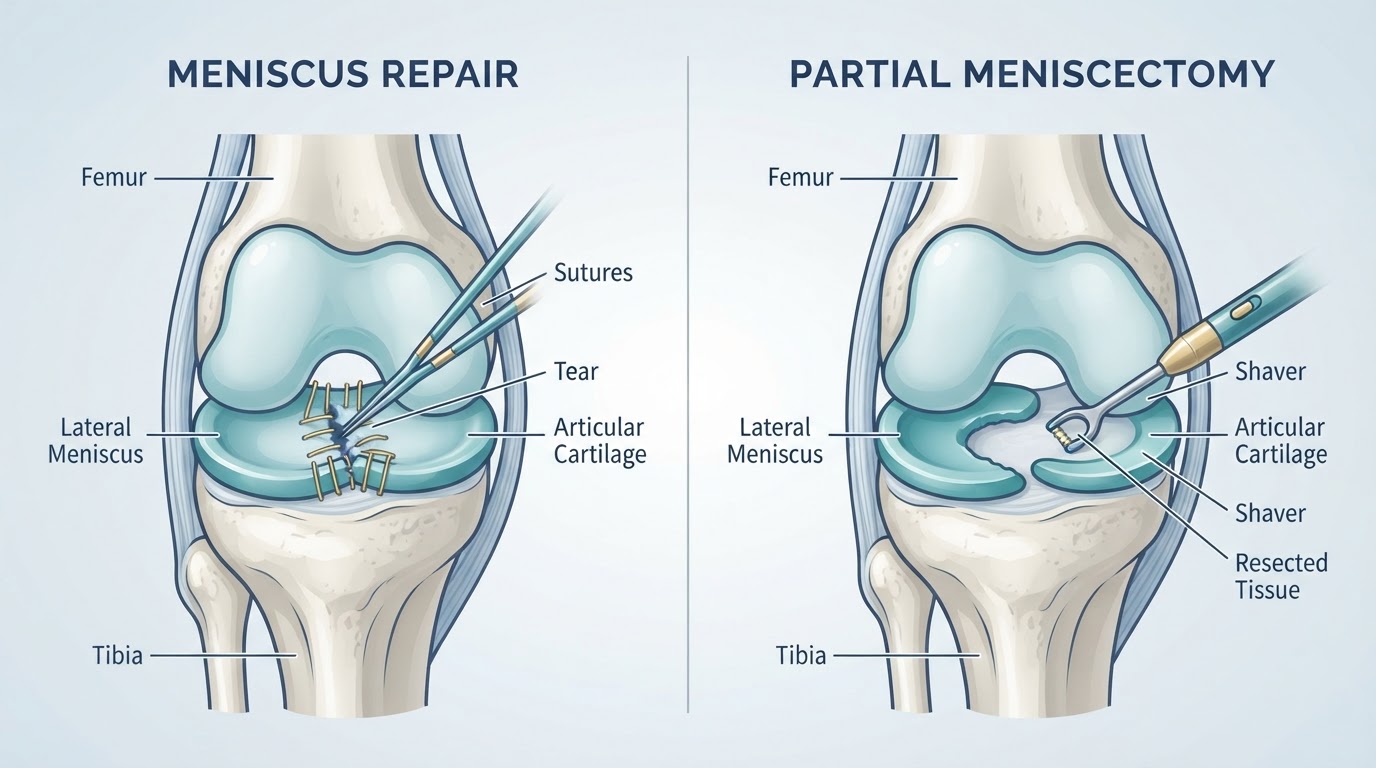
The two principal surgical options differ fundamentally. Meniscus repair preserves meniscal tissue: the torn edges are re-approximated with sutures or dedicated repair devices so the meniscus can heal, retaining its load distribution and shock absorption. Repair is favoured where the tear is in the vascular peripheral zones, is longitudinal and stable, and the patient is suitable. It usually involves a more protected rehabilitation period, with restrictions on weight-bearing and range of motion in the early weeks. Partial meniscectomy removes only the unstable or irreparable damaged tissue, trimming back to a stable, smooth rim; it may relieve symptoms in selected cases, particularly for tears with no repair potential, but it reduces the amount of functional meniscal tissue. Because meniscectomy is known to increase contact stress and accelerate osteoarthritis in susceptible knees, it should be performed conservatively — removing as little tissue as necessary. Preserving functional meniscal tissue is an important surgical principle, and repair is preferred whenever the tear, the patient and the biology support it.
Meniscus root tears
The posterior meniscal root anchors the meniscus to the tibia and transmits the hoop stress that lets the meniscus resist load. A root tear disrupts this anchor, leading to meniscal extrusion — the meniscus is squeezed out beyond the joint margin — increased compartment loading and potential implications for the overlying cartilage. Root tears can be traumatic but are often degenerative and associated with cartilage loss. In selected patients, root repair may be considered to restore the anchor and re-establish hoop function, particularly when the meniscus is otherwise preserved; in others, conservative management or addressing the associated osteoarthritis is more appropriate. Because root tears behave differently from other tears and influence compartment mechanics, they warrant individualised assessment rather than a generic approach.
Meniscus tears and knee osteoarthritis
Meniscal dysfunction, cartilage loading and osteoarthritis are interrelated. A meniscus that is torn or has been largely removed no longer distributes load as intended, increasing focal stress on the articular cartilage and, over time, accelerating degeneration. Conversely, established osteoarthritis alters the meniscus, making degenerative tears more common. This is why existing cartilage damage changes surgical decisions: in a knee with advanced compartmental arthritis, trimming a degenerative tear often yields limited and short-lived benefit, and arthroscopy is not recommended where the predominant problem is advanced osteoarthritis. Meniscus preservation is not merely a technical preference — it is a way of protecting the joint. The same principle explains why, where cartilage damage is already present, the conversation is often less about the meniscus in isolation and more about the overall joint strategy, including joint-preserving procedures or knee replacement where indicated.
Recovery after meniscus surgery
Recovery differs according to what was done. After meniscus repair, rehabilitation is more protected: weight-bearing may be limited for a period, range of motion is progressed gradually, and a structured physiotherapy programme rebuilds strength and control before a graded return to daily activities and sport. After partial meniscectomy, recovery is usually quicker because the repaired tissue does not need to heal — patients often weight-bear as tolerated and return to routine activities sooner — but the long-term benefit depends on how much meniscal tissue remains and on the state of the joint. No fixed recovery time applies to every patient: protocols depend on tear morphology, the specific repair technique, any associated procedures such as ligament reconstruction or cartilage work, and individual factors. Promising a fixed timeline misleads patients. Your surgeon sets the rehabilitation milestones and a realistic plan for your return to daily activities and sport after assessing your knee.
Second opinion: when to seek one
A specialist second opinion can be valuable when an MRI has reported a meniscus tear and you are unsure what it means; when surgery has been recommended and you want to confirm the indication or explore alternatives; when symptoms persist despite appropriate treatment; when there is uncertainty about whether your meniscus can be repaired rather than trimmed; or when there are associated cartilage or ligament injuries that complicate the decision. A second opinion is not about disagreeing with your current doctor — it is an independent specialist reassessment of your imaging, symptoms and options that may confirm surgery, suggest a different approach, or clarify what to expect. For international residents on the Costa Blanca, an English-speaking assessment can be particularly useful. Bringing your imaging and previous reports lets the surgeon give you a more precise opinion.
Conclusions
The meniscus is worth preserving. The objective of treatment is not simply to remove a torn fragment but to preserve as much functional meniscal tissue as possible while restoring knee function and protecting the joint over time. Whether a tear needs surgery depends on its type, location and repair potential, the symptoms it produces, the patient's age and activity, and the state of the articular cartilage and any associated osteoarthritis. Many degenerative and stable tears are best managed conservatively; displaced, traumatic, repairable or root tears may justify surgery, with repair preferred whenever feasible. The decision follows a specialist assessment that integrates examination, MRI and the individual patient — not an MRI report alone. A consultation with an orthopaedic surgeon is the way to decide what is appropriate for your knee.
The Bottom Line: Preserving the Meniscus
Not every meniscus tear needs an operation. The right treatment depends on the type of tear, your symptoms, your knee and your goals, and it is decided by a specialist assessment — not by an MRI alone. Where surgery is indicated, the priority is to preserve as much functional meniscal tissue as possible: repair is preferred when feasible, and partial meniscectomy is kept conservative. An individualised consultation with an orthopaedic surgeon is the way to determine whether conservative care, meniscus repair, partial meniscectomy, or a different strategy is appropriate for your knee.
References & scientific evidence
- van de Graaf YA et al.. Effect of Early Arthroscopic Partial Meniscectomy vs Conservative Supervised Exercise Therapy on Knee Symptoms and Function in Patients With a Degenerative Meniscal Tear: The ESCAPE Randomized Clinical Trial.. JAMA, 2024.Randomised controlled trialDOI: 10.1001/jama.2024.23490PMID: 39215835View source
- Katz JN et al.. Surgery versus Physical Therapy for a Meniscal Tear and Osteoarthritis.. New England Journal of Medicine, 2013.Randomised controlled trialDOI: 10.1056/NEJMoa1301408PMID: 23614506View source
- Beaufils P et al.. ELSKA-SICOT consensus on the management of meniscal tears by meniscal repair.. Orthopaedics & Traumatology: Surgery & Research, 2023.Clinical guidelineDOI: 10.1016/j.otsr.2023.103582PMID: 36948521View source
- AAOS Clinical Practice Guideline: Management of Meniscal Tears of the Knee (Evidence-Based Clinical Practice Guideline).. American Academy of Orthopaedic Surgeons, 2022.Clinical guidelineDOI: 10.5435/AAOS_OST_MEN_KNEE_GMGView source
- Karia M et al.. Current concepts in the techniques, timing and outcomes of meniscal repairs: a systematic review.. European Journal of Orthopaedic Surgery & Traumatology, 2021.Systematic reviewDOI: 10.1007/s00590-020-02821-7PMID: 32880687View source
- Chung KS et al.. Root tear of the posterior root of the medial meniscus: comparison of partial meniscectomy and arthroscopic pullout repair.. Arthroscopy, 2024.Observational studyDOI: 10.1016/j.arthro.2023.09.014PMID: 38071996View source
Frequently asked questions

Dr. Pablo Banchero Lasalvia
Orthopaedic Surgeon · Traumatology Team
- Author:
- Dr. Pablo Banchero Lasalvia
- Medical reviewer:
- Dr. Pablo Banchero Lasalvia
- Published:
- 1 November 2026
- Medical review date:
- 1 November 2026
- ·
- 13 min read
Book Your Consultation via WhatsApp
Request a private orthopaedic assessment or a second opinion about your MRI and treatment options with Dr Pablo Banchero.
Official number: +34 602 99 22 22