
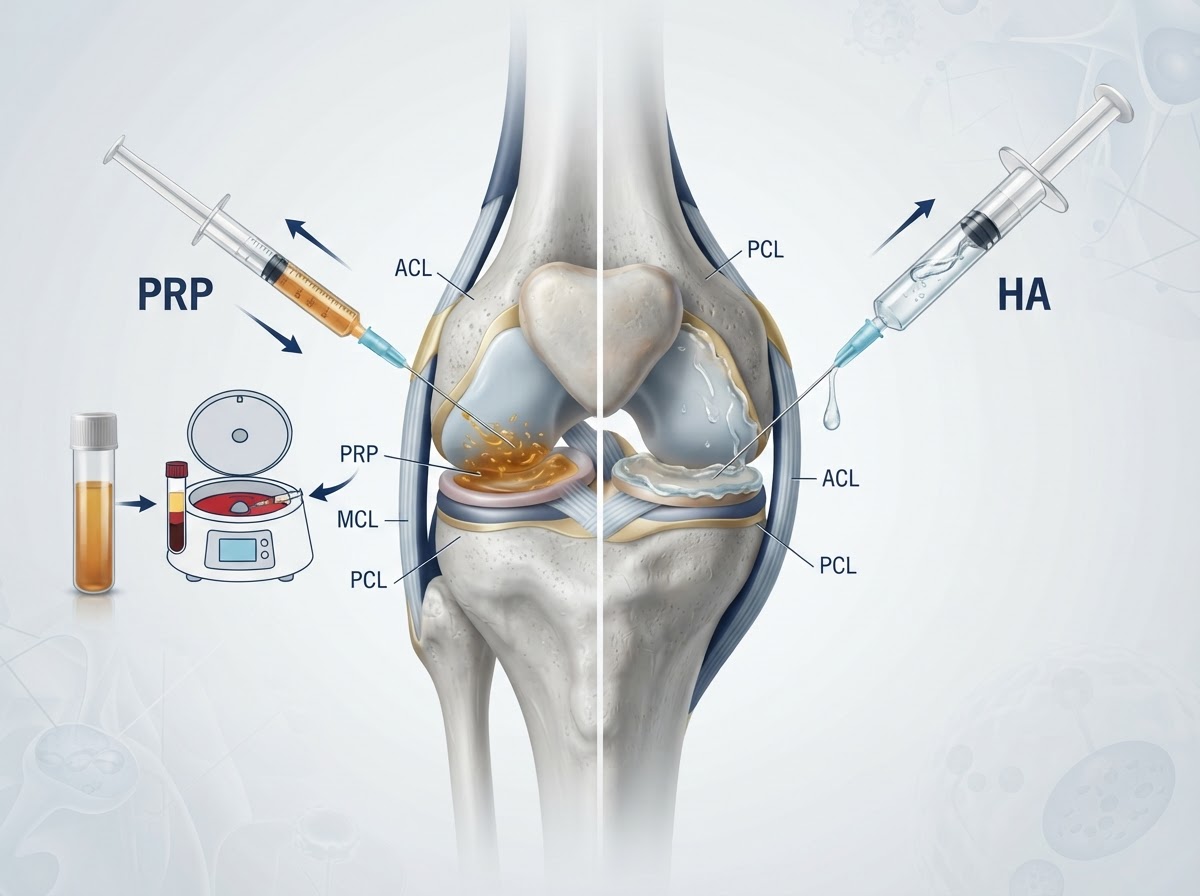
Platelet-rich plasma (PRP) and hyaluronic acid are both intra-articular injections used in selected patients with knee osteoarthritis, but they are very different treatments: they come from different sources, work through different proposed mechanisms, follow different preparation and injection protocols, and are supported by different — and still uncertain — clinical evidence. This article compares them objectively so you can have a better-informed conversation with your orthopaedic surgeon. Neither is presented here as universally superior.
Understanding knee osteoarthritis
Knee osteoarthritis is a condition in which the articular cartilage that covers the ends of the femur, tibia and patella gradually thins and loses its smooth surface, together with changes in the underlying subchondral bone. The synovial membrane that lines the joint can become inflamed, contributing to pain, swelling and stiffness. As the joint changes, pain and functional limitation often increase, but the relationship between what is seen on imaging and how a patient feels is not always direct: two people with similar-looking scans can have very different symptoms. The course of osteoarthritis is influenced by age, joint loading, body weight, prior injury, alignment, muscle support and activity, which is why management is individualised rather than one-size-fits-all.
What is platelet-rich plasma (PRP)?
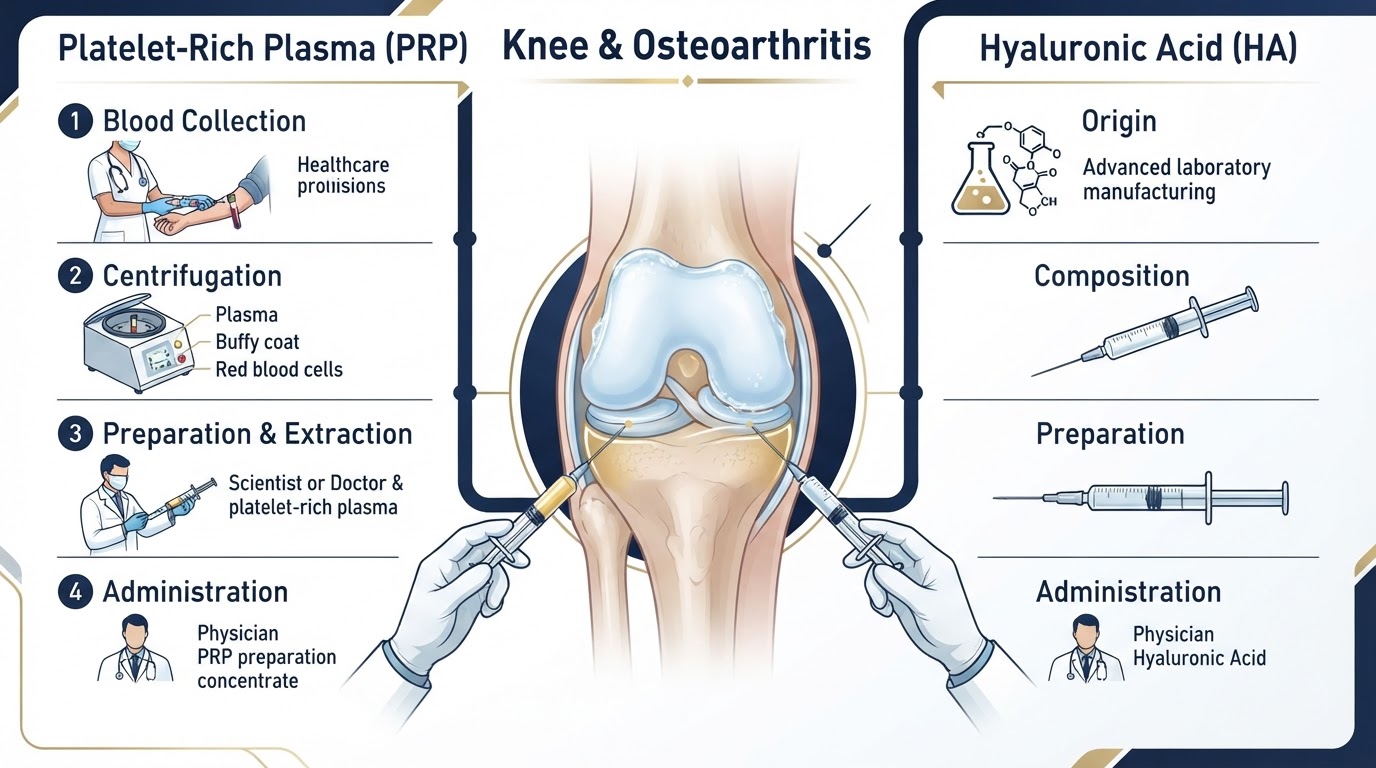
Platelet-rich plasma is a preparation made from a sample of your own blood. The blood is centrifuged to separate and concentrate the platelets, and the resulting platelet-rich fraction is injected into the knee when clinically indicated. Because it is prepared from your own blood, PRP is described as autologous. Platelets carry a range of growth factors and signalling molecules involved in tissue repair signalling. PRP is not a single standardised product: preparations vary in platelet concentration, leukocyte (white blood cell) content, red blood cell contamination, activation characteristics, total platelet dose and injection volume. Preparations are often described as leukocyte-rich or leukocyte-poor, and these differences may influence the biological properties of the product — one reason published studies do not always agree. The injection is administered intra-articularly, often with ultrasound guidance where clinically appropriate to improve the accuracy of placement. PRP has not been shown to regenerate articular cartilage in humans or to reverse established osteoarthritis; its possible effects are on symptoms, not on restoring lost cartilage.
What is hyaluronic acid?
Hyaluronic acid is a naturally occurring molecule and a key component of synovial fluid, the liquid that lubricates the knee joint. In a healthy knee it gives the synovial fluid its viscosity and viscoelastic properties, helping with shock absorption and smooth gliding of the joint surfaces. In osteoarthritis, the concentration and quality of endogenous hyaluronic acid are thought to fall, which is the rationale for supplementing it by intra-articular injection — an approach known as viscosupplementation. Commercial hyaluronic acid preparations differ between themselves in molecular weight, whether they are cross-linked, concentration and formulation, and these differences can affect how the product behaves. Administration protocols also vary, including the number of injections in a course. As with PRP, the proposed mechanism (restoring the viscoelastic properties of synovial fluid) is a biological rationale rather than a guarantee of outcome, and recommendations vary between professional guidelines.
PRP vs hyaluronic acid: key differences
The clearest way to understand the two treatments is to compare their main characteristics. PRP is autologous — prepared from your own blood — while hyaluronic acid is a manufactured product (sometimes of animal or bacterial origin, depending on the preparation). PRP's proposed mechanism centres on platelet-derived growth factors and signalling molecules acting on the synovial environment; hyaluronic acid's proposed mechanism is viscosupplementation — restoring the viscosity and viscoelastic properties of synovial fluid. Preparation differs too: PRP requires blood collection and centrifugation, while hyaluronic acid is supplied ready to inject. The usual number of injections per course, the expected duration of any effect when evidence is sufficient, the safety profile, the relative cost and the strength of the scientific evidence all differ, and none of these can be reduced to a simple ranking. It is important to distinguish a proposed biological mechanism from a demonstrated clinical result.
What does the scientific evidence say?
The evidence on PRP versus hyaluronic acid for knee osteoarthritis is mixed, heterogeneous and still evolving. Randomised controlled trials, systematic reviews and meta-analyses, and clinical guidelines have produced somewhat different conclusions, partly because the preparations studied are not uniform and partly because of differences in study design, controls and follow-up. Outcomes are usually measured with patient-reported scales such as WOMAC and VAS for pain and function, at short- and medium-term follow-up. A balanced picture needs to include favourable findings, inconclusive findings and contradictory findings — selecting only studies favourable to one treatment would mislead patients. The sections below set out the direct-comparison evidence, where guidelines disagree, and a balanced summary.
Randomised trials and meta-analyses of direct comparisons
Several randomised controlled trials have compared PRP directly with hyaluronic acid, and systematic reviews and meta-analyses have pooled some of these studies. Some analyses suggest that PRP may provide greater symptom improvement than hyaluronic acid at certain time points, but the size of any difference is often modest and the studies are highly heterogeneous — differences in PRP preparation (leukocyte-rich vs leukocyte-poor, platelet concentration, dose), hyaluronic acid formulation (molecular weight, cross-linking), injection protocols and patient selection make it hard to generalise the pooled result to any individual. The clinical relevance of some reported differences has also been debated, and not every trial has favoured PRP. A high-quality randomised trial of intra-articular hyaluronic acid against placebo has also underscored how variable injection outcomes can be, which tempers claims about either product.
Where guidelines and reviews disagree
Professional recommendations are not unanimous. Some guidelines and consensus statements are more favourable toward PRP in selected patients with mild-to-moderate disease after failure of conservative measures, while others remain more cautious, citing concerns about study quality, heterogeneity of preparations and insufficient certainty to support a recommendation. Recommendations for hyaluronic acid likewise vary between guidelines — some support its use in selected patients, while others do not find sufficient evidence to recommend it routinely. It is normal for guidelines to differ: they weigh evidence using different methods, consider different populations and set different thresholds before recommending a treatment. This article does not resolve those disagreements in favour of one product; it reports them.
Balanced summary of the evidence
PRP and hyaluronic acid are both still under active investigation. For PRP, some evidence suggests possible improvements in pain and function for selected patients, but the magnitude, duration and clinical relevance of benefit remain uncertain and direct comparisons with hyaluronic acid are limited by heterogeneity. For hyaluronic acid, recommendations and evidence vary between guidelines. Neither treatment has been shown to regenerate lost articular cartilage or cure osteoarthritis. There is no universal protocol proven optimal for all patients, and no head-to-head comparison establishes one as superior in every situation.
Which treatment may be more appropriate for each patient?
There is no universal choice. Whether PRP, hyaluronic acid, or another option might be more appropriate depends on age and activity level, radiographic grade of osteoarthritis, the nature and duration of symptoms, the overall state of the joint, previous treatments tried, comorbidities and relevant risk factors, and the patient's expectations. Mild-to-moderate disease is usually considered separately from advanced structural disease. Radiographic grading (such as the Kellgren-Lawrence grade) is a classification of what is seen on imaging; it does not by itself determine whether a patient will benefit and should not replace clinical assessment. No patient should be promised a benefit from either treatment. A specialist orthopaedic assessment — available on the Costa Blanca with Dr Pablo Banchero — is the way to weigh the options for an individual knee.
Can PRP and hyaluronic acid be combined?
Some clinicians have explored combining PRP and hyaluronic acid in the same course, on the hypothesis that their proposed mechanisms could be complementary. The evidence for combined administration is limited and should be distinguished from a biological hypothesis: a plausible rationale is not proof of benefit. Combination is not an established or universal protocol, and there is no recommendation here that the two should routinely be given together. Whether a combination might be considered in a specific case is a clinical decision to discuss with your surgeon.
When are injections not enough?
Injections are one part of a broader management plan, and they are not always the answer. Exercise therapy and structured rehabilitation are central to conservative care and help maintain function and the muscle support around the knee. Weight management, where clinically appropriate, can reduce load on the joint. Physiotherapy, oral medication and other non-surgical interventions each have a role and limitations. When symptoms and structural damage progress despite appropriate conservative management, joint-preserving procedures or knee replacement may need to be considered. The decision to move toward surgery follows a specialist assessment, not an article or a single injection.
The Bottom Line: PRP vs Hyaluronic Acid for Knee Osteoarthritis
PRP and hyaluronic acid are different intra-articular treatments with different origins, proposed mechanisms, protocols and evidence. For some selected patients, one or the other may be worth discussing as part of a broader plan, but neither regenerates lost cartilage or cures osteoarthritis, and direct comparisons are too heterogeneous to declare a universal winner. The right choice depends on an individual assessment of your knee, your symptoms, your previous treatments and your goals. A consultation with an orthopaedic surgeon is the way to decide which, if either, is appropriate for you.
References & scientific evidence
- Bennell KL et al.. Effect of Intra-articular Hyaluronic Acid vs Placebo Injection on Knee Osteoarthritis Pain: A Randomized Clinical Trial.. JAMA, 2020.Randomised controlled trialDOI: 10.1001/jama.2020.13895PMID: 32795224View source
- Roman-Blas M et al.. Platelet-rich plasma versus hyaluronic acid in knee osteoarthritis: A meta-analysis of randomized clinical trials.. Journal of Clinical Medicine, 2021.Meta-analysisDOI: 10.3390/jcm10122706PMID: 34202990View source
- Filardo G et al.. Platelet-Rich Plasma vs Hyaluronic Acid: A Randomized, Double-Mask, Non-Inferiority Clinical Trial for the Treatment of Knee Osteoarthritis.. The American Journal of Sports Medicine, 2020.Randomised controlled trialDOI: 10.1177/0363546520979072PMID: 33662079View source
- Kolasinski SL et al.. 2019 American College of Rheumatology/Arthritis Foundation Guideline for the Management of Osteoarthritis of the Hand, Hip and Knee.. Arthritis Care & Research, 2020.Clinical guidelineDOI: 10.1002/acr.24131PMID: 31988064View source
- AAOS Clinical Practice Guideline: Management of Osteoarthritis of the Knee (Evidence-Based Clinical Practice Guideline).. American Academy of Orthopaedic Surgeons, 2021.Clinical guidelineDOI: 10.5435/AAOS_OST_KOA_GMG_v2.0View source
- Kampshoff PG et al.. Platelet-rich plasma injections for knee osteoarthritis: a systematic review and meta-analysis of high-quality randomized controlled trials.. BMJ Open Sport & Exercise Medicine, 2019.Meta-analysisDOI: 10.1136/bmjsem-2019-000598PMID: 32047844View source
Frequently asked questions

Dr. Pablo Banchero Lasalvia
Orthopaedic Surgeon · Traumatology Team
- Author:
- Dr. Pablo Banchero Lasalvia
- Medical reviewer:
- Dr. Pablo Banchero Lasalvia
- Published:
- 1 November 2026
- Medical review date:
- 1 November 2026
- ·
- 13 min read
Book Your Consultation via WhatsApp
Contact TraumatologyTeam to request a private orthopaedic assessment with Dr Pablo Banchero on the Costa Blanca.
Official number: +34 602 99 22 22