
Not every rotator cuff tear requires surgery. The rotator cuff is a group of tendons that stabilise and move the shoulder, and a tear can cause pain, night pain and weakness when lifting the arm — but the right treatment depends on the type of tear, the symptoms, the patient's age and activity, the quality of the tendon and the goals of treatment. This article explains how a specialist assessment — rather than an imaging report alone — guides the decision between conservative care and surgery, and why surgery is individualised rather than automatic.
Understanding rotator cuff tears
The shoulder is the most mobile joint in the body, and that mobility depends on a fine balance between the rotator cuff tendons and the surrounding muscles. When a rotator cuff tendon tears, that balance is disturbed, and the consequences range from occasional pain on overhead movement to marked weakness and disturbed sleep. Importantly, a rotator cuff tear is common: degenerative tears become more prevalent with age and many are present in shoulders that have no symptoms at all. This is why a tear seen on a scan must always be interpreted in its clinical context. A rotator cuff tear is a structural finding, but the decision to treat it conservatively or surgically is a clinical one that weighs the tear, the patient and the whole shoulder.
What is the rotator cuff?
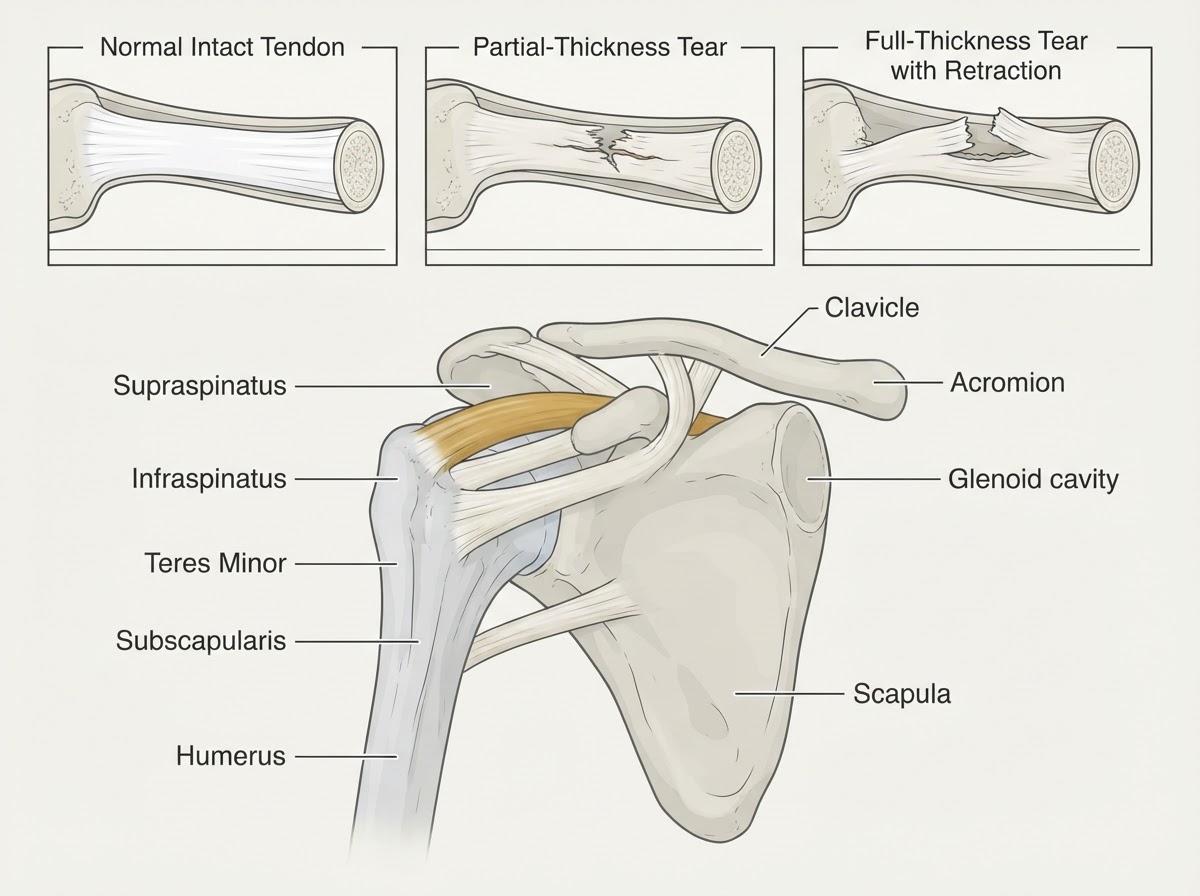
The rotator cuff is formed by four tendons that blend around the head of the humerus: the supraspinatus, which initiates lifting the arm away from the body; the infraspinatus and teres minor, which rotate the arm outward; and the subscapularis, which rotates it inward. Together these tendons compress the humeral head into the shallow socket of the shoulder blade, keeping the joint centred during movement and giving the larger muscles a stable platform from which to act. The tendons pass beneath the acromion, the bony arch at the top of the shoulder, and this narrow space is relevant because changes under the arch can contribute to wear. Understanding the cuff means understanding both its individual parts and its role as the dynamic stabiliser of the shoulder.
Types of rotator cuff tears
Rotator cuff tears are described by whether they pass through the full thickness of the tendon and by their size. A partial-thickness tear involves only part of the tendon, while a full-thickness tear passes completely through it, allowing communication between the joint and the overlying bursa. Tears are further described as small, medium, large or massive; a massive tear typically involves more than one tendon or a complete tear with significant retraction, where the tendon edge has pulled back. The mechanism also matters. Acute traumatic tears follow a specific injury — a fall, a sudden load or a dislocation — often in younger patients. Degenerative tears develop gradually with age and repetitive loading, typically in the supraspinatus, and are far more common. Two further features influence treatment: retraction (how far the tendon has pulled back) and fatty infiltration of the muscle, where the muscle belly is progressively replaced by fat as the tendon stays torn. High-grade fatty infiltration and marked retraction reduce the potential for a successful repair, which is why the type of tear is central to the decision.
Common symptoms
Typical symptoms include pain over the outer shoulder and upper arm, pain that is often worse at night and may wake the patient when rolling onto the affected side, and pain on lifting the arm overhead or against resistance. Weakness when raising the arm, a reduced range of motion and difficulty with everyday activities such as dressing, reaching behind the back or sleeping comfortably are common. It is important to recognise that symptoms do not always correlate directly with tear size: a small but well-localised tear can be very painful, while a large chronic tear may produce relatively little pain if it has developed slowly and the shoulder has adapted. Night pain and weakness on overhead use are the symptoms patients most often want addressed, and they are key elements of the clinical assessment.
Why do rotator cuff tears occur?
Most rotator cuff tears are degenerative — the result of age-related tendon change, reduced blood supply and cumulative mechanical stress over years — and their prevalence rises steadily with age. Repetitive overhead activities, whether occupational or sporting, can accelerate this wear, as can specific sports injuries. Acute trauma, such as a fall on the outstretched hand, a sudden violent contraction or a shoulder dislocation, can tear a previously healthy tendon, and this is more often seen in younger active patients. Contributing factors include the shape of the acromion and changes in the subacromial space, and tendon biology: the cuff tendons have a relatively poor blood supply, which limits their capacity to repair themselves. The result is that a tear is usually the product of several factors acting together rather than a single cause, which is also why prevention and rehabilitation focus on restoring balanced shoulder mechanics rather than on one isolated intervention.
How is a rotator cuff tear diagnosed?
Diagnosis combines history, physical examination and imaging, in that order. The clinical history establishes how the symptoms began, their pattern and the patient's functional demands; examination tests strength in specific positions, assesses range of motion and stiffness, and reproduces pain to localise the problem. Specific shoulder tests help identify which tendon is involved and whether the tear causes weakness rather than pain inhibition alone. Imaging is requested when it will change management. Ultrasound is a dynamic, accessible test that can demonstrate a full-thickness tear and assess the tendon and bursa in real time. MRI gives more detail of tear size, retraction, muscle quality and fatty infiltration, and shows associated cartilage, ligament or labral pathology; an MRI arthrogram may be used for subtle partial tears. Plain radiographs remain important: they exclude other causes of shoulder pain, show calcification, arthritis and the shape of the acromion, and help plan surgery. Each technique has its place, and the choice depends on the clinical question and on whether surgery is being considered.
Can a rotator cuff tear heal without surgery?
This is an important distinction. Symptom improvement and anatomical tendon healing are not the same thing. Many patients with degenerative tears improve substantially in pain and function with a structured programme of physiotherapy, even though the tear itself does not heal anatomically; the shoulder adapts by restoring balanced mechanics and strengthening the muscles that remain. A genuinely re-torn or retracted tendon, however, does not reliably re-attach itself. Randomised evidence reflects this nuance: in the Kukkonen trial of non-traumatic tears, conservative and operative groups had similar outcomes at one year, while the Moosmayer pragmatic trial showed that, for full-thickness tears that did not settle after initial physiotherapy, surgery gave better pain and function at two years. The honest reading is that many tears can be managed without an operation, that improvement does not require the tendon to heal, and that persistent full-thickness tears with ongoing symptoms are the group most likely to benefit from surgery. What is appropriate for you is a clinical decision made after assessment, not a conclusion drawn from a scan alone.
Non-surgical treatment options
Conservative management is built around a structured physiotherapy programme: progressive strengthening of the cuff and shoulder-blade muscles, mobility work to restore range and address stiffness, and a graded return to activity. Activity modification reduces the movements that provoke symptoms, and pain management helps patients engage with rehabilitation. A single corticosteroid injection can be considered for short-term relief of pain and inflammation in selected cases; repeated injections are not advised, particularly before surgery, as they may affect tendon healing and infection risk. The AAOS clinical practice guideline supports these principles and notes that, for many patients, a well-supervised home exercise programme can be as effective as more intensive supervised therapy after repair. Each approach has a role and a limit: physiotherapy is the foundation of conservative care, injections are a short-term adjunct rather than a cure, and activity modification sustains the benefit. Conservative care is not a placeholder before surgery; for many degenerative tears it is the definitive treatment.
When is surgery necessary?
Surgery is considered when there is a clear mismatch between the problem and what conservative care can reasonably achieve. Typical situations include an acute traumatic tear with functional loss in an active patient; persistent symptoms despite an adequate trial of physiotherapy; significant weakness that interferes with work, sport or daily life; evidence of tear progression on follow-up imaging; and tears that are repairable and in a patient whose tendon quality and biological potential support healing. The decision also weighs patient factors — age, activity level and functional requirements — and technical factors such as tendon retraction and fatty infiltration, which reduce the likelihood of a durable repair. For degenerative massive tears with advanced fatty infiltration, or in lower-demand patients whose symptoms settle with physiotherapy, conservative care may be the better choice. This is why surgery must be individualised: there is no universal threshold, and the indication comes from integrating the clinical picture, the imaging and the patient's goals, not from a tear on a scan.
Arthroscopic rotator cuff repair
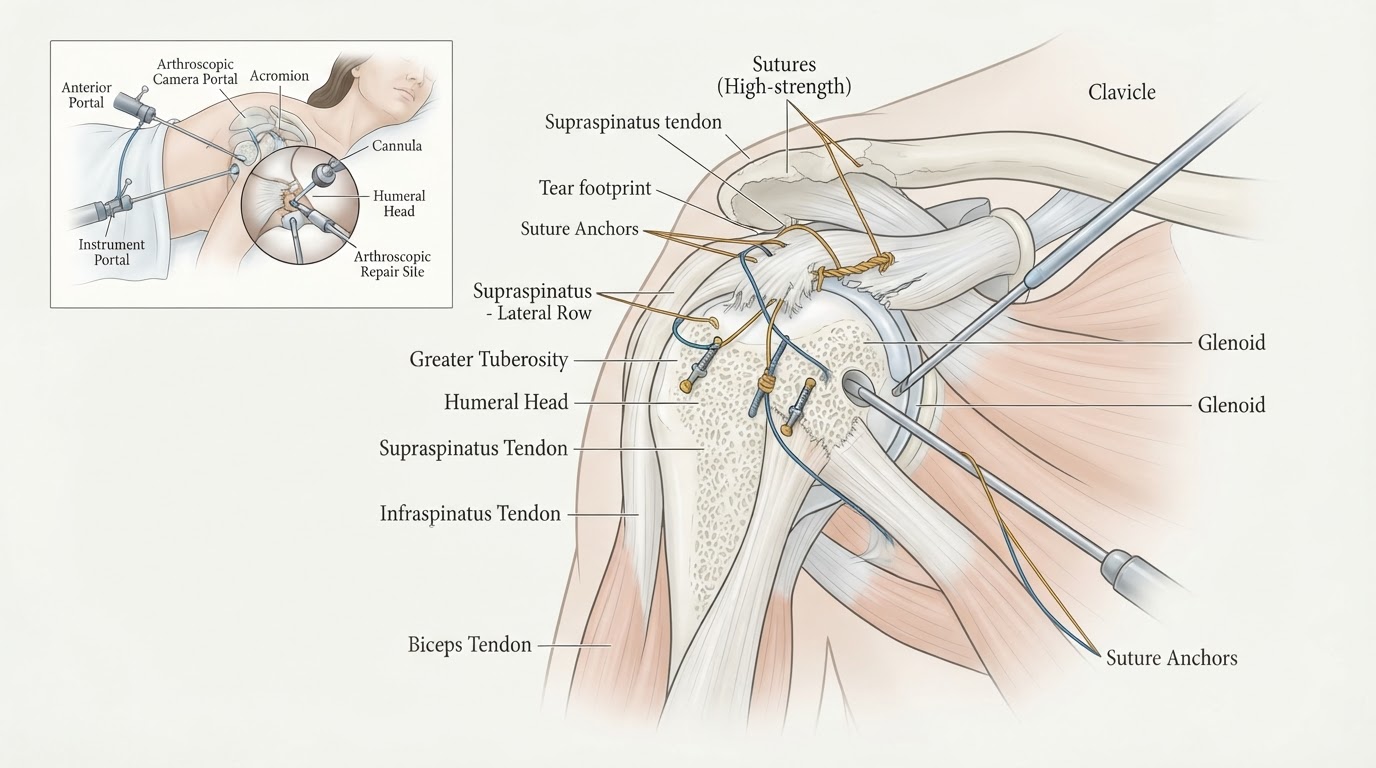
Arthroscopic rotator cuff repair is a minimally invasive procedure performed through small portals. The camera visualises the tear directly, the torn tendon is mobilised and prepared, any inflamed tissue or bone spurs under the acromion that may have contributed to wear are addressed, and the tendon is reattached to its footprint on the greater tuberosity using suture anchors — small devices fixed in bone that hold sutures passing through the tendon. The aim is to restore the tendon to its anatomical position so that, in an appropriate biological environment, it can heal. Its benefits are the smaller incisions, direct visualisation of the tear and the ability to address associated pathology at the same time. Its limitations are real: the repair is only as good as the biological potential of the tendon, and healing is not guaranteed, particularly for large tears, poor-quality tendon or advanced fatty infiltration. The AAOS guideline notes that surgery can yield improved patient-reported and functional outcomes compared with nonoperative care in repairs that heal — and that the healed repair is the key to the benefit. It is a precise technique, not a guarantee.
What happens after surgery?
Recovery after rotator cuff repair is staged and protects the healing tendon. Initially the arm is protected in a sling and movement is limited while the tendon begins to heal; range-of-motion exercises are introduced gradually, then active movement, and only later progressive strengthening. Physiotherapy guides each phase and a graded return to daily activities precedes return to sport. Recovery is not the same for everyone: it varies according to tear size, tissue quality, the specific repair technique and individual factors such as age, diabetes and smoking, all of which affect tendon healing. For small-to-medium tears, the AAOS guideline reports that early and delayed mobilisation give broadly similar clinical outcomes, allowing a more flexible rehabilitation in selected patients, but larger or more complex repairs remain more protected. No fixed timeline applies to every patient, and promising a standard date for return to sport would mislead. Your surgeon sets realistic milestones after assessing your shoulder and your repair.
What if a rotator cuff tear is left untreated?
The natural history of an untreated tear varies. Some degenerative tears remain stable and asymptomatic for years, particularly in lower-demand patients, and this is part of why conservative care is reasonable for many. In other cases a tear can progress: the tendon retracts further, the muscle develops fatty infiltration and loses contractile substance, and the shoulder may lose active movement, sometimes progressing toward a pattern of pseudoparalysis or cuff tear arthropathy in which the joint itself deteriorates. These are possible risks, not inevitable outcomes, and they are more relevant for larger or younger-onset tears and for patients with higher functional demands. This is also why some patients benefit from review over time rather than a single decision point: monitoring tear progression, tendon retraction and muscle quality helps distinguish those who will do well conservatively from those for whom earlier repair may protect the joint. Possible progression is a reason for assessment and follow-up, not a reason to assume that every tear will deteriorate.
Conclusions
The right treatment for a rotator cuff tear depends on the symptoms, the type and size of the tear, the quality of the tendon, the patient's age and activity and the goals of treatment — and it is decided by specialist assessment, not by an MRI alone. Many degenerative tears are best managed conservatively, with a structured programme that improves pain and function even when the tendon does not heal anatomically. Surgery is considered for acute traumatic tears with functional loss, for persistent symptoms despite adequate physiotherapy, and for repairable tears in suitable patients, with arthroscopic repair restoring the tendon to its footprint so it can heal. Recovery is individualised and protects the healing tendon. The objective is not simply to repair a torn tendon but to restore comfortable, useful shoulder function while preserving the best available options for the future. A consultation with an orthopaedic surgeon is the way to decide what is appropriate for your shoulder.
The Bottom Line: Matching Treatment to the Shoulder
Not every rotator cuff tear needs an operation. Many degenerative tears improve with physiotherapy even without anatomical healing, while surgery is considered for acute tears with functional loss, persistent symptoms despite adequate conservative care, and repairable tears in suitable patients. Arthroscopic repair reattaches the tendon to its footprint so it can heal, and recovery is individualised to protect that repair. An assessment with an orthopaedic surgeon — integrating your symptoms, your imaging and your goals — is the way to determine whether conservative treatment, arthroscopic repair, or ongoing review is appropriate for your shoulder.
References & scientific evidence
- American Academy of Orthopaedic Surgeons Management of Rotator Cuff Injuries: Evidence-Based Clinical Practice Guideline.. American Academy of Orthopaedic Surgeons, 2025.Clinical guidelineView source
- Moosmayer S et al.. Rotator cuff tear with moderate objective shoulder symptoms: a pragmatic randomised clinical trial with 2-year follow-up after initial conservative treatment versus immediate surgical repair.. Annals of the Rheumatic Diseases, 2021.Randomised controlled trialDOI: 10.1136/annrheumdis-2020-218443PMID: 33361214View source
- Kukkonen J et al.. Treatment of non-traumatic rotator cuff tears: A randomised controlled trial with one-year clinical results.. The Bone & Joint Journal, 2014.Randomised controlled trialDOI: 10.1302/0301-620X.96B1.32156PMID: 24395315View source
- Hegedus EJ et al.. Rotator cuff repair vs. nonoperative treatment: a systematic review with meta-analysis of randomized controlled trials.. Journal of Shoulder and Elbow Surgery, 2022.Meta-analysisDOI: 10.1016/j.jse.2021.06.011PMID: 34416692View source
- Pedrazzoni M et al.. Rotator cuff repair vs. nonoperative treatment: a systematic review with meta-analysis of randomized controlled trials.. Journal of Shoulder and Elbow Surgery, 2022.Systematic reviewDOI: 10.1016/j.jse.2021.06.011View source
- Lambers Heerspink FO et al.. Comparing surgical repair with conservative treatment for degenerative rotator cuff tears: a randomized controlled trial.. Journal of Shoulder and Elbow Surgery, 2015.Randomised controlled trialDOI: 10.1016/j.jse.2015.04.012PMID: 26031643View source
Frequently asked questions

Dr. Pablo Banchero Lasalvia
Orthopaedic Surgeon · Traumatology Team
- Author:
- Dr. Pablo Banchero Lasalvia
- Medical reviewer:
- Dr. Pablo Banchero Lasalvia
- Published:
- 1 November 2026
- Medical review date:
- 1 November 2026
- ·
- 14 min read
Book Your Consultation via WhatsApp
Request a private orthopaedic assessment with Dr Pablo Banchero on the Costa Blanca.
Official number: +34 602 99 22 22