
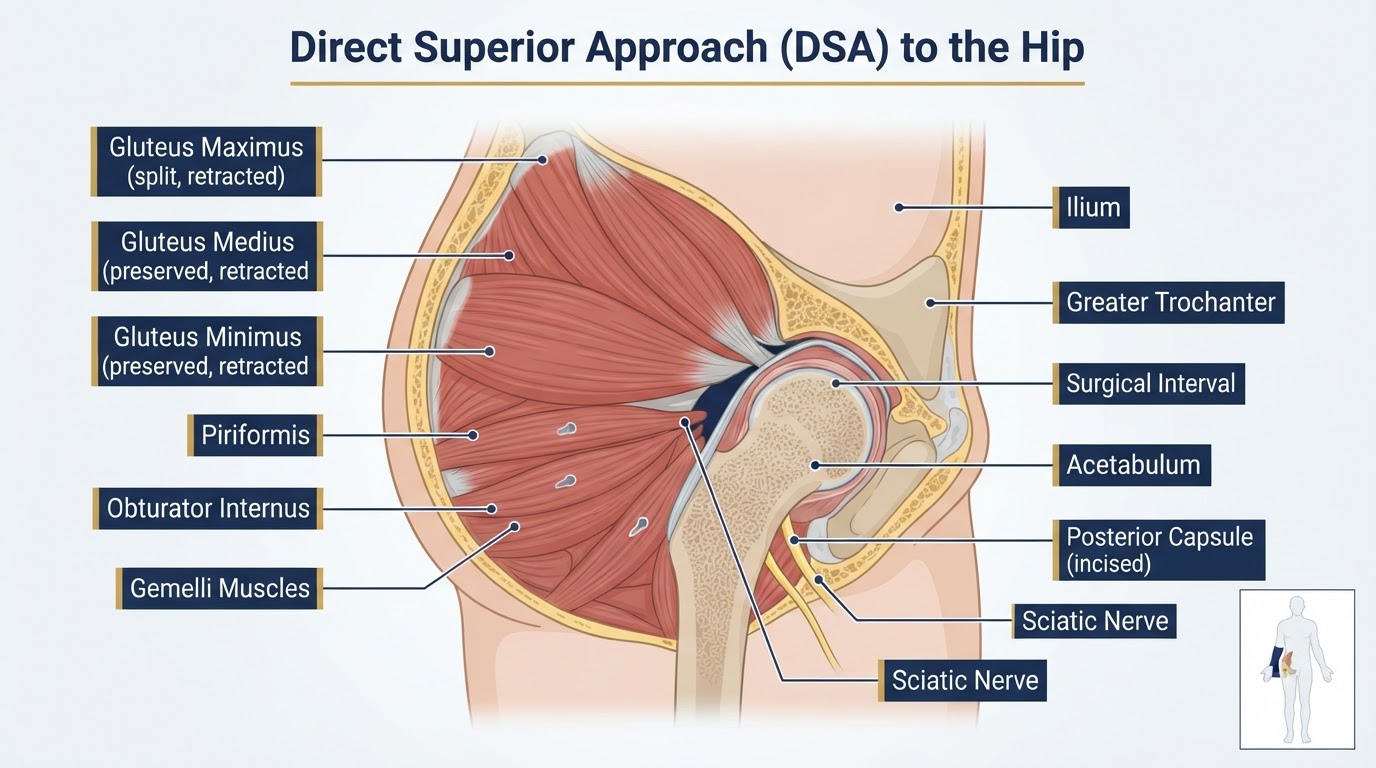
When you are offered a hip replacement, the surgeon chooses a surgical approach — the path through which the joint is exposed. Two approaches used in modern practice are the direct superior approach and the anterolateral approach. They differ in anatomy, patient positioning, the way muscles and soft tissues are handled, the recovery profile and the complications that surgeons watch for. This article explains those differences in detail, with specialist-level anatomical accuracy but written for patients. It does not promote one approach as universally better, because the honest position is that a well-executed operation through either approach, with well-placed components, can achieve excellent results. It is written for residents and visitors on the Costa Blanca — including patients in Alicante, Torrevieja and Orihuela Costa — and for international patients seeking an evidence-based second opinion. The aim is to help you understand what each approach involves so you can have an informed conversation with your surgeon about which may suit your anatomy and clinical situation.
Introduction: why are there different approaches to hip replacement?
Total hip replacement is one of the most successful operations in orthopaedic surgery, but there is no single 'best' way to reach the hip joint. Different surgical approaches were developed because the hip is deep and surrounded by important muscles, nerves and blood vessels, and surgeons need a route that gives safe exposure while respecting soft tissues as much as possible. The direct superior and anterolateral approaches represent two different anatomical strategies for achieving the same goal: removing the damaged joint surfaces and positioning the implant components accurately. Each has anatomical principles, potential advantages and limitations, and a learning curve. The choice depends on the surgeon's experience, the patient's anatomy and individual factors. Understanding why approaches differ is the first step to understanding why no single approach is universally superior.
What is total hip replacement?
A total hip replacement replaces the worn ball-and-socket joint of the hip with artificial components: an acetabular cup fixed into the pelvis (with a liner inside it) and a femoral stem inserted into the thigh bone, topped by a femoral head that articulates with the liner. To place these components accurately, the surgeon must expose the joint, dislocate the femoral head from the acetabulum, prepare the bone, and position the components with the correct orientation, leg length and offset. The surgical approach is the route taken to reach the joint and manage the soft tissues around it. The approach is only one part of the operation — component positioning, fixation and surgical technique matter at least as much as the approach itself.
Understanding surgical approach terminology
Approach names can be confusing because they describe anatomy rather than incision size. 'Direct superior' refers to a posterior-based, tissue-sparing route that approaches the hip from above and behind. 'Anterolateral' refers to a route that approaches the hip from the front-and-side, through the interval between the tensor fasciae latae and the gluteus medius. Neither name tells you the length of the incision or guarantees a particular recovery. It is also important not to confuse these approaches with others: the direct superior approach is distinct from SuperPath and other supercapsular techniques, and the anterolateral approach is distinct from the direct anterior approach. Each approach has variants, and outcomes from one variant cannot automatically be applied to another.
Direct superior approach: anatomical principles
The direct superior approach is a posterior-based, tissue-sparing approach. It approaches the hip from a postero-superior direction, working through a limited interval that aims to spare the abductor mechanism (gluteus medius and minimus) and manage the short external rotators and posterior capsule according to the specific technique. The principle is to gain access to the joint through a confined corridor that minimises detachment or splitting of the key stabilising muscles. It is important to distinguish this approach from SuperPath and other supercapsular techniques, which have different technical details and should not be assumed to be identical. Not every modification of the direct superior approach is the same, and the way the posterior capsule and external rotators are handled varies with the specific technique.
Direct superior approach: patient positioning and surgical exposure
The direct superior approach is usually performed with the patient in lateral decubitus (lying on the side). Lateral positioning allows the surgeon to access the postero-superior aspect of the hip and helps manage the soft tissues through the planned interval. The exposure is deliberately limited, which is the basis of its tissue-sparing intent but also demands precise knowledge of the anatomy and a learning curve. Femoral exposure is achieved by carefully managing the posterior soft tissues to deliver the femoral head and prepare the femur, while acetabular exposure is gained through the same interval. The limited exposure means the technique is suited to selected patients and depends on surgeon experience; it is not simply a smaller version of a standard posterior approach.
Anterolateral approach: anatomical principles
The anterolateral approach is based on the Watson-Jones anatomical principles and uses the intermuscular interval between the tensor fasciae latae and the gluteus medius. By passing between these two muscles, the approach aims to reach the hip while respecting the abductor mechanism as far as possible. The term 'anterolateral' covers different technical modifications: some variants are genuinely muscle-sparing and intermuscular, while others involve a partial release or splitting of abductor structures to improve exposure. These variants are not identical, and their outcomes cannot always be pooled as if they were the same operation. The relationship with the abductor mechanism is the central anatomical consideration, because the gluteus medius and minimus are key to hip stability and gait.
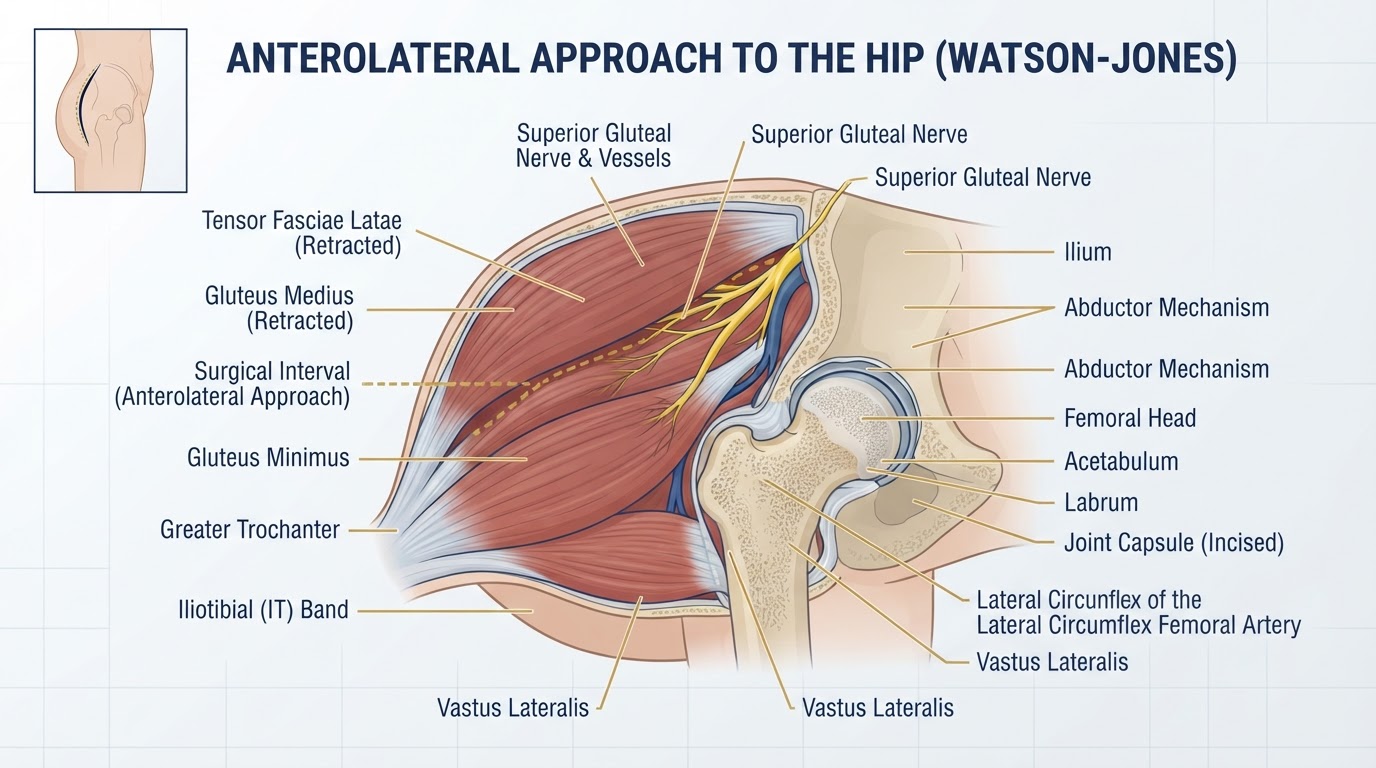
Anterolateral approach: lateral decubitus positioning
The anterolateral approach can be performed with the patient in lateral decubitus (lying on the side). Lateral positioning is a well-established setup for this approach and influences how the soft tissues fall, how the joint is exposed and how the surgeon judges component orientation. In lateral decubitus, the abductor mechanism is accessible from the anterolateral interval, and the surgeon can manage the capsule and expose the acetabulum and femur according to the specific variant. Positioning is a technical choice influenced by surgical exposure, the use of intraoperative imaging, component orientation and surgeon preference. It does not by itself determine the quality of the result.
Anterolateral approach: supine positioning
Some anterolateral variants are performed with the patient supine (lying on the back). Supine positioning can facilitate the use of intraoperative imaging and may suit particular operating-room setups and surgeon preferences. The anatomical interval is the same — between the tensor fasciae latae and the gluteus medius — but the way the soft tissues are managed and the way component orientation is judged differ with the patient flat. Whether supine or lateral is used depends on the specific technique, the surgeon's training and the equipment available. Neither position is automatically better; each has practical implications for exposure, imaging and workflow that the surgeon weighs in each case.
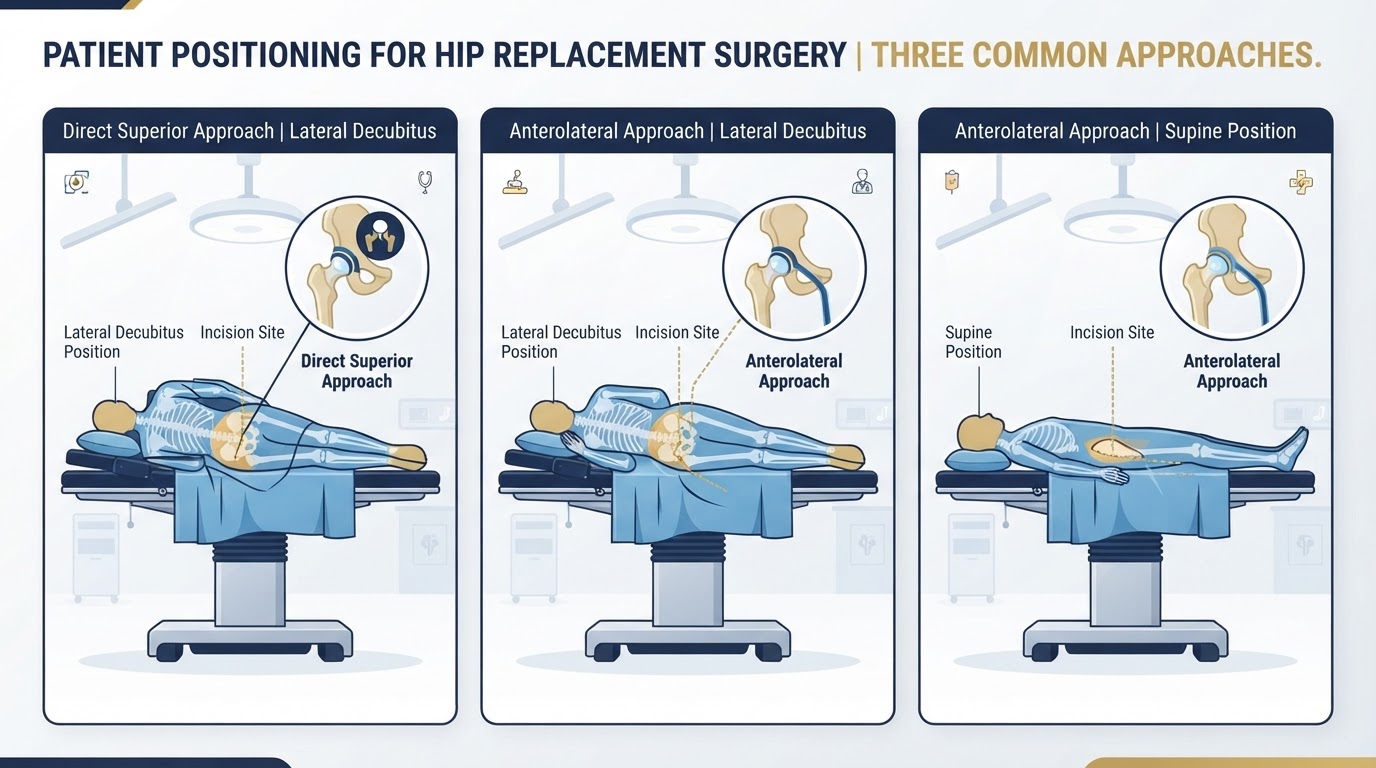
Comparison of muscle and soft-tissue management
The two approaches manage muscles and soft tissues differently, and this is the core of their distinction. The direct superior approach works through a postero-superior interval, aiming to spare the abductors and to handle the short external rotators and posterior capsule according to the specific technique. The anterolateral approach works through the interval between the tensor fasciae latae and the gluteus medius, aiming to respect the abductor mechanism, with variants ranging from fully intermuscular to those involving partial release or splitting of abductor fibres. Neither approach is completely 'muscle-sparing' in an absolute sense — both require management of soft tissues to expose the joint — but the muscles affected and the way they are handled differ. This is why outcomes from one approach cannot be assumed to apply to the other.
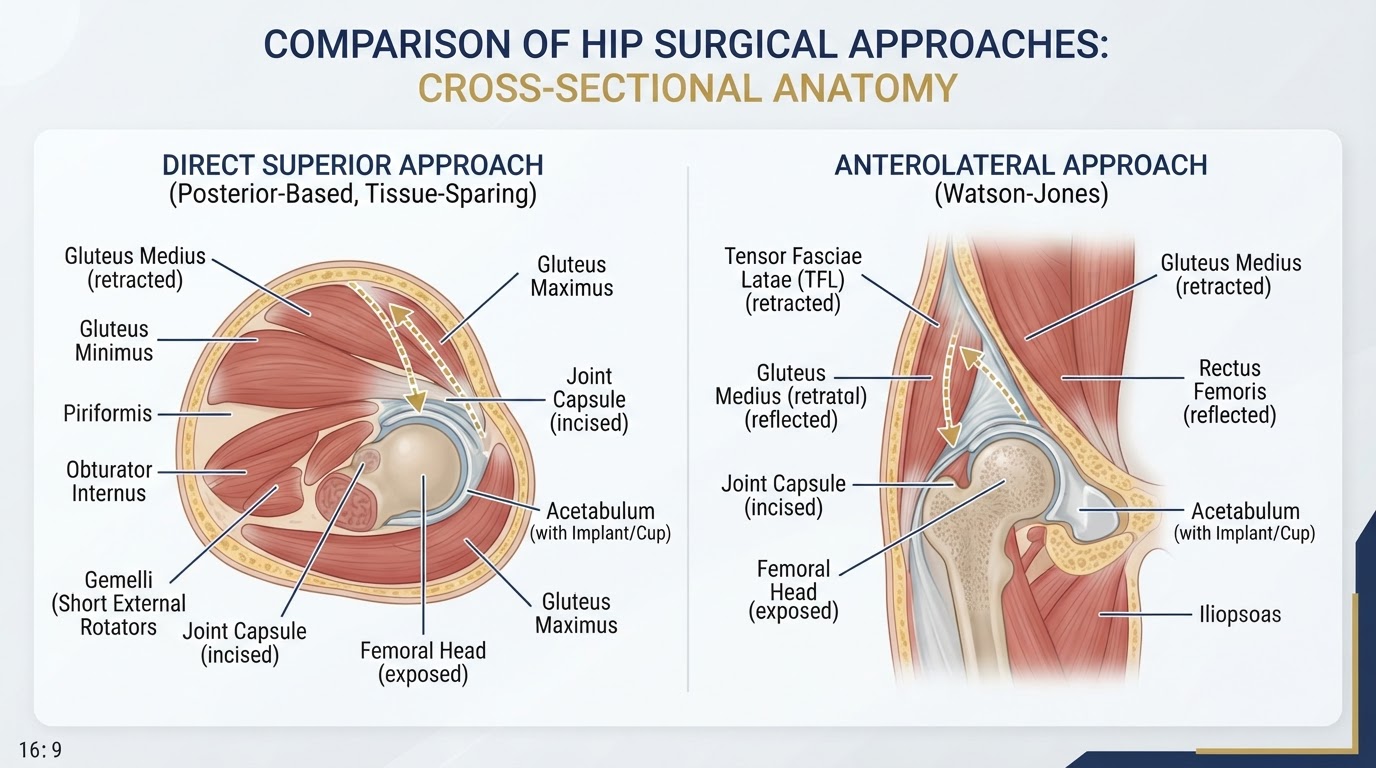
Preservation of the gluteus medius and minimus
The gluteus medius and minimus are the abductor muscles that stabilise the pelvis during walking; weakness causes a limp (Trendelenburg gait) and reduces function. Preserving these muscles is a central goal of both approaches, but the way each achieves it differs. The direct superior approach is designed to avoid detaching or splitting the abductors by working posterior to them. The anterolateral approach passes between the tensor fasciae latae and the gluteus medius, and in its muscle-sparing intermuscular variants the abductors are respected; in variants that involve partial release or splitting, there is a theoretical risk of abductor injury that the surgeon manages carefully. Abductor preservation is one reason both approaches are described as tissue-sparing, but the anatomical route to that goal is different.
Management of the short external rotators and posterior capsule
The short external rotators and the posterior capsule are important for the posterior stability of the hip. The direct superior approach, being posterior-based, manages these structures according to the specific technique — some variants preserve or repair them, others work around them — and the way they are handled influences the dislocation risk profile. The anterolateral approach, approaching from the front-and-side, generally does not require the same posterior dissection, which is one reason it has historically been associated with a particular stability profile. The key point is that the management of these structures is technique-dependent, and broad statements about dislocation risk must be interpreted alongside the specific variant and the surgeon's technique.
Femoral exposure and preparation
Exposing and preparing the femur is a technical step that differs between the approaches. In the direct superior approach, femoral exposure is achieved through the limited postero-superior interval by carefully managing the posterior soft tissues to deliver the femur. In the anterolateral approach, femoral exposure is gained through the anterolateral interval, sometimes requiring specific leg positioning and retraction. Adequate femoral exposure is important because it allows correct preparation of the canal and positioning of the stem, which affects leg length, offset and stability. Both approaches can achieve good femoral exposure in experienced hands, but the technique and the demands on the soft tissues differ.
Acetabular exposure and component positioning
Acetabular exposure and cup positioning are central to the longevity and stability of the replacement. Both approaches must provide enough exposure to prepare the acetabulum and place the cup with the correct orientation (inclination and version). The direct superior approach exposes the acetabulum through its postero-superior interval; the anterolateral approach exposes it through the anterolateral interval. Intraoperative imaging may support component positioning in either approach, depending on the setup. The accuracy of cup positioning depends on exposure, the surgeon's judgement and, where used, imaging or robotic assistance — not on the approach alone.
Leg length and offset restoration
Restoring leg length and offset (the distance the femoral head sits from the centre of the hip) is important for stability, muscle tension and patient satisfaction. Both approaches allow leg length and offset to be assessed and restored, using intraoperative checks and, in some setups, imaging. The risk of leg length discrepancy exists with any approach and depends on exposure, component selection and surgical technique rather than the approach alone. A careful surgeon using either approach aims to restore leg length and offset, and patients with concerns about leg length should discuss how this is assessed during their operation.
Stability and risk of dislocation
Dislocation is one of the complications patients ask about most. The dislocation risk profile differs between approaches largely because of how the posterior soft tissues are managed. The anterolateral approach, which generally does not require the same posterior dissection, has historically been associated with a particular stability profile. The direct superior approach, being posterior-based, manages the posterior capsule and external rotators according to the specific technique, and the way these are handled influences stability. However, dislocation risk also depends on component positioning, patient factors, surgical technique and postoperative precautions. No approach eliminates dislocation risk, and broad comparative claims must be interpreted alongside the specific variant and surgeon experience.
Nerve injury and neurological complications
Nerve injury is a rare but recognised complication of hip replacement, and the nerves at risk differ by approach. The anterolateral approach has a particular relationship with the superior gluteal nerve, which supplies the abductors, because of its proximity to the interval used; injury can cause abductor weakness. The direct superior approach, working posteriorly, has a relationship with structures in that region. Femoral and sciatic nerve injuries are general risks of hip replacement that vary with approach, exposure and patient anatomy. Neurological complications are uncommon, and careful technique and knowledge of the anatomy are central to avoiding them. The nerve injury profile is one of the factors a surgeon weighs when choosing an approach for a particular patient.
Intraoperative fractures and other complications
Intraoperative fractures of the femur or acetabulum can occur during any hip replacement and are influenced by bone quality, exposure, the approach and surgical technique. Other general complications include heterotopic ossification (bone forming in soft tissues), wound complications, leg length discrepancy, infection and persistent postoperative pain. Some complications are more associated with one approach than another — for example, the soft tissues handled and the nerves at risk differ — but many complications are general to hip replacement rather than specific to an approach. A balanced discussion of complications distinguishes those specifically associated with each approach from those that can occur with any hip replacement.
Postoperative pain and early recovery
Early postoperative pain and recovery are influenced by the approach, the soft-tissue management, the patient's fitness and the surgical detail. Tissue-sparing intent, in either approach, aims to reduce soft-tissue trauma and support early mobilisation. Many patients mobilise on the day of surgery or the next, with walking aids as needed. Early recovery varies between individuals and depends on the procedures performed, pain management and rehabilitation. Some studies report early functional differences between approaches, but these differences are not always clinically meaningful or sustained, and the evidence does not establish that one approach produces uniformly faster recovery.
Rehabilitation and return to daily activities
Rehabilitation after hip replacement guides the progression of movement, strengthening and gait, and the return to driving, work and sport. The rehabilitation pathway is broadly similar across approaches, with early mobilisation, walking aids as needed, and progressive strengthening. Return to driving, work and sport depends on the side operated, the approach, the patient's recovery and the surgeon's guidance, and no fixed recovery date can be guaranteed. The approach may influence some early precautions, but the overall trajectory toward restored mobility and reduced pain is similar. Rehabilitation is individualised to the patient and the procedures performed.
Functional results at medium and long-term follow-up
Medium and long-term functional results depend on component positioning, fixation, bearing surfaces, surgical technique and patient factors as much as on the approach. Registry data and comparative studies show that well-executed hip replacement through either approach can achieve excellent long-term function. Network meta-analyses comparing approaches have found some early functional and safety differences but have not established one approach as universally superior at medium or long-term follow-up. The honest interpretation is that long-term outcomes are driven by the quality of the reconstruction and the patient's characteristics, not by the approach alone.
Learning curve and surgeon experience
Every approach has a learning curve, and surgeon experience is one of the most important factors in outcome. The direct superior approach, with its limited exposure and specific interval, has a learning curve that includes planning, registration of the anatomy, operating-room workflow and the management of soft tissues through a confined corridor. The anterolateral approach also has a learning curve, particularly for its muscle-sparing intermuscular variants. Team training and consistent workflow matter for both. Robotic technology, where used, adds its own learning requirements. The key message is that robotic or minimally invasive technology does not replace surgical judgement or experience; the best results come from an appropriately experienced surgeon working within a technique they perform regularly.
Patient selection: when might each approach be considered?
Approach selection depends on body habitus, hip anatomy, femoral morphology, bone quality, the condition of the abductors, previous surgery, deformity, contractures, neuromuscular conditions, comorbidities, the surgeon's expertise and the complexity of the reconstruction. There are no universally valid absolute contraindications to either approach; rather, certain factors make one approach more or less suitable for a given patient. For example, a patient with particular abductor concerns or previous surgery may favour one route, while a patient with specific anatomical considerations may favour another. The best approach is the one that permits safe exposure, accurate reconstruction and reproducible results in the hands of an appropriately experienced surgeon. This is a clinical judgement, not a formula.
Is one approach universally better?
No. The evidence does not support one approach being universally superior. Network meta-analyses comparing surgical approaches in total hip arthroplasty have found different probabilities of early functional and safety advantages across approaches, but none has established a single approach as best for all patients. The 2026 network meta-analysis of 85 randomised controlled trials and 6,575 patients found different early efficacy and safety profiles but did not establish one universally superior approach. The 2026 Soler network meta-analysis (13 studies, 972 patients) comparing posterior, anterior and direct superior approaches found some early functional differences but no significant differences in pain or functional outcomes at 12 months, with imprecise complication estimates. The honest conclusion is that a well-executed operation through an appropriate approach, with well-placed components, can achieve excellent results — and the right approach is the one that suits the patient and the surgeon.
Conclusion and consultation CTA
The direct superior and anterolateral approaches are two anatomically distinct routes to the same goal: a stable, well-functioning hip replacement. They differ in the interval used, patient positioning, the muscles and soft tissues managed, the recovery profile and the complications surgeons watch for, but neither is universally superior. The choice depends on the surgeon's experience, your anatomy and individual factors, and the evidence supports excellent results through either approach when the operation is well executed. For residents and visitors across the Costa Blanca — Alicante, Torrevieja and Orihuela Costa — Dr Pablo Banchero offers an individualised, evidence-based assessment and an honest second opinion on which approach may be suitable for your anatomy and clinical situation.
An individualised, evidence-based approach
No single hip replacement approach is universally superior. The direct superior and anterolateral approaches differ in anatomy, positioning, soft-tissue management, recovery and complications, but both can achieve excellent results when well executed. The choice depends on the surgeon's experience, the patient's anatomy and individual factors. Network meta-analyses have found early differences but no universally superior approach at medium or long-term follow-up. On the Costa Blanca — Alicante, Torrevieja and Orihuela Costa — Dr Pablo Banchero provides evidence-based assessment and second opinions to help you understand which approach may suit your situation.
References & scientific evidence
- Van Dooren W, De Vries LM, Middeldorp S, et al.. The Direct Superior Approach in Total Hip Arthroplasty: A Systematic Review.. Journal of Bone and Joint Surgery Reviews, 2024.Systematic reviewDOI: 10.2106/JBJS.RVW.23.00182View source
- Soler JA, et al.. Comparing posterior, anterior, and direct superior approaches in total hip arthroplasty: a network meta-analysis.. International Journal of Surgery / Acta Orthopaedica et Traumatologica, 2026.Meta-analysisDOI: 10.1177/11207000261426222PMID: 41902509View source
- Shin YS, et al.. Early Postoperative Outcomes of the Direct Superior Approach versus the Posterior Approach in Total Hip Arthroplasty.. Journal of Arthroplasty / Comparative Clinical Study, 2024.Observational studyPMID: 39518441View source
- Journal of Orthopaedics. Evaluating the direct superior approach compared to the traditional posterior approach for hip arthroplasty: a meta-analysis.. Journal of Orthopaedics, 2025.Meta-analysisDOI: 10.1016/j.jor.2025.05.062View source
- JAMA Network Open network meta-analysis. Network meta-analysis of surgical approaches in total hip arthroplasty: 63 randomized clinical trials and 4,859 participants.. JAMA Network Open, 2023.Meta-analysisView source
- BMC Musculoskeletal Disorders. Early clinical efficacy and safety of different surgical approaches in total hip arthroplasty: a network meta-analysis of 85 randomized controlled trials and 6,575 patients.. BMC Musculoskeletal Disorders, 2026.Meta-analysisDOI: 10.1186/s12891-026-09683-3View source
- Petis S, Howard JL, Lanting BL, Vasarhelyi EM.. Surgical approach in primary total hip arthroplasty: anatomy, technique and clinical outcomes.. HIP International, 2015.Systematic reviewDOI: 10.5301/hipint.5000262View source
- Higgins BT, Barlow DR, Heagerty NE, Lin TJ.. Anterior vs. posterior approach for total hip arthroplasty: a systematic review and meta-analysis.. Journal of Arthroplasty, 2015.Meta-analysisDOI: 10.1016/j.arth.2014.12.009View source
- Miller LE, Gondusky JS, Kamath AF, Boettner F, Wright TM, Bhattacharyya S.. Influencing risk factors for instability in total hip arthroplasty: a systematic review and meta-analysis.. Orthopaedic Journal of Sports Medicine, 2020.Meta-analysisDOI: 10.1177/2325967120951834View source
- National Joint Registry (NJR) for England, Wales, Northern Ireland and the Isle of Man. National Joint Registry 21st Annual Report — Hip, Knee, Ankle, Elbow and Shoulder Arthroplasty: Outcomes and Survivorship.. National Joint Registry, 2024.Observational studyView source
- Australian Orthopaedic Association National Joint Replacement Registry (AOANJRR). Hip, Knee & Shoulder Arthroplasty: Annual Report.. AOA NJRR, 2024.Observational studyView source
- Evans JT, Evans JP, Walker RW, Blom AW, Whitehouse MR, Sayers A.. How long does a hip replacement last? A systematic review and meta-analysis of case series and national registry reports.. The Lancet, 2019.Meta-analysisDOI: 10.1016/S0140-6736(18)31665-9View source
- Bayliss LE, Culliford D, Monk AP, et al.. The effect of patient age at intervention on risk of implant revision after total hip replacement: population-based cohort study.. BMJ, 2017.Observational studyDOI: 10.1136/bmj.j1411View source
- Rüdiger HA, et al.. Abductor mechanism function after anterolateral approach total hip arthroplasty: a comparative study.. Journal of Arthroplasty / Clinical Orthopaedics, 2019.Observational studyView source
- Müller M, et al.. Superior gluteal nerve injury and abductor function after anterolateral approach hip arthroplasty.. Journal of Orthopaedic Research / Hip International, 2018.Observational studyView source
Frequently asked questions

Dr. Pablo Banchero Lasalvia
Orthopaedic Surgeon · Traumatology Team
- Author:
- Dr. Pablo Banchero Lasalvia
- Medical reviewer:
- Dr. Pablo Banchero Lasalvia
- Published:
- 2 November 2026
- Medical review date:
- 2 November 2026
- ·
- 22 min read
Book Your Consultation via WhatsApp
Request a private, evidence-based orthopaedic assessment with Dr Pablo Banchero to discuss hip replacement, compare the direct superior and anterolateral approaches, understand which may suit your anatomy and clinical situation, or seek a second opinion on the Costa Blanca.
Official number: +34 602 99 22 22