
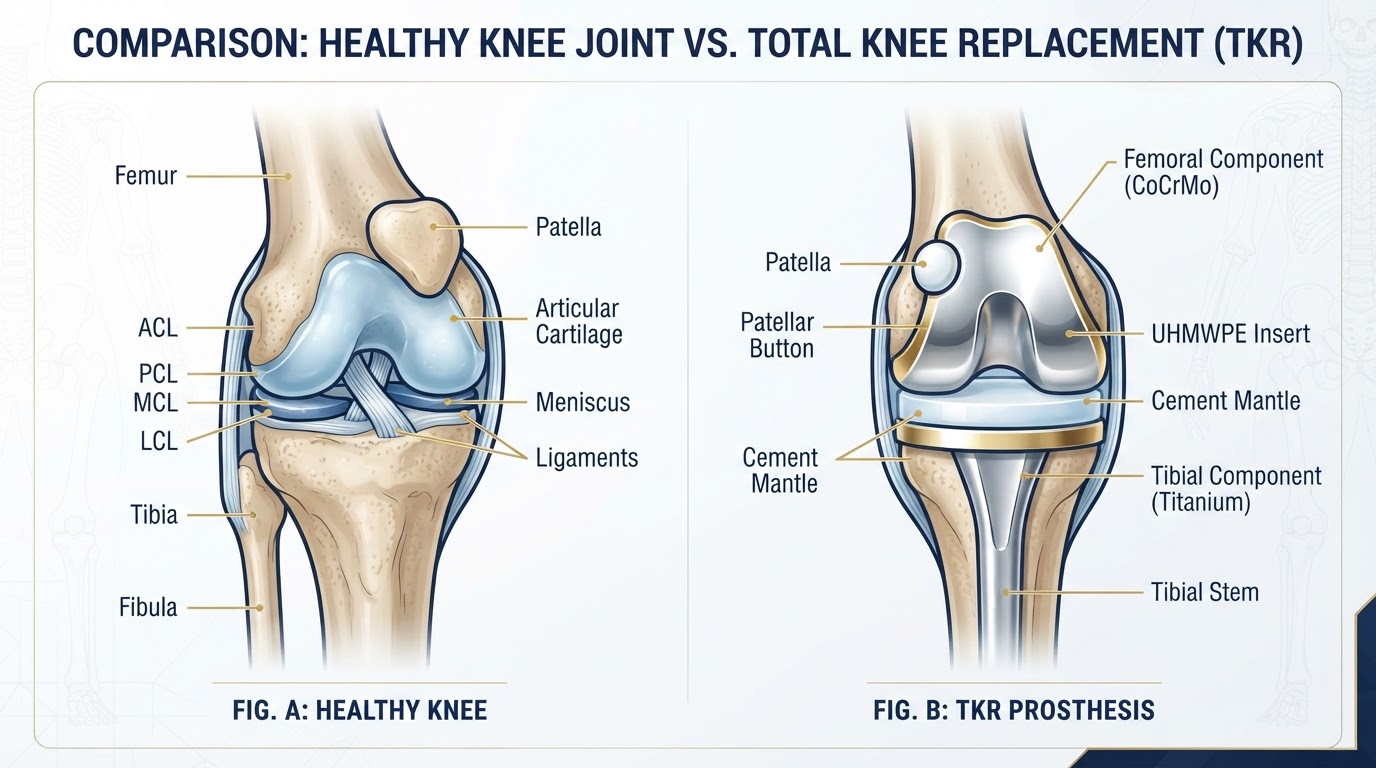
One of the most frequent questions patients ask when considering total or partial knee replacement is how long the artificial joint will actually last. Will it serve them for 15, 20, or 25 years, or will they inevitably face a second, complex operation known as revision surgery? In modern orthopaedic surgery, advancements in implant design, highly cross-linked polyethylene, precise surgical instrumentation and multimodal perioperative pathways have made knee replacement one of the most durable and cost-effective procedures in all of medicine. However, no artificial joint is indestructible, and implant longevity is governed by a nuanced interaction between surgical precision, biomechanical wear, implant materials, patient age, weight, bone quality and activity levels. For international residents and active adults living along the Costa Blanca — including Alicante, Torrevieja, Orihuela Costa and La Zenia — understanding what the latest clinical registries and international studies demonstrate helps dispel common myths and provides realistic, reassuring expectations.
Introduction: How long can a knee replacement last?
A total knee replacement is not a temporary fix; it is designed to be a durable, long-term reconstruction of a joint damaged by advanced osteoarthritis. Historical literature from three decades ago often quoted a lifespan of roughly 10 to 15 years. Today, that estimate is substantially outdated. Contemporary research, incorporating data from hundreds of thousands of patients tracked across national joint replacement registries over multiple decades, reveals that the vast majority of modern knee replacements continue to function smoothly well past 15 to 20 years, with significant cohorts surviving at 25 years and beyond. Nonetheless, longevity varies between individuals. An artificial joint does not possess biological regenerative capacity: it is subjected to millions of repetitive load cycles every single year. The goal of orthopaedic consultation is to help you understand what current evidence shows, what factors you can influence, and how to maintain joint health for the longest possible horizon.
What does implant survival actually mean?
In orthopaedic research and national registry publications, 'implant survival' has a very precise definition: the implant remains inside the patient without requiring revision surgery (the surgical removal or exchange of one or more prosthetic components). While survival is the gold standard endpoint for epidemiological studies, it is essential to distinguish between survivorship, mechanical wear, and clinical success. | Concept | Clinical Definition | Practical Patient Meaning | |---|---|---| | Implant Survival | The prosthesis remains in place without surgical revision or removal. | The joint has not had to be re-operated for component exchange. | | Implant Wear | Gradual microscopic surface loss of the polyethylene spacer over time. | Normal mechanical aging of the bearing that may or may not cause symptoms. | | Clinical Success | Meaningful relief of pain, restored mobility, stability and patient satisfaction. | You can walk comfortably, engage in daily hobbies and enjoy good quality of life. | An implant may show mild radiographic signs of wear after 18 years while the patient remains entirely pain-free, active and satisfied. Conversely, a patient could have an intact, unrevised prosthesis that suffers from stiffness or unexplained discomfort. True success represents both high survivorship and lasting functional satisfaction.
What current scientific evidence tells us about implant longevity
The most definitive data on knee replacement longevity comes from two complementary sources: large, population-based national arthroplasty registries and comprehensive systematic reviews of peer-reviewed clinical series. Large registries — such as the National Joint Registry (NJR) of England, Wales and Northern Ireland, and the Australian Orthopaedic Association National Joint Replacement Registry (AOANJRR) — track virtually every arthroplasty performed within entire healthcare systems, capturing real-world outcomes across diverse surgeons, implants, and patient demographics. In 2019, a landmark systematic review and meta-analysis published in The Lancet by Evans and colleagues synthesized data from case series alongside national registries in Australia, New Zealand, Norway, Sweden and the UK. Their analysis encompassed over 299,000 total knee replacements and more than 17,000 unicompartmental knee replacements, providing the most robust global estimates of 15, 20 and 25-year survival available in orthopaedic literature.
Survival rates at 10, 15, 20 and 25 years: What the data shows
The Lancet meta-analysis by Evans et al. (2019) demonstrated remarkable survivorship for total knee arthroplasty (TKA): * At 10 years post-surgery: Approximately 96% to 97% of total knee replacements remain in place without revision. * At 15 years: Approximately 93% of total knee replacements survive without revision. * At 20 years: More than 90% (estimated at 90.5%) of total knee replacements continue functioning in situ. * At 25 years: Approximately 82% (estimated at 82.3%) of total knee replacements remain intact without needing revision surgery. These numbers are profoundly reassuring. They indicate that for an individual aged 65 to 70 undergoing a standard total knee replacement today, the statistical probability that the implant will last their entire remaining lifetime without requiring revision exceeds 80% to 90%. However, these percentages represent statistical medians across broad cohorts; individual survivorship is modulated by age, activity, biomechanics and biological response.
Differences between total and partial knee replacement longevity
When comparing total knee replacement (TKA) to unicompartmental or partial knee replacement (UKA), registry analyses consistently demonstrate a higher cumulative revision rate for partial replacements over long-term follow-up. In the Evans et al. Lancet meta-analysis, 25-year survival for unicompartmental knee replacement was estimated at approximately 72%, compared to 82% for total knee replacement. Similarly, the NJR 21st Annual Report (2024) indicates a cumulative revision rate of approximately 3% to 4% at 10 years for cemented TKA, compared to roughly 8% to 11% for medial UKA. However, this comparison requires careful interpretation. First, revision of a partial knee replacement is technically more straightforward than revising a total knee, often converting smoothly into a primary-style total knee replacement. Surgeons may have a lower clinical threshold to revise a symptomatic partial knee than a total knee. Second, unreplaced compartments in a partial knee can naturally develop progressive osteoarthritis over 10 to 15 years, requiring completion to a total knee. Third, randomised controlled trial data, such as the 5-year and 10-year follow-ups of the TOPKAT trial (Beard et al., The Lancet 2019), showed similar patient-reported outcomes and comparable revision rates when partial knee replacements were performed by experienced, high-volume surgeons within an allocated clinical trial framework. As we explore in Article 07, the choice between total and partial knee replacement is governed by your specific joint pathology rather than longevity figures alone.
What causes an artificial knee to wear out?
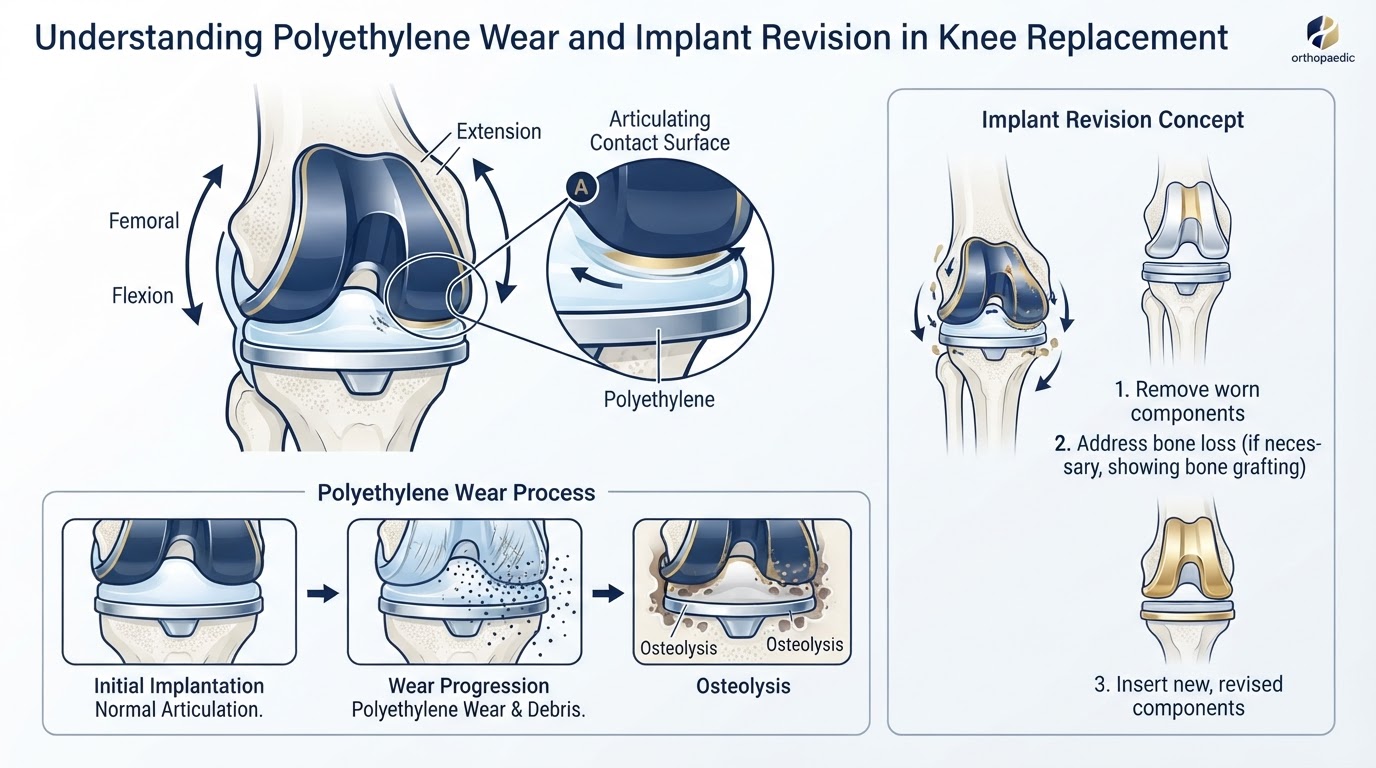
A prosthetic knee joint consists of inert biomaterials that cannot biological remodel or lubricate themselves in the exact manner of youthful hyaline cartilage. The primary physical and biological drivers of implant deterioration over extended timeframes include: * Polyethylene adhesive and abrasive wear: Microscopic shedding of polymer particles as the femoral metal condyle articulates against the tibial plastic insert. * Particle-induced osteolysis: The body's immune system (macrophages) attempts to engulf microscopic wear debris, triggering a local inflammatory cascade that resorbs surrounding bone (osteolysis), potentially undermining implant anchorage. * Aseptic loosening: Gradual debonding between the prosthetic components and host bone or bone cement, usually secondary to mechanical overload or osteolysis, without bacterial infection. * Instability and ligamentous laxity: Progressive stretching or attenuation of collateral ligaments or periarticular soft tissues over years, resulting in abnormal shearing forces on the implant. * Infection (periprosthetic joint infection): Even decades after primary surgery, haematogenous seeding of bacteria from dental work, skin infections or urinary tract infections can seed the prosthetic surface. * Periprosthetic fracture: A fall or traumatic injury causing a fracture of the femur or tibia immediately adjacent to the rigid metal stem.
Polyethylene wear and modern implant materials
Historically, the weakest link in total joint arthroplasty was conventional ultra-high-molecular-weight polyethylene (UHMWPE). In early generation prostheses, gamma sterilisation in air generated free radicals that promoted polymer oxidation, leading to delamination, pitting, severe volumetric wear and secondary bone loss. Over the past two decades, materials engineering has radically transformed this landscape. Modern knee replacements predominantly utilise highly cross-linked polyethylene (HXLPE) or antioxidant-stabilised polyethylenes (such as vitamin E-infused UHMWPE), which undergo thermal treatment or free-radical scavenging to eliminate oxidation potential. Laboratory simulator studies and retrieval analyses confirm that contemporary cross-linked inserts exhibit volumetric wear rates up to 50% to 70% lower than legacy materials. In tandem, femoral components are manufactured from premium cobalt-chromium alloys or advanced oxidized zirconium (ceramicized metal) bearing surfaces with exceptional surface smoothness and scratch resistance, dramatically reducing friction and particulate generation.
Factors influencing implant longevity
The lifespan of an artificial knee is not pre-ordained at the moment of manufacturing; it is shaped by an interplay of patient-specific, surgical, and biomechanical variables: * Age at index surgery: Younger patients (under 55 to 60) consistently exhibit higher cumulative revision rates than older cohorts, driven primarily by greater physical activity, higher annual cycle counts and a longer remaining life expectancy. * Body mass index (BMI) and mechanical loading: Every kilogram of excess body weight multiplies joint reactive forces during stair climbing and walking by three to four times. Elevated BMI accelerates mechanical stress across the cement-bone interface and increases perioperative complication risks. * Activity level and sport selection: High-impact, repetitive collision activities generate peak stress spikes that accelerate wear, whereas low-impact cardiovascular pursuits preserve joint health and bone density. * Precision of implant alignment and surgical technique: Correct component sizing, restoration of coronal and sagittal limb alignment, balanced flexion and extension gaps, and solid cement interdigitation are paramount. A well-aligned knee distributes contact pressures evenly across the polyethylene surface, preventing eccentric edge-loading. * Host bone quality: Severe osteoporosis or compromised subchondral bone can impair initial implant stability and long-term osteointegration.
Does being younger mean the implant will need replacing sooner?
Registry data unambiguously confirms that younger age at the time of surgery is one of the strongest predictors of revision arthroplasty. According to data from the UK National Joint Registry and Australian Registry, patients under the age of 55 have an estimated 10-year revision risk of approximately 6% to 9%, compared to less than 3% for patients aged 70 and older. This disparity does not stem from biological incompatibility, but rather from functional demands. A 52-year-old patient typically takes 2 to 3 times more steps per year, participates in more demanding work or sporting activities, and has a statistical life expectancy of 30 to 35 additional years. If an implant has an average mechanical survivorship of 20 to 25 years, a patient operated at age 50 has a substantial statistical probability of outliving their primary prosthesis, whereas a patient operated at age 73 will likely enjoy their primary prosthesis for life. This reality underscores the importance of conservative care and joint preservation strategies in young patients, balanced against the severe disability of advanced end-stage osteoarthritis.
Which activities are recommended after knee replacement?
Undergoing a knee replacement should never mean retiring into sedentary inactivity. Regular exercise is essential to maintain bone mineral density around the implant, preserve muscular strength, and support cardiovascular health. Orthopaedic consensus guidelines classify physical activities into recommended, permitted with caution, and discouraged: * Highly recommended (low impact): Walking, swimming, water aerobics, stationary cycling, outdoor road cycling on smooth terrain, low-resistance cross-trainers, ballroom dancing, and golf. * Permitted with caution (depending on prior experience and skill): Doubles tennis, hiking on graded terrain, cross-country skiing, light weight training, sailing, and gentle bowling. * Generally discouraged (high impact): Running and jogging on hard surfaces, football, basketball, squash, singles tennis, contact martial arts, and high-impact aerobics. While an occasional jog across a street will not break a modern prosthesis, engaging in repetitive marathon training or competitive collision sports subjects the polyethylene and fixation interface to excessive peak shear stresses, accelerating wear and increasing the risk of early aseptic loosening.
Warning signs that may indicate a problem with an implant
A successfully integrated knee replacement should feel stable, secure, and largely pain-free during standard daily living. If an implant begins to wear excessively, loosen, or develop an infection, it rarely fails without prior warning. Patients should contact their orthopaedic specialist if they experience any of the following symptoms: * New or progressive pain: An ache that develops after months or years of comfortable, painless function, particularly pain that occurs during weight-bearing or persists at night. * Joint instability or 'giving way': A sensation that the knee is slipping, buckling, or uncoordinated during level walking or descending stairs. * Sudden or unexplained swelling: A new effusion or fullness in the joint, especially if accompanied by localized warmth, redness, or skin tension. * Progressive angular deformity: Noticing that the leg is beginning to bow inward (varus) or drift outward (valgus) compared to previous postoperative radiographs. * Mechanical clicking, clunking, or grinding: While faint benign clicks are common early on, a new, harsh grinding sensation with weight-bearing can indicate polyethylene thinning or displacement. * Systemic symptoms: Chills, fever, or drainage from any area near the scar, which necessitates immediate emergency evaluation for periprosthetic infection.
When is revision knee replacement necessary?
Revision knee replacement is not performed simply because a set number of years has passed on the calendar, nor is it indicated for minor, asymptomatic radiographic changes. The decision to undertake revision surgery requires a rigorous clinical workup combining weight-bearing radiographs, long-leg alignment views, inflammatory serology (ESR and C-reactive protein), and, when indicated, joint aspiration or advanced cross-sectional imaging (CT or metal-suppression MRI). Clear clinical indications for revision include confirmed aseptic loosening with progressive bone loss, periprosthetic joint infection, recurrent mechanical instability or ligamentous rupture, catastrophic polyethylene failure, periprosthetic fracture, or debilitating stiffness (arthrofibrosis) refractory to comprehensive non-operative management.
What happens during revision surgery?
Revision knee arthroplasty is a specialized, technically demanding discipline that differs fundamentally from primary knee replacement. In primary surgery, the surgeon resurfaces the worn bone ends; in revision surgery, the surgeon must carefully extract the existing components while preserving as much viable host bone as possible, excise scarred or infected soft tissues, restore the patient's joint line and anatomical alignment, and securely anchor new revision components. Revision implants typically feature modular stems that extend into the femoral and tibial diaphyseal canals for enhanced stability, metal augments or cones (such as trabecular metal or porous titanium) to reconstruct bone defects, and semi-constrained or hinged bearing mechanisms if collateral ligaments are deficient. Modern revision surgery boasts excellent functional restoration and limb salvage rates, but it carries longer operative times, a higher risk profile, and a more prolonged rehabilitation period than primary surgery.
Can a knee replacement last a lifetime?
For many patients, the answer is an emphatic yes. If a total knee replacement is performed in a patient aged 65 or older who maintains a healthy body weight, engages in sensible low-impact physical exercise, and experiences no early complications such as deep infection, the statistical probability that the prosthesis will outlast them without needing revision exceeds 85% to 90%. Even in patients operated in their late 50s, modern highly cross-linked polyethylenes and precision surgical techniques make a lifespan of 20 to 25 years or more a realistic, evidence-backed expectation. However, longevity cannot be guaranteed as an absolute warranty: biological host responses, unanticipated medical illnesses, falls, or severe infections can alter the trajectory of any artificial joint.
Questions patients should ask their orthopaedic surgeon
During your preoperative consultation, having an open, informed discussion regarding implant choice and longevity is empowering. Consider asking your orthopaedic specialist the following questions: * What specific implant design and bearing materials do you recommend for my knee anatomy and activity level? * Does the proposed prosthesis have a proven, published track record in national joint registries (such as the NJR or Australian Registry) with an ODEP 10A* or 15A* rating? * How does my age, BMI, bone quality, and desired physical activities influence my expected implant lifespan? * Will computer navigation, robotic assistance, or personalized surgical instrumentation be used to optimize component alignment? * What routine follow-up schedule and radiographic monitoring do you advise to check on the implant over the next 10 to 20 years?
Conclusions: Maximising your implant's lifespan
Modern knee replacement is an extraordinary triumph of clinical biomechanics, providing millions of patients worldwide with lasting pain relief and renewed mobility. Scientific evidence confirms that modern total knee prostheses reliably achieve survivorship rates of over 90% at 20 years and greater than 80% at 25 years. The key to maximizing your artificial knee's longevity lies in a collaborative approach: meticulous surgical technique and implant selection by an experienced orthopaedic surgeon, followed by sensible weight management, consistent low-impact exercise, and adherence to routine clinical follow-up. If you are experiencing knee pain, considering joint replacement, or seeking an expert second opinion regarding an existing knee implant on the Costa Blanca, Dr Pablo Banchero offers comprehensive, evidence-based consultations tailored to your individual lifestyle.
The bottom line on knee replacement longevity
A modern knee replacement is built to last decades. Authoritative registry data confirms that over 90% of total knee replacements survive at 20 years and more than 80% at 25 years. Survivorship is optimized through precise surgical positioning, advanced bearing materials, sensible low-impact activity, and maintaining a healthy body weight. For international residents and visitors across Alicante, Torrevieja, Orihuela Costa and La Zenia, Dr Pablo Banchero provides specialized orthopaedic assessment to help you protect your mobility for a lifetime.
References & scientific evidence
- Evans JT, Walker RW, Evans JP, Blom AW, Sayers A, Whitehouse MR. How long does a knee replacement last? A systematic review and meta-analysis of case series and national registry reports.. The Lancet, 2019.Meta-analysisDOI: 10.1016/S0140-6736(18)32531-5View source
- National Joint Registry (NJR) for England, Wales, Northern Ireland and the Isle of Man. National Joint Registry 21st Annual Report — Hip, Knee, Ankle, Elbow and Shoulder Arthroplasty Outcomes and Survivorship.. National Joint Registry, 2024.Observational studyView source
- Australian Orthopaedic Association National Joint Replacement Registry (AOANJRR). Hip, Knee & Shoulder Arthroplasty Annual Report 2024: Long-Term Prosthesis Survivorship.. AOA NJRR, 2024.Observational studyView source
- Beard DJ, Davies LJ, Cook JA, MacLennan G, Price A, Kent S, et al.. The clinical and cost-effectiveness of total versus partial knee replacement in patients with medial compartment osteoarthritis (TOPKAT): 5-year outcomes of a randomised controlled trial.. The Lancet, 2019.Randomised controlled trialDOI: 10.1016/S0140-6736(19)31281-4View source
- Wilson HA, Middleton R, Abram S, Smith S, Alvand A, Jackson W, et al.. Patient relevant outcomes of unicompartmental versus total knee replacement: systematic review and meta-analysis.. BMJ, 2019.Meta-analysisDOI: 10.1136/bmj.l352View source
- American Academy of Orthopaedic Surgeons (AAOS). Surgical Management of Osteoarthritis of the Knee — Evidence-Based Clinical Practice Guideline (SMOAK2).. AAOS Clinical Practice Guidelines, 2022.Clinical guidelineView source
- National Institute for Health and Care Excellence (NICE). Joint replacement (primary): hip, knee and shoulder. NICE guideline NG157.. NICE Clinical Guidelines, 2020.Clinical guidelineView source
- Postler A, Lützner C, Beyer F, Tille E, Lützner J. Analysis of polyethylene wear and damage modes in retrieved knee arthroplasty components.. Materials (Basel), 2021.Experimental researchDOI: 10.3390/ma14010128View source
- Kurtz SM, Ong KL, Lau E, Bozic KJ. Impact of the economic downturn on total joint replacement survival in the United States.. Journal of Bone and Joint Surgery (Am), 2014.Observational studyDOI: 10.2106/JBJS.M.00285View source
Frequently asked questions

Dr. Pablo Banchero Lasalvia
Orthopaedic Surgeon · Traumatology Team
- Author:
- Dr. Pablo Banchero Lasalvia
- Medical reviewer:
- Dr. Pablo Banchero Lasalvia
- Published:
- 2 November 2026
- Medical review date:
- 2 November 2026
- ·
- 19 min read
Book Your Consultation via WhatsApp
Request a private orthopaedic assessment with Dr Pablo Banchero to evaluate knee replacement options or discuss implant longevity on the Costa Blanca.
Official number: +34 602 99 22 22