
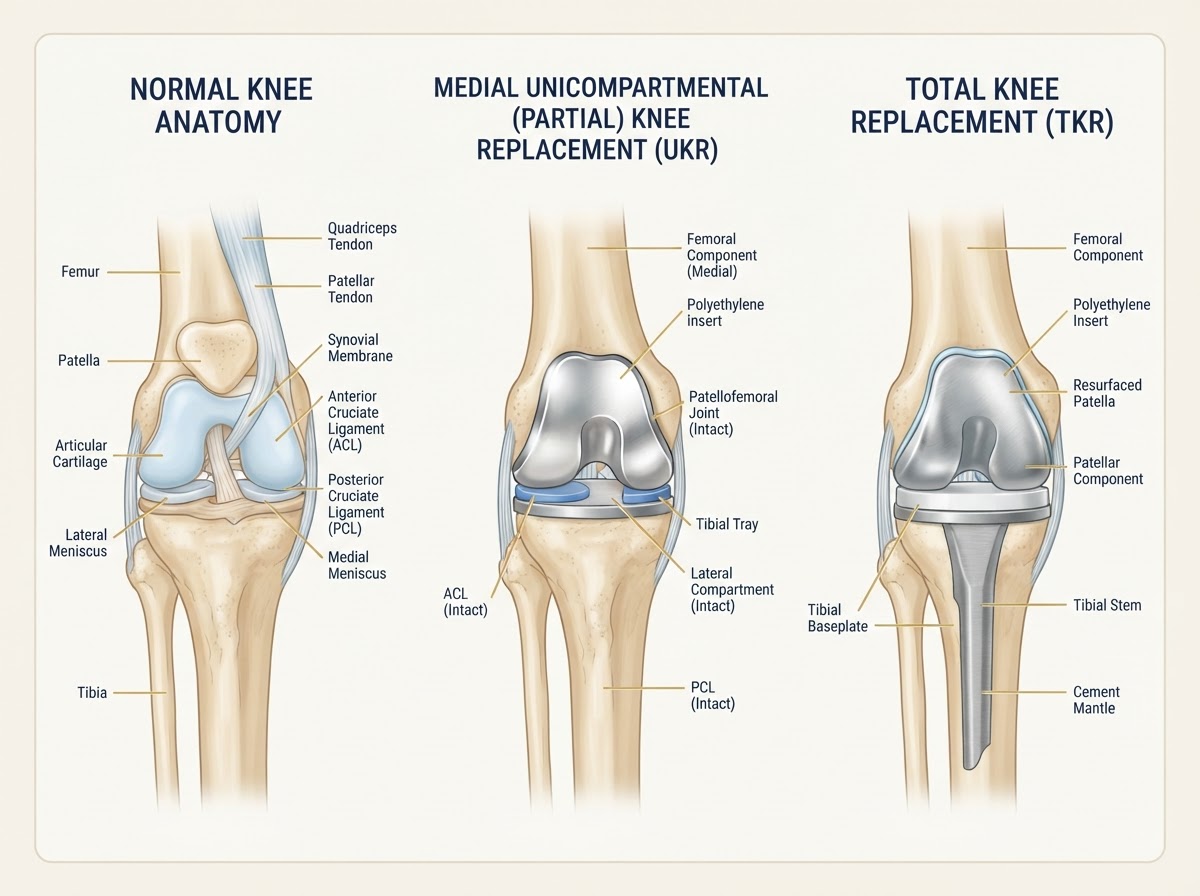
Knee replacement is one of the most reliable operations in orthopaedic surgery for advanced knee osteoarthritis, but it is not a single operation: the knee can be replaced completely (total knee replacement) or only in the part that is worn out (partial or unicompartmental knee replacement). Patients often ask which is better, but the honest answer is that neither is universally superior. The right choice depends on which compartments of your knee are affected, the condition of your ligaments, your anatomy and your functional needs — not on a general preference for the smallest or the largest operation. This article explains the differences between total and partial knee replacement honestly — covering the operations, who is suitable for each, recovery, complications, implant survival and what the scientific evidence actually shows — so you can understand why the decision is individualised to your knee.
Understanding knee replacement options
Knee osteoarthritis does not always affect the entire joint. In many people the wear is concentrated in one compartment — most often the medial (inner) side — while the rest of the knee remains comparatively healthy. Because the disease can be focal or widespread, more than one surgical option exists. A total knee replacement resurfaces the whole joint, while a partial (unicompartmental) knee replacement resurfaces only the worn compartment and leaves the healthy compartments alone. Neither is a universally better operation: each addresses a different pattern of disease, and the choice depends on which parts of your knee are affected, the state of your ligaments, your anatomy and your goals. Understanding that the options exist — rather than assuming there is one best knee replacement — is the first step to understanding why the decision is individualised and why a specialist assessment is needed.
Knee anatomy and osteoarthritis
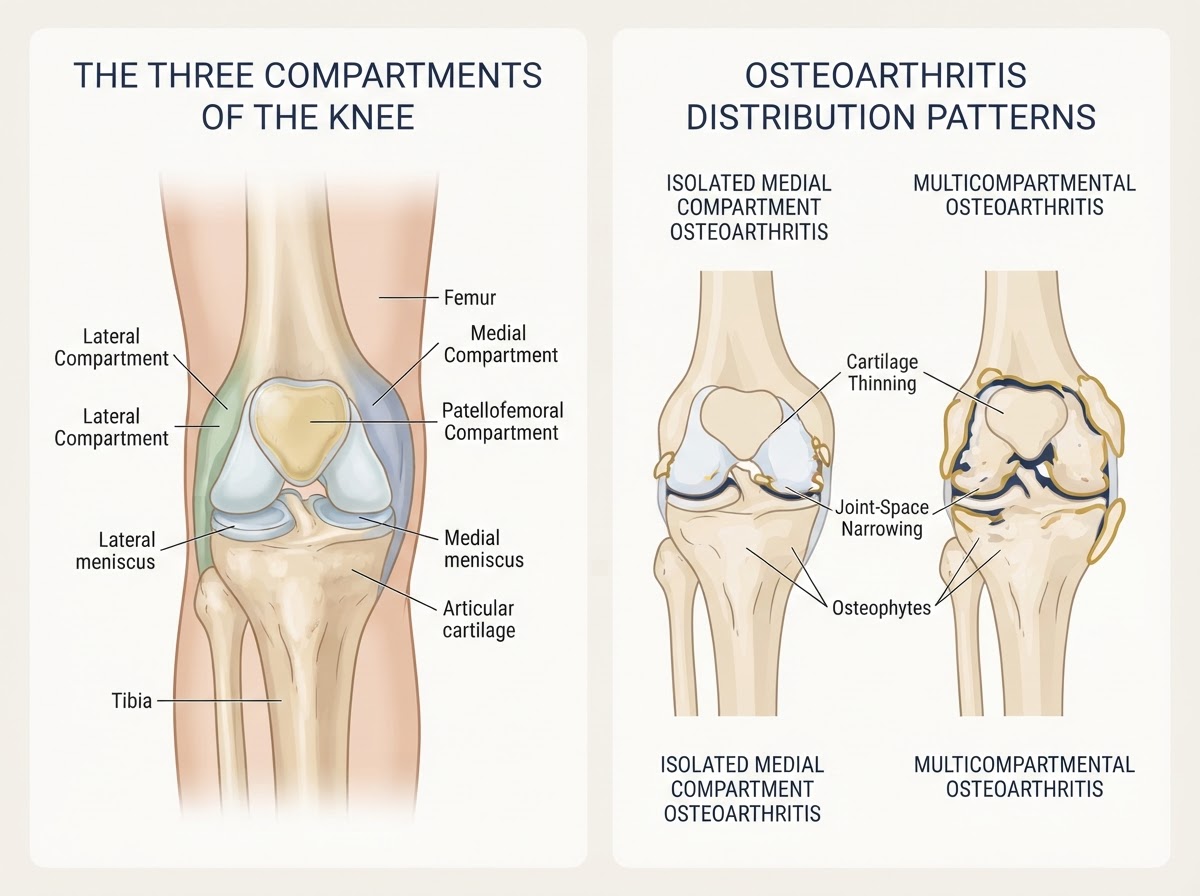
The knee has three compartments: the medial compartment (the inner side, between the femur and tibia), the lateral compartment (the outer side) and the patellofemoral compartment (behind the kneecap, where the patella meets the femur). Each is lined with articular cartilage, the smooth surface that allows the joint to glide, and separated by the menisci. In osteoarthritis that cartilage thins and wears, the joint space narrows, the bone beneath stiffens and bone spurs (osteophytes) form. The key distinction for surgery is whether the disease is isolated to one compartment or involves several. Isolated medial compartment osteoarthritis — one worn compartment with healthy lateral and patellofemoral compartments — is the classic pattern that may suit a partial replacement. Multicompartmental disease, where two or three compartments are affected, usually favours a total replacement. Imaging findings must be read together with your symptoms and an examination, because not every worn compartment on an X-ray needs surgery, and the decision is not made on imaging alone.
What is a total knee replacement?
A total knee replacement (total knee arthroplasty) resurfaces all three compartments of the knee. The damaged bone surfaces of the femur and tibia are prepared and replaced with metal components, a plastic (polyethylene) insert sits between them as the new bearing surface, and the patella may be resurfaced when indicated. The operation removes the worn cartilage surfaces throughout the knee and replaces them with a stable, artificial joint. It is indicated when osteoarthritis affects multiple compartments, when there is significant deformity or ligament insufficiency that a partial replacement would not address, and when a partial replacement would leave diseased compartments behind. Total replacement is one of the most performed and studied operations in orthopaedic surgery and has a long, well-documented track record. The aim is a reliable, durable joint that relieves pain and restores function in advanced disease, with components chosen and positioned to suit your anatomy.
What is a partial (unicompartmental) knee replacement?
A partial or unicompartmental knee replacement (unicompartmental knee arthroplasty) resurfaces only the compartment that is worn — most often the medial compartment — while preserving the healthy compartments and more of the native knee. The implant is smaller: a metal femoral component and a metal tibial tray with a polyethylene insert sit in the diseased compartment, and the cruciate ligaments and the opposite side of the joint are left intact where suitable. The concept is to treat the worn part of the knee and keep the rest working as it is, which can retain more normal knee mechanics in appropriately selected patients. It is not simply a smaller version of a total replacement; it is a different operation with different indications. Because it relies on the remaining compartments being healthy and the ligaments being stable, it is best suited to isolated compartment disease, and candidacy has to be confirmed by an individual clinical and radiological assessment rather than assumed from a desire for a less invasive operation.
Total vs partial: key differences
The clearest way to understand the difference is to compare the two operations directly. The table below summarises the main features; it is educational, not a recommendation of one operation over the other. | Feature | Total knee replacement | Partial (unicompartmental) knee replacement | |---|---|---| | Extent of replacement | All three compartments | Only the diseased compartment | | Preservation of native structures | More extensive bone and cartilage removal | Preserves healthy compartments and more native structures | | Surgical approach and complexity | Resurfaces the whole joint | Smaller implant, compartment-specific; technically demanding in its own way | | Hospital stay | Often short; varies | Often short; sometimes shorter in selected patients | | Early recovery | Reliable; varies | Potentially faster early recovery in some patients | | Range of motion and function | Reliable, well-studied | Can feel more natural in appropriately selected patients | | Complications | Established complication profile | Different profile; can include progression in unreplaced compartments | | Revision and implant survival | Historically lower revision in several registries | Historically higher revision in several registries | The key message is that the operations differ in what they replace and in their considerations, but neither is automatically better. The decision follows assessment of your knee, not a rule that the smallest operation is best.
Who is suitable for partial knee replacement?
Suitability for a partial knee replacement depends on whether your disease is genuinely isolated and whether the rest of the knee is healthy and stable. The main considerations are: predominantly isolated compartment osteoarthritis, most often medial, with the lateral and patellofemoral compartments in good condition; the condition of the remaining compartments, since a partial replacement left beside diseased compartments risks ongoing symptoms; ligament stability, including an intact and functional anterior cruciate ligament, because the operation preserves ligaments rather than replacing them; deformity and whether it is correctable, since very stiff or severe coronal deformity can be difficult to balance with a partial implant; range of motion, as marked stiffness can affect the result; correlation between your symptoms and the imaging, so that the worn compartment on the scan is the one actually causing your pain; and your expectations and activity, since the operation should match what you want to do afterwards. Candidacy is not assumed from the wish for a smaller operation: it requires an individual clinical and radiological assessment, and not every knee with one worn compartment is suitable.
When is total knee replacement more appropriate?
A total knee replacement is generally more appropriate when the disease is not confined to one compartment. This includes multicompartmental osteoarthritis, where two or three compartments are worn; significant disease involving the patellofemoral joint alongside other compartments; relevant deformity or stiffness that a partial implant cannot balance; ligament insufficiency, because a partial replacement depends on intact, functioning ligaments; and situations where a partial replacement would leave diseased compartments behind and the knee would continue to cause symptoms. In these cases a total replacement addresses the whole joint rather than treating one part and leaving the rest untreated. The decision is not a sign that the bigger operation is better in general; it reflects that the pattern of disease and the state of the ligaments make a partial replacement the less appropriate option for that knee.
Advantages and limitations of partial knee replacement
Potential advantages of a partial knee replacement include preservation of healthy structures, because the unaffected compartments and more of the native knee are kept; less extensive bone resection, which can matter if revision is ever needed later; a potentially faster early recovery in some patients; and knee mechanics that can feel more natural in appropriately selected patients, since the ligaments and the opposite compartment keep working. These are real benefits, but they are not guaranteed and apply to suitable candidates. The limitations are equally important. The operation is technically demanding: the implant has to be precisely sized and aligned, and the preserved compartments have to be genuinely healthy. The main limitation is progression of osteoarthritis in the unreplaced compartments, which can cause symptoms later and may lead to conversion to a total replacement. Partial replacement is best understood as an excellent option for the right knee, not a universally superior or inherently safer one.
Advantages and limitations of total knee replacement
The advantages of a total knee replacement lie in its role in advanced multicompartmental disease and its very well-established track record. Because it resurfaces all the compartments, it addresses the whole joint and is not exposed to the same risk of progression in a remaining compartment. Its outcomes, complications and revision rates are among the best studied in all of surgery, which gives patients and surgeons a clear picture of what to expect. The limitations relate to the more extensive nature of the operation: more bone is removed, the recovery can be more demanding, and the knee mechanics are less native than those of a well-functioning partial replacement. A total replacement is not better simply because it is larger; it is appropriate when the disease is extensive or the ligaments are not suitable for a partial replacement. As with any implant, it carries a revision risk over time, and the components are chosen and positioned for the individual knee.
What does the scientific evidence show?
The evidence comparing total and partial knee replacement comes from randomised controlled trials, systematic reviews, meta-analyses and large registry studies, and it is important not to oversimplify it. The TOPKAT trial — a multicentre randomised controlled trial comparing total and partial knee replacement for medial compartment osteoarthritis — reported similar clinical outcomes at five years, with no clear advantage to either operation, and similar reoperation and complication rates; its ten-year follow-up, published in 2026, again reported similar clinical outcomes and similar revision rates by allocated treatment, while finding partial replacement more cost-effective. A systematic review and meta-analysis of patient-relevant outcomes reported that partial replacement can offer advantages in some patient-reported outcomes and potentially faster early recovery. On the other hand, several large registry comparisons have historically shown higher revision rates after unicompartmental arthroplasty than total arthroplasty, partly because progression in unreplaced compartments can lead to reoperation. The AAOS Clinical Practice Guideline on the surgical management of knee osteoarthritis similarly notes improved short-term patient-reported and functional outcomes with partial replacement, while long-term revision rates may be higher. The honest reading is that partial replacement can offer advantages in early recovery and some functional outcomes in appropriately selected patients, that total replacement has historically shown lower revision rates in several registries, and that outcomes depend on patient selection, surgical expertise, implant factors and follow-up duration — not on one operation being categorically better.
Recovery: total vs partial knee replacement
Recovery after both operations shares principles: early mobilisation, pain management, physiotherapy, progressive return to walking and daily activities, and long-term rehabilitation. Some studies report a faster early recovery after partial knee replacement — shorter hospital stay, earlier walking and earlier return to function in the first weeks — though these differences are not found in every study and tend to narrow over time. After a total replacement, the early phase can be more demanding because more of the knee has been resurfaced, but patients generally regain reliable function over the rehabilitation period. How long recovery takes depends on many factors: which operation you had, your fitness before surgery, the state of your tissues, the rehabilitation protocol and any complications. It is not honest to give a rigid recovery promise or a guaranteed return-to-sport date. Walking aids are used for a short period, driving returns once you can control the knee safely, and return to work depends on the demands of your job. Your recovery follows your surgeon's individualised protocol, and milestones are set after assessment of your knee and your operation.
Implant longevity and revision surgery
Implant longevity is not a single number that applies to everyone. It depends on the implant design, the bearing surface, fixation, component positioning, your activity and weight, the surgical technique and follow-up duration, and it differs between total and partial replacement. Historically, large national registries have reported higher revision rates after unicompartmental (partial) knee arthroplasty than after total knee arthroplasty, and a reason is progression of osteoarthritis in the unreplaced compartments rather than failure of the implant itself. The TOPKAT ten-year randomised follow-up, by contrast, reported similar revision rates by allocated treatment, which illustrates that trial and registry evidence can differ because they measure different populations and durations. It is important to distinguish revision (a further operation to replace or revise the implant) from reoperation (any further surgery, which may be for a different reason). A single survival percentage quoted without its source, population, implant and follow-up period is misleading. Partial replacement has the potential advantage that conversion to a total replacement can be more straightforward than revising a failed total replacement, but this depends on the case. Your surgeon can give a realistic picture for your knee rather than a generic lifespan figure.
Questions to ask your orthopaedic surgeon
A consultation is the right place to understand how the choice applies to your knee. Practical questions include: Which compartments of my knee are affected, and how severely? Are my ligaments — including the anterior cruciate ligament — suitable for a partial replacement, or do they favour a total replacement? Why do you recommend one procedure rather than the other for my knee? What are the expected benefits and limitations of each in my case? What is your experience and outcome with each procedure you perform? What happens if osteoarthritis progresses in the parts of the knee that were not replaced? These questions help you understand the individualised reasoning behind a recommendation, and a surgeon who explains the choice in terms of your anatomy, your ligaments and your goals is giving you the most useful information — not a claim that one operation is universally best.
Conclusion: choosing the right knee replacement
The objective is not to perform the smallest operation or the largest operation, but to select the procedure that best addresses your pathology and functional needs. Total and partial knee replacement are both established, reliable operations for the right knee. Partial replacement can offer advantages in early recovery and some functional outcomes in appropriately selected patients; total replacement has a long-established track record and historically lower revision rates in several registries; the TOPKAT ten-year randomised follow-up reported similar clinical outcomes and similar revision rates by allocated treatment. Outcomes depend on patient selection, surgical expertise, implant factors and follow-up duration. A specialist assessment — weighing which compartments are affected, the state of your ligaments, your anatomy and your goals — is the way to determine which knee replacement is right for you, not a general rule that one is better.
The bottom line: the right replacement is the right one for your knee
Neither total nor partial knee replacement is universally superior. Total and partial (unicompartmental) knee replacement are both established operations, and the right choice depends on which compartments of your knee are affected, the condition of your ligaments, your anatomy and your functional needs. Partial replacement can offer advantages in early recovery and some functional outcomes in appropriately selected patients; total replacement has historically shown lower revision rates in several registries; the TOPKAT ten-year randomised follow-up reported similar clinical outcomes and similar revision rates by allocated treatment. Outcomes depend on patient selection, surgical expertise, implant factors and follow-up duration. A specialist consultation is the way to determine which knee replacement is right for you.
References & scientific evidence
- Beard DJ et al.. The clinical and cost-effectiveness of total versus partial knee replacement in patients with medial compartment osteoarthritis (TOPKAT): a randomised controlled trial.. The Lancet, 2019.Randomised controlled trialDOI: 10.1016/S0140-6736(19)31281-4View source
- Beard DJ et al.. Assessing clinical and cost effectiveness of total versus partial knee replacement (TOPKAT): 10-year follow-up of a multicentre, randomised controlled trial.. The Lancet Rheumatology, 2026.Randomised controlled trialDOI: 10.1016/S2665-9913(25)00250-4View source
- Wilson HA et al.. Patient relevant outcomes of unicompartmental versus total knee replacement: systematic review and meta-analysis.. BMJ, 2019.Meta-analysisDOI: 10.1136/bmj.l352View source
- Hu H et al.. Comparative long-term outcomes of unicompartmental and total knee arthroplasty in knee osteoarthritis patients: a systematic review and meta-analysis.. Frontiers in Surgery, 2024.Meta-analysisDOI: 10.3389/fsurg.2024.1405025View source
- Knifsund J et al.. Functional results of total-knee arthroplasty versus medial unicompartmental arthroplasty: two-year results of a randomised, assessor-blinded multicentre trial.. BMJ Open, 2021.Randomised controlled trialDOI: 10.1136/bmjopen-2020-046731View source
- American Academy of Orthopaedic Surgeons. Surgical Management of Osteoarthritis of the Knee — Evidence-Based Clinical Practice Guideline.. American Academy of Orthopaedic Surgeons (AAOS), 2022.Clinical guidelineView source
- Liddle AD et al.. The clinical and cost-effectiveness of total versus partial knee replacement in patients with medial compartment osteoarthritis: 5-year outcomes of a randomised controlled trial (TOPKAT).. The Lancet, 2019.Randomised controlled trialDOI: 10.1016/S0140-6736(19)31281-4View source
- Burn E et al.. The association between unicompartmental knee replacement and patient-reported outcomes: a cohort study from the National Joint Registry.. BMJ Open, 2022.Observational studyDOI: 10.1136/bmjopen-2021-059553View source
- Evans JT et al.. How long does a knee replacement last? A systematic review and meta-analysis of case series and national registry reports.. The Lancet Rheumatology, 2019.Meta-analysisDOI: 10.1016/S2665-9913(19)30025-7View source
Frequently asked questions

Dr. Pablo Banchero Lasalvia
Orthopaedic Surgeon · Traumatology Team
- Author:
- Dr. Pablo Banchero Lasalvia
- Medical reviewer:
- Dr. Pablo Banchero Lasalvia
- Published:
- 1 November 2026
- Medical review date:
- 1 November 2026
- ·
- 16 min read
Book Your Consultation via WhatsApp
Request a private orthopaedic assessment with Dr Pablo Banchero to discuss whether total or partial knee replacement is right for your knee on the Costa Blanca.
Official number: +34 602 99 22 22