
Knee replacement can substantially improve pain, stiffness and function in advanced knee osteoarthritis, and for many people it is a genuinely life-changing operation. Recovery, however, is progressive rather than instantaneous, and it varies considerably between patients. A common expectation is that there is one recovery time for knee replacement, but in reality the timeline depends on which operation you had, your general health, your strength before surgery, the rehabilitation you do and whether any complications occur. This guide walks through recovery week by week so you can anticipate the milestones — walking further, relying less on aids, returning to driving, work and activity — while understanding that these are general expectations rather than guaranteed deadlines. For international residents and visitors on the Costa Blanca considering or recovering from knee replacement — whether in Torrevieja, Alicante, Orihuela Costa or La Zenia — realistic information helps you plan and avoid both overdoing it and holding back unnecessarily.
Introduction
Knee replacement is one of the most reliable operations in orthopaedic surgery for advanced knee osteoarthritis, and for many people it restores comfort and mobility that arthritis had taken away. But recovery is a progressive process that unfolds over weeks and months, not days, and it varies considerably between patients. People often ask how long knee replacement recovery takes, but there is no single answer: it depends on which operation you had, your general health, the strength and mobility you started with, the rehabilitation you do and whether any complications occur. This guide describes recovery week by week so you can anticipate the milestones — walking further, relying less on aids, returning to driving, work and sport — while understanding that these are general expectations, not guaranteed deadlines. For international residents and visitors on the Costa Blanca — in Torrevieja, Alicante, Orihuela Costa or La Zenia — planning or recovering from knee replacement, realistic information helps you pace your recovery and ask the right questions.
What happens during knee replacement?
Understanding recovery is easier once you understand the operation. A total knee replacement resurfaces all three compartments of the knee with metal and plastic components, while a partial (unicompartmental) knee replacement resurfaces only the worn compartment and preserves the healthy parts — we explore that distinction in detail in our article on total versus partial knee replacement. During surgery the damaged cartilage surfaces are removed, the bone ends are prepared and the implant components are fixed in place, with the patella resurfaced when indicated. Most knee replacements are performed under spinal or general anaesthesia, often within an enhanced-recovery approach that controls pain and encourages early movement. The extent of the operation is one of several factors that shape the early recovery: because a partial replacement preserves more of the native knee, some patients mobilise a little earlier, while a total replacement resurfaces more of the joint and can make the first weeks more demanding. Neither guarantees a particular recovery speed on its own.
What to expect immediately after surgery
After the operation you wake in a recovery area, where nurses monitor your blood pressure, pulse, oxygen levels and pain. Pain control usually follows a multimodal plan — a combination of regular paracetamol, an anti-inflammatory, a nerve-sparing technique and stronger medication if needed — so pain is kept manageable rather than chased once it becomes severe. Your knee has a dressing, the wound is checked for bleeding, and the joint is iced and elevated. Medication to reduce the risk of a blood clot, together with early movement and compression, helps prevent clots. Mobilisation is normally encouraged as soon as it is clinically appropriate — often on the day of or the day after surgery — because getting up and moving safely reduces complications. Discharge planning starts immediately: the team confirms you can move safely, control your pain and manage at home before you leave, which is why hospital stays after knee replacement are often short.
The first 24–48 hours
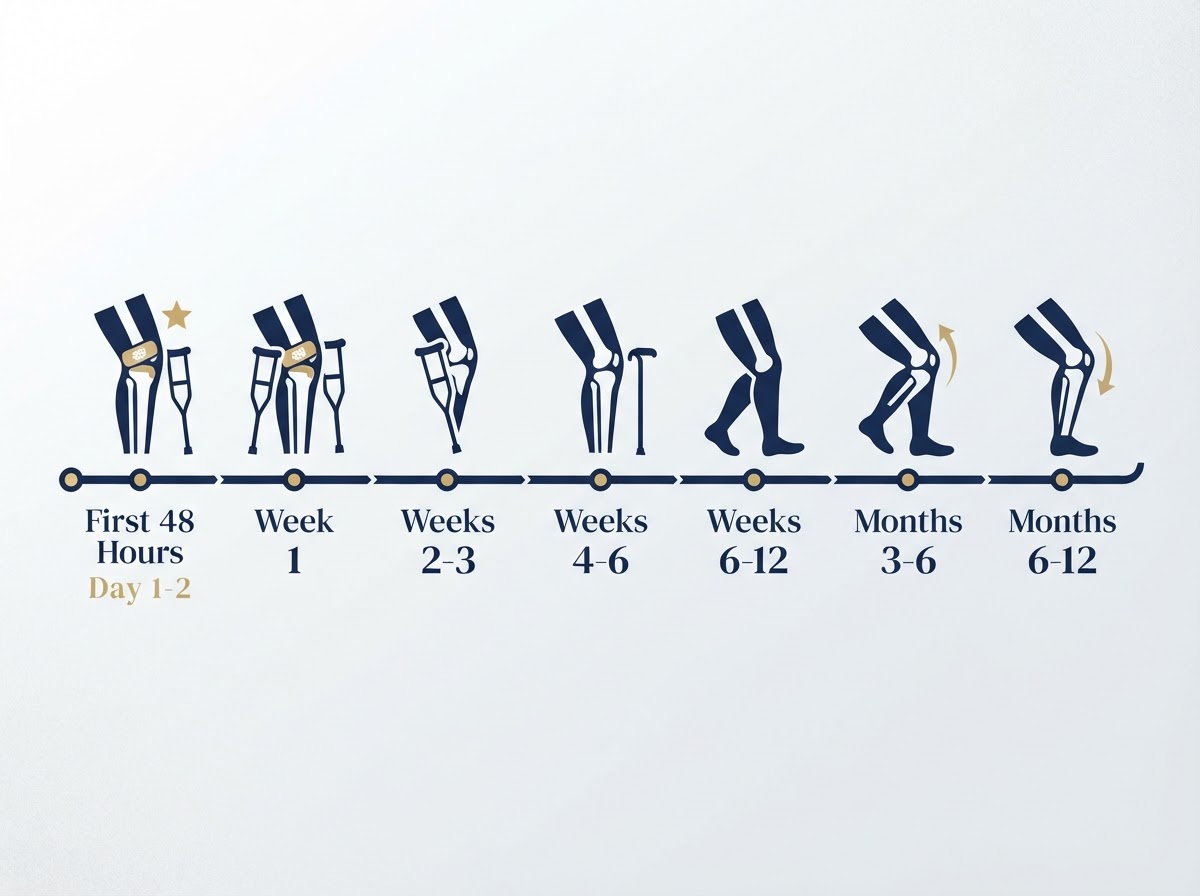
In the first day or two the aim is safe, assisted movement rather than distance. You will usually stand and take a few steps with a walking frame or crutches, helped by a physiotherapist, and begin gentle knee exercises to regain bend and reduce stiffness. Walking is the priority, but so is learning to get in and out of bed and to sit and stand safely — the transfers that people often underestimate. Pain and swelling are at their most noticeable now, and the medication, ice and elevation you are advised to use are there to keep both controlled so you can move. You are not expected to walk normally or to climb stairs independently at this stage; the goal is supervised, safe mobilisation. This early phase sets the tone for the rest of recovery, but it is also the most uncomfortable, and it improves steadily over the following days.
Week 1: the early recovery phase
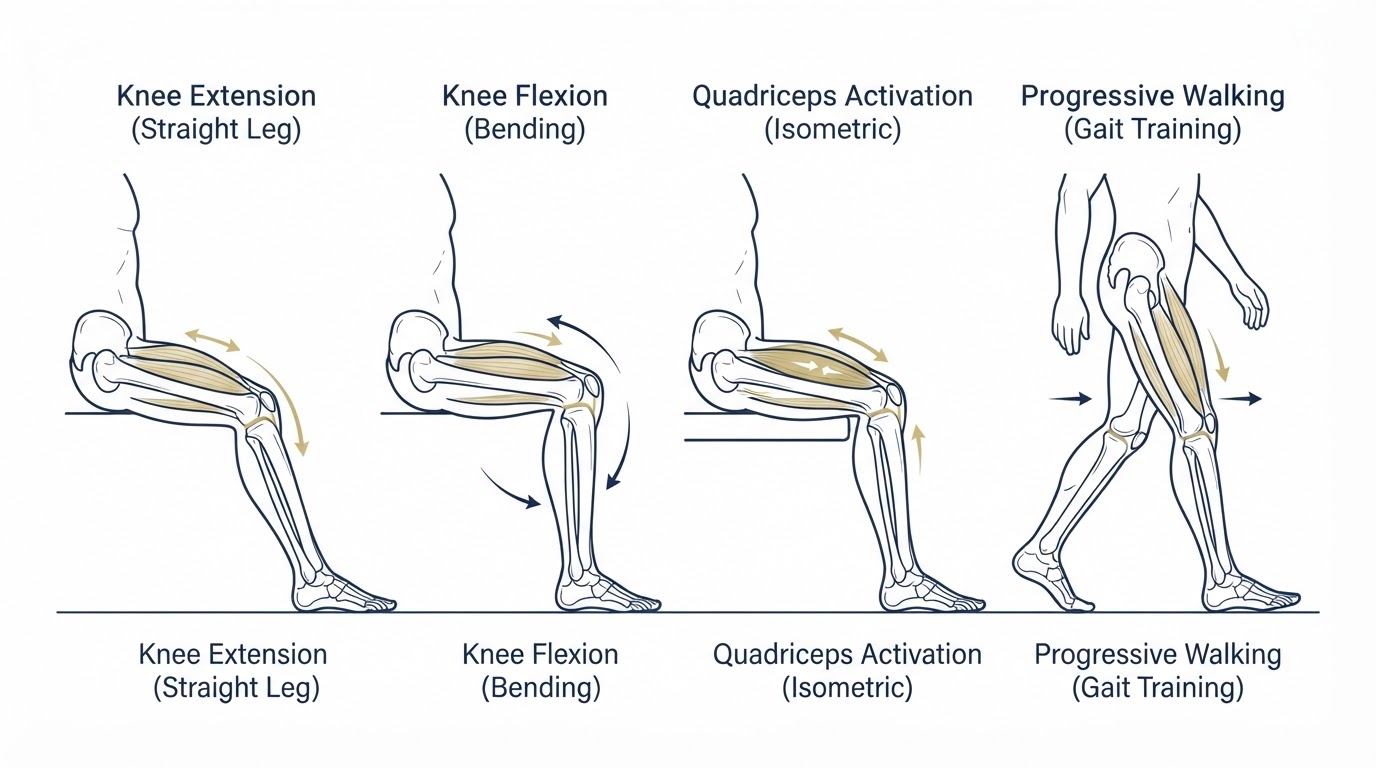
Through the first week you gradually walk short distances with an appropriate aid, usually crutches or a frame, concentrating on a smooth, controlled step rather than distance. The wound is kept clean and dry under its dressing, and you are shown how to check for increasing redness, discharge or warmth. Swelling and bruising around the knee and into the lower leg are normal and settle over the first couple of weeks; regular rest with the leg elevated helps. Your prescribed knee exercises — bending, straightening, quadriceps activation — are done several times a day in short sets. Rest matters as much as exercise: the knee recovers between sessions, and overdoing it tends to increase swelling and discomfort rather than speed healing. The single most important habit this week is following the individual rehabilitation plan you have been given, rather than adding extra activity on your own initiative.
Weeks 2–3: building confidence
By the second and third week mobility improves noticeably. Walking distance increases, the gait becomes steadier, and you can usually move around the house with more confidence, though you may still use one crutch or a stick outdoors. Physiotherapy progresses from bed-based exercises to standing and walking work, with attention to range of motion — regaining bend and fully straightening the knee — and to activating the quadriceps, the muscles on the front of the thigh that control the knee. Stairs become a practical goal when your balance and strength allow, starting with a technique that protects the operated leg. Persistent swelling and a deep ache after activity are still common and are not a sign of something going wrong; they reflect the ongoing healing of the tissues around the implant. Progress is steady but rarely linear — some days feel better than others.
Weeks 4–6: improving strength and mobility
Over weeks four to six the focus shifts toward strength and quality of movement. Walking continues to improve and you can often reduce your dependence on walking aids when it is safe to do so, though this is guided by your balance and control rather than the calendar. Functional exercises — sit-to-stand, step-ups, balance work — build the strength needed for everyday activities. Improving knee flexion (bend) and, equally important, full extension (straightening) remains a priority, because a knee that does not straighten fully can feel stiff and affect your gait. Most people are managing most daily activities by this point — dressing, walking for errands, light household tasks — but with some residual fatigue. Individual variation is substantial: two people with the same operation can be at quite different points at six weeks, and both can be recovering normally.
Weeks 6–12: returning to daily activities
From six to twelve weeks independence increases markedly. Longer walks become comfortable, strengthening progresses, and many people return to selected activities they had paused before surgery. Improvement in function usually continues through this window rather than stopping at a fixed date — the twelve-week mark is a milestone, not a deadline, and the knee is not necessarily finished recovering at twelve weeks. Some activities are resumed gradually and in a structured way, guided by your recovery and your surgeon's and physiotherapist's advice. Residual mild swelling after long days is still possible and generally settles with rest and elevation. The emphasis moves from 'recovering from the operation' to 'getting back to life', but the knee keeps adapting and strengthening for months.
Months 3–6 and beyond
Between three and six months, strength and endurance continue to improve, and many people feel the knee is becoming more natural and less of a 'feature' of daily life. Functional adaptation — how you trust and use the knee on stairs, on uneven ground, when tired — develops over this period. Some residual swelling or stiffness persists in a minority of patients, particularly after heavy days, and is usually not a concern, but it is worth mentioning at follow-up. Recovery after knee replacement can continue for six to twelve months and sometimes longer, with gradual gains in strength and confidence. Long-term expectations are generally good — relief of the arthritic pain and improved function — but the knee is an artificial joint with its own considerations, and how it behaves long-term depends on your activity, your weight and the implant as much as on the early recovery.
Physiotherapy: what really matters?
Physiotherapy is central to recovery, but there is no single protocol that suits every patient — it should be individualised. The elements that matter are range of motion (regaining bend and full straightening), quadriceps and hip strengthening (the muscles that control and stabilise the knee), gait retraining (walking with a normal pattern rather than favouring the leg), balance and functional exercises (stairs, steps, turns), and a home exercise programme you continue consistently. Consistency matters more than intensity: regular, correct practice builds the strength and confidence the knee needs, while excessive overtraining tends to increase swelling and set progress back. Your physiotherapist progresses the programme according to your knee, not to a generic timetable, and the exercises you are given at the start evolve as you recover. The aim is a knee that works in your life, not one that meets a textbook range-of-motion number.
Pain, swelling and sleep
Some pain, swelling and disturbed sleep are part of normal recovery and are worth understanding so they do not cause unnecessary worry. Postoperative pain is most noticeable in the first week or two and gradually eases; it should be improving rather than worsening as the weeks pass. Swelling around the knee and into the lower leg, with some bruising, is common and settles over the first weeks; the knee may also swell more after a long active day. Night discomfort and waking to move the knee happen because the joint is stiff after inactivity. Practical management combines elevation when resting, a sensible balance of activity and rest, the medication you have been prescribed, and ice when appropriate and advised. Pain that is clearly worsening rather than improving, or that is not controlled by the plan you have been given, should be discussed with your team.
When can I drive again?
When you can drive again depends on several things, so there is no universal fixed date. Key factors are which leg was operated on, whether you drive an automatic or a manual car, your reaction time and your ability to perform an emergency stop safely, your mobility and pain, and whether you are taking medication that can impair driving. The medical and legal or insurance requirements in your country also apply, and some insurers specify a minimum period. As a general principle, driving returns once you can control the car safely and react quickly, and are no longer reliant on medication that affects alertness — for many people this is somewhere in the weeks after surgery, but it is individual. Your surgeon can advise on the timing that is appropriate for your case, and it is sensible to confirm this before getting back behind the wheel.
When can I return to work, travel and sport?
Return to work, travel and sport is staged according to the demands of each and your recovery. Sedentary work can often resume within a few weeks, while physically demanding work may take several months and depends on the tasks involved. Air travel after surgery requires planning: long flights carry a clot risk in the early weeks, so timing and precautions such as moving during the flight, hydration and compression are discussed with your surgeon, and most surgeons advise waiting before flying long-haul. For sport, walking and swimming usually return early once the wound is healed; cycling and golf follow once strength and range allow; low-impact exercise is generally encouraged; high-impact or contact activities are usually discouraged because they can increase wear and the risk of problems. For international patients travelling to or from Spain for surgery, planning follow-up and recovery around the flight is part of the conversation. There is no guaranteed date for any of these — timing depends on your recovery, your clinical progress and your surgeon's advice.
Warning signs: when to seek medical attention
Most of what happens in recovery is normal and settles, but certain symptoms warrant prompt medical assessment, and it helps to know the difference. Contact your team for: increasing wound redness, discharge or spreading warmth, a fever, or a wound that opens; pain that is clearly worsening rather than gradually improving; significant calf pain or new, asymmetric swelling of one calf, which can indicate a clot; and a sudden deterioration in knee function, such as the knee giving way or new severe pain. Two symptoms need emergency assessment rather than a routine call: sudden shortness of breath or chest pain, which can indicate a clot on the lung and requires immediate care. These warning signs are uncommon, and raising them early is the right thing to do — recovery is generally smooth, but being alert to them is part of a safe recovery.
What influences recovery?
Recovery varies because it is shaped by many factors. Age and general health, and conditions such as diabetes, influence healing. Preoperative mobility and muscle strength matter: people who go into surgery stronger and more mobile tend to recover more readily. Weight and metabolic health affect both healing and the load the new joint bears. Previous knee surgery can change the tissue quality and the approach. The type of implant and the surgical technique play a role, but no single approach or implant guarantees faster recovery — the difference is usually smaller than the difference between patients. Adherence to rehabilitation is among the most important controllable factors. Complications, if they occur, can slow recovery. And there is simply individual biological variation — two similar patients can recover at different speeds. Understanding this is why your timeline is individualised rather than read off a chart.
Conclusion: a realistic recovery timeline
The milestones below summarise a typical recovery; they are general expectations, not guaranteed deadlines, and your own timeline depends on the factors above and on your surgeon's individualised protocol. | Phase | Typical milestones | |---|---| | First 48 hours | Assisted standing and short walks with a frame; pain and swelling control | | Week 1 | Walking short distances with an aid; wound care; regular exercises; rest and elevation | | Weeks 2–3 | Longer walks; physiotherapy progression; improving range of motion; stairs when appropriate | | Weeks 4–6 | Reducing walking aids when safe; functional strengthening; most daily activities resuming | | Weeks 6–12 | Greater independence; longer walks; returning to selected activities; continued improvement | | Months 3–6 | Strength and endurance building; functional adaptation; residual swelling settling | | Months 6–12 | Ongoing gains; the knee feeling more natural; long-term expectations becoming clear | The message to take away is that knee replacement recovery is a progressive process measured in weeks and months, not days, and that the right pace is the one matched to your knee, your operation and your goals. If you are considering or recovering from knee replacement and want individualised guidance, a consultation is the right next step.
The bottom line: recovery is progressive, not instant
Knee replacement can substantially improve pain and function, but recovery unfolds over weeks and months and varies between patients. Early mobilisation, individualised physiotherapy, sensible management of pain and swelling and a staged return to driving, work and activity are the principles that guide it. Milestones are general expectations, not guaranteed deadlines, and your timeline depends on your health, your operation, your rehabilitation and any complications. A specialist consultation with Dr Pablo Banchero is the way to set realistic expectations for your own knee on the Costa Blanca.
References & scientific evidence
- Beard DJ et al.. The clinical and cost-effectiveness of total versus partial knee replacement in patients with medial compartment osteoarthritis (TOPKAT): a randomised controlled trial.. The Lancet, 2019.Randomised controlled trialDOI: 10.1016/S0140-6736(19)31281-4View source
- Beard DJ et al.. Assessing clinical and cost effectiveness of total versus partial knee replacement (TOPKAT): 10-year follow-up of a multicentre, randomised controlled trial.. The Lancet Rheumatology, 2026.Randomised controlled trialDOI: 10.1016/S2665-9913(25)00250-4View source
- Evans JT et al.. How long does a knee replacement last? A systematic review and meta-analysis of case series and national registry reports.. The Lancet Rheumatology, 2019.Meta-analysisDOI: 10.1016/S2665-9913(19)30025-7View source
- Wilson HA et al.. Patient relevant outcomes of unicompartmental versus total knee replacement: systematic review and meta-analysis.. BMJ, 2019.Meta-analysisDOI: 10.1136/bmj.l352View source
- Knifsund J et al.. Functional results of total-knee arthroplasty versus medial unicompartmental arthroplasty: two-year results of a randomised, assessor-blinded multicentre trial.. BMJ Open, 2021.Randomised controlled trialDOI: 10.1136/bmjopen-2020-046731View source
- Hu H et al.. Comparative long-term outcomes of unicompartmental and total knee arthroplasty in knee osteoarthritis patients: a systematic review and meta-analysis.. Frontiers in Surgery, 2024.Meta-analysisDOI: 10.3389/fsurg.2024.1405025View source
- American Academy of Orthopaedic Surgeons. Surgical Management of Osteoarthritis of the Knee — Evidence-Based Clinical Practice Guideline.. American Academy of Orthopaedic Surgeons (AAOS), 2022.Clinical guidelineView source
- National Institute for Health and Care Excellence. Osteoarthritis in over 16s: assessment and management. NICE guideline CG177.. National Institute for Health and Care Excellence (NICE), 2014.Clinical guidelineView source
- National Joint Registry for England, Wales, Northern Ireland and the Isle of Man. National Joint Registry Annual Report — hip and knee arthroplasty outcomes and revision rates.. National Joint Registry (NJR), 2024.Observational studyView source
Frequently asked questions
Dr. Pablo Banchero Lasalvia
Orthopaedic Surgeon · Traumatology Team
- Author:
- Dr. Pablo Banchero Lasalvia
- Medical reviewer:
- Dr. Pablo Banchero Lasalvia
- Published:
- 1 November 2026
- Medical review date:
- 1 November 2026
- ·
- 18 min read
Book Your Consultation via WhatsApp
Request a private orthopaedic assessment with Dr Pablo Banchero to discuss your knee replacement recovery or treatment options on the Costa Blanca.
Official number: +34 602 99 22 22