
For the great majority of patients, knee replacement is a safe, reliable operation that relieves pain and restores mobility for many years. Yet, like any major surgical procedure, it carries risks. Understanding those risks — distinguishing the normal, temporary symptoms of healing from genuine complications — helps you make an informed decision, prepare properly and recognise when to seek help. This article reviews the main complications that can follow total or partial knee replacement, what current scientific evidence and joint registries report, which patient and surgical factors influence risk, and what you and your surgical team can do to reduce it. It is written for people considering knee replacement on the Costa Blanca — including patients in Alicante, Torrevieja and Orihuela Costa — and for international residents seeking an English-speaking orthopaedic assessment in Spain.
Introduction: understanding the risks of knee replacement surgery
Knee replacement (knee arthroplasty) is one of the most common and successful elective orthopaedic operations performed worldwide. National registry data show that the overwhelming majority of patients experience lasting pain relief and improved function. However, no operation is entirely without risk. Complications, when they occur, may range from minor wound-healing delays that settle with simple measures, through to serious problems such as deep infection or blood clots that require urgent treatment. A balanced understanding of the risks is part of informed consent: it does not mean the operation is unsafe, but that you should know what is common, what is rare, what can be prevented, and what to do if a problem arises. This article deliberately separates ordinary postoperative symptoms — swelling, bruising, early discomfort and stiffness — from true complications that require investigation or additional treatment.
How safe is modern knee replacement surgery?
Modern knee replacement is a well-established, routinely audited procedure. Large national registries that track virtually every arthroplasty performed in entire healthcare systems — including the UK National Joint Registry (NJR) and the Australian Orthopaedic Association National Joint Replacement Registry (AOANJRR) — report that the great majority of knee replacements function well over long periods and that serious complications are uncommon. NICE guidance on primary joint replacement (NG157) and the AAOS Clinical Practice Guideline on the surgical management of osteoarthritis of the knee (SMOAK2) both support knee replacement as an effective treatment for advanced symptomatic osteoarthritis when conservative measures have failed. Safety is further improved by contemporary anaesthesia, multimodal pain control, enhanced-recovery pathways and standardised infection-prevention and thromboprophylaxis protocols. That said, overall safety is a population-level statistic; your individual risk profile is what matters and should be discussed with your surgeon.
General risks associated with major surgery and anaesthesia
Knee replacement is major surgery performed under regional or general anaesthesia, so it carries the general risks common to any substantial operation. These include reactions to anaesthetic agents, bleeding requiring transfusion, cardiovascular events (such as arrhythmia, heart attack or stroke) in susceptible patients, urinary retention or urinary tract infection, postoperative nausea and confusion (particularly in older adults), and the rare but serious risks of thromboembolism. Your anaesthetist and surgeon will assess your individual cardiovascular, respiratory and metabolic risk before surgery and may request preoperative tests or ask you to stop or adjust certain medications. For most patients, these general risks are low and carefully managed, but they underline why a thorough preoperative medical assessment is essential rather than optional.
Infection
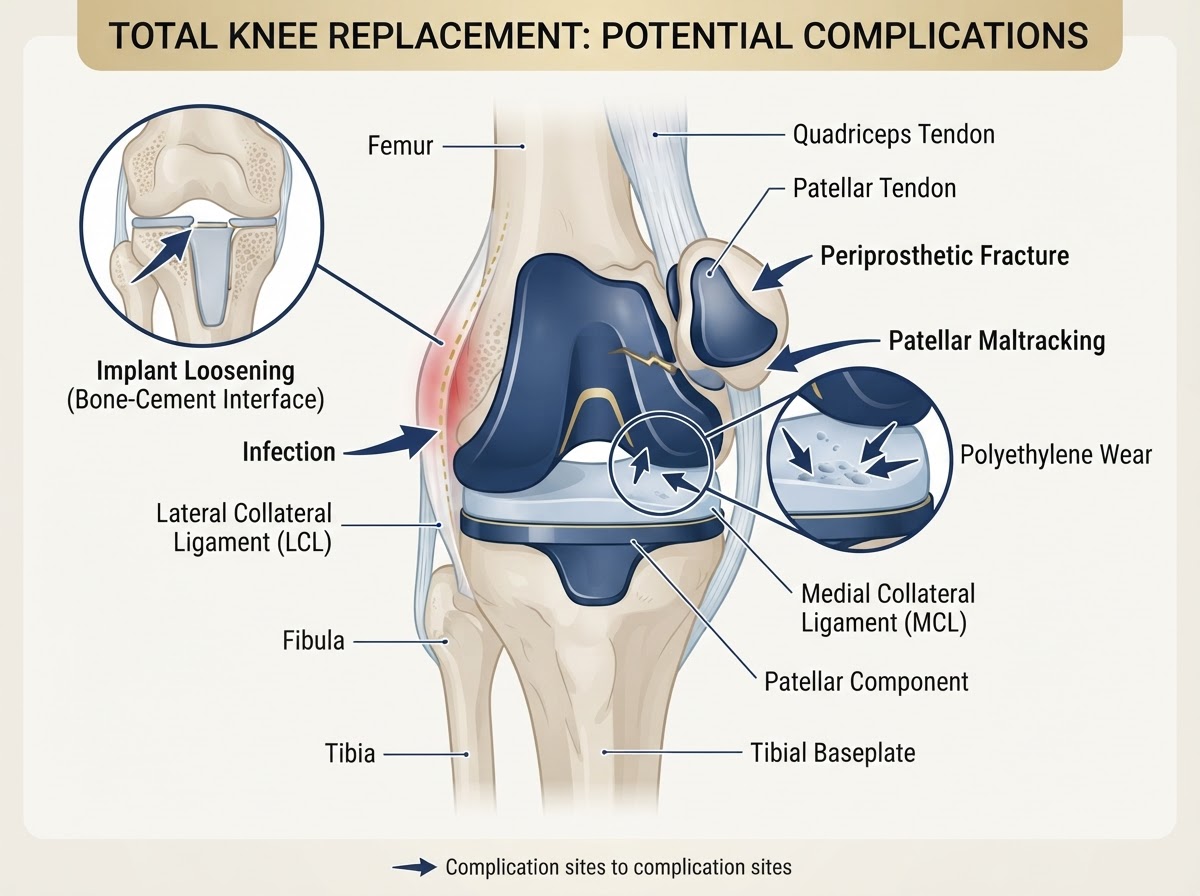
Infection remains one of the most important complications in joint replacement and is classified by depth and timing: * Superficial wound infection: infection confined to the skin and subcutaneous tissues around the incision. Usually managed with local wound care and oral antibiotics, with close monitoring. * Deep periprosthetic joint infection (PJI): infection involving the prosthetic components and surrounding joint space. This is a serious complication that typically requires prolonged intravenous antibiotics and one or more further operations. * Early infection: occurring within the first weeks after surgery, often related to contamination at the time of the operation or wound-healing problems. * Late infection: presenting months or years later, frequently caused by bacteria reaching the bloodstream from distant sources (dental procedures, skin infections, urinary infections) and seeding the implant. Reported infection rates in registry and surveillance studies generally fall in a low single-digit percentage range for primary knee replacement, though exact figures depend on the population, definition of PJI and length of follow-up. Treatment depends on timing and severity: options range from oral or intravenous antibiotics alone, through surgical washout and debridement with modular component exchange, to one- or two-stage revision of the implant. Prevention combines preoperative skin preparation and screening, perioperative antibiotic prophylaxis, ultra-clean airflow theatres and meticulous sterile technique.
Blood clots and pulmonary embolism
Major lower-limb surgery increases the risk of venous thromboembolism (VTE), because both the operation itself and the period of reduced mobility slow blood flow in the deep veins of the leg. The two principal complications are: * Deep vein thrombosis (DVT): a clot in the deep veins, usually of the calf or thigh, causing calf or leg pain, swelling and tenderness. * Pulmonary embolism (PE): a clot that breaks free and travels to the lungs, causing chest pain, breathlessness and — in severe cases — a life-threatening event requiring emergency treatment. NICE and AAOS guidance both recommend risk-stratified thromboprophylaxis. This typically combines mechanical methods (early mobilisation, compression stockings or intermittent pneumatic compression) with pharmacological prophylaxis (blood-thinning medication) tailored to each patient's bleeding and clotting risk. The most effective prevention is early mobilisation: getting moving safely soon after surgery is one of the cornerstones of modern enhanced-recovery pathways. Sudden chest pain, shortness of breath or significant new calf pain and swelling should be treated as an emergency and assessed immediately.
Bleeding, haematoma and wound-healing problems
Some bleeding and bruising around the knee is expected after any knee replacement, and a collection of blood (haematoma) can form beneath the skin. In most cases this is self-limiting and resolves with time, elevation and observation. Wound-healing problems — delayed closure, persistent ooze or skin-edge necrosis — are more likely in patients with diabetes, obesity, smoking, peripheral vascular disease, inflammatory arthritis or poor nutritional status. A problematic wound that does not heal can become the route for deep infection, so wound care is treated seriously: keep the incision clean and dry as instructed, avoid soaking or submerging it, and report persistent drainage, widening redness or separation of the wound edges. Rarely, a large haematoma or ongoing bleeding requires a return to theatre for evacuation, or a blood transfusion if blood counts drop significantly.
Persistent pain after knee replacement
Most patients experience substantial pain relief after knee replacement, but a proportion continue to have pain beyond the expected healing period. The term 'persistent pain' covers several distinct causes that require careful assessment: an unrecognised infection (including low-grade periprosthetic infection), component loosening or malposition, instability, stiffness or arthrofibrosis, referred pain from the hip or spine, and — less commonly — complex regional pain syndrome. It is important to separate this from the normal, gradually settling discomfort of recovery and from the expected rehabilitation course. When pain persists or worsens after an initial period of improvement, a structured workup is indicated: clinical examination, weight-bearing and long-leg radiographs, inflammatory markers (C-reactive protein and erythrocyte sedimentation rate), and — when infection must be excluded — joint aspiration. Not every painful knee after replacement is failing: many patients improve steadily over the first three to six months and continue to gain function for a year or more. As we explore in Article 09, an implant showing minor radiographic changes may still be entirely asymptomatic, while a painful, well-fixed implant can require systematic investigation.
Stiffness and reduced range of motion
Stiffness is one of the most frequently discussed outcomes after knee replacement. In the early weeks, a degree of swelling, discomfort and limited flexion is a normal part of healing and usually improves with guided physiotherapy and a consistent home exercise programme. More troublesome stiffness — sometimes described as arthrofibrosis — is reduced or loss of motion that persists despite rehabilitation. Risk factors include prolonged preoperative stiffness, severe postoperative pain limiting therapy, diabetes, higher body mass index, previous knee surgery and complex primary reconstruction. Management is graded: a well-supervised physiotherapy programme is first-line; manipulation under anaesthesia may be considered in the early months when passive flexion plateaus; and, in resistant cases, arthroscopic or open lysis of adhesions is occasionally indicated. The aim is a functional range — typically enough for daily activities, stairs and comfortable walking — rather than a specific number of degrees that is the same for everyone.
Implant-related complications
Several complications relate to the mechanical performance of the prosthesis itself: * Aseptic loosening: the implant gradually loses its fixation to bone or cement over time, without infection. It may cause progressive aching and is confirmed on radiographs by migration of the component or radiolucent lines at the bone-cement interface. * Polyethylene wear: the plastic bearing surface slowly wears over millions of cycles, producing fine particles that can provoke osteolysis (bone resorption) around the implant. * Instability: a sense of the knee giving way, buckling or being unstable, often due to ligament imbalance or component rotation/malposition. * Implant malposition: components placed in suboptimal alignment can cause abnormal mechanics, early wear, stiffness or instability, and may contribute to earlier revision. These problems tend to develop over years rather than weeks, and are explored in detail in Article 09 on implant longevity. The distinction matters: early postoperative discomfort is usually part of recovery, whereas new pain or instability after a long symptom-free interval warrants assessment for one of these causes.
Patellar complications
The kneecap (patella) and its tracking in the trochlear groove can be a source of problems after knee replacement: * Anterior knee pain: pain over the front of the knee, which may relate to the patellar component, soft-tissue tension, or patellofemoral overload. * Patellar maltracking: the kneecap does not glide centrally through its groove, often related to component rotation or soft-tissue balance, producing a catching or subluxation sensation. * Patellar instability: more marked lateral tilt or subluxation, in some cases requiring revision of the trochlear or patellar components or soft-tissue realignment. Not all anterior discomfort is a complication: many patients notice some frontal knee symptoms early in rehabilitation that settle as swelling and quadriceps control improve. Persistent, localised anterior pain with mechanical symptoms, however, should be assessed.
Nerve and vascular complications
Injury to nerves or blood vessels around the knee during surgery is uncommon but recognised. The structure most often discussed is the peroneal (common fibular) nerve, which runs around the outside of the knee; a stretch or contusion can cause numbness or, more rarely, weakness of ankle extension (foot drop). Most nerve symptoms are mild and recover over weeks to months, but a complete injury may require specialist assessment and occasionally nerve exploration. Vascular injury to the popliteal vessels is rare but serious and would be managed immediately. Risk is higher in complex or revision surgery, in patients with significant preoperative deformity or stiffness, and where extensive soft-tissue release is required. Any new, dense numbness, severe pain or loss of pulses after surgery should be reported urgently.
Fractures around the implant (periprosthetic fractures)
A periprosthetic fracture is a break in the femur or tibia immediately around the knee replacement. It is uncommon after primary surgery and more often seen in older patients with fragile bone, in revision procedures, or after a fall. Risk is increased by osteoporosis, rheumatoid arthritis, long-term steroid use, stiffness requiring forceful manipulation, and technical factors such as the presence of stress-risers from previous fixation devices or bone defects. Treatment depends on the fracture pattern, bone quality and stability of the implant: some fractures can be managed with protected weight-bearing or internal fixation, while others require revision of the loosened component with a long-stemmed prosthesis. Prevention includes optimising bone health, careful falls precautions during rehabilitation, and surgical technique that respects the biomechanics of the bone around the prosthesis.
Implant failure and revision surgery
When a knee replacement fails — from infection, loosening, instability, wear, fracture or persistent symptomatic stiffness that cannot be managed conservatively — revision surgery may be necessary. Revision knee replacement is a more complex procedure than primary surgery: existing components are carefully removed while preserving bone, defects are reconstructed with bone graft, augments or cones, and modular stems may be used to gain fixation in the femoral or tibial canal. The operation takes longer, the recovery is more demanding, and the risk profile is higher than for a primary knee replacement. Registry data consistently show that, when performed for the right indication by an experienced revision surgeon, revision surgery provides meaningful improvement. As explained in Article 09, national registry figures report cumulative revision rates in a low single-digit percentage range at 10–15 years for primary total knee replacement, with partial (unicompartmental) replacement showing higher cumulative revision rates in registry comparisons; these figures depend on the population, implant and follow-up.
What patients and surgeons can do to reduce complications
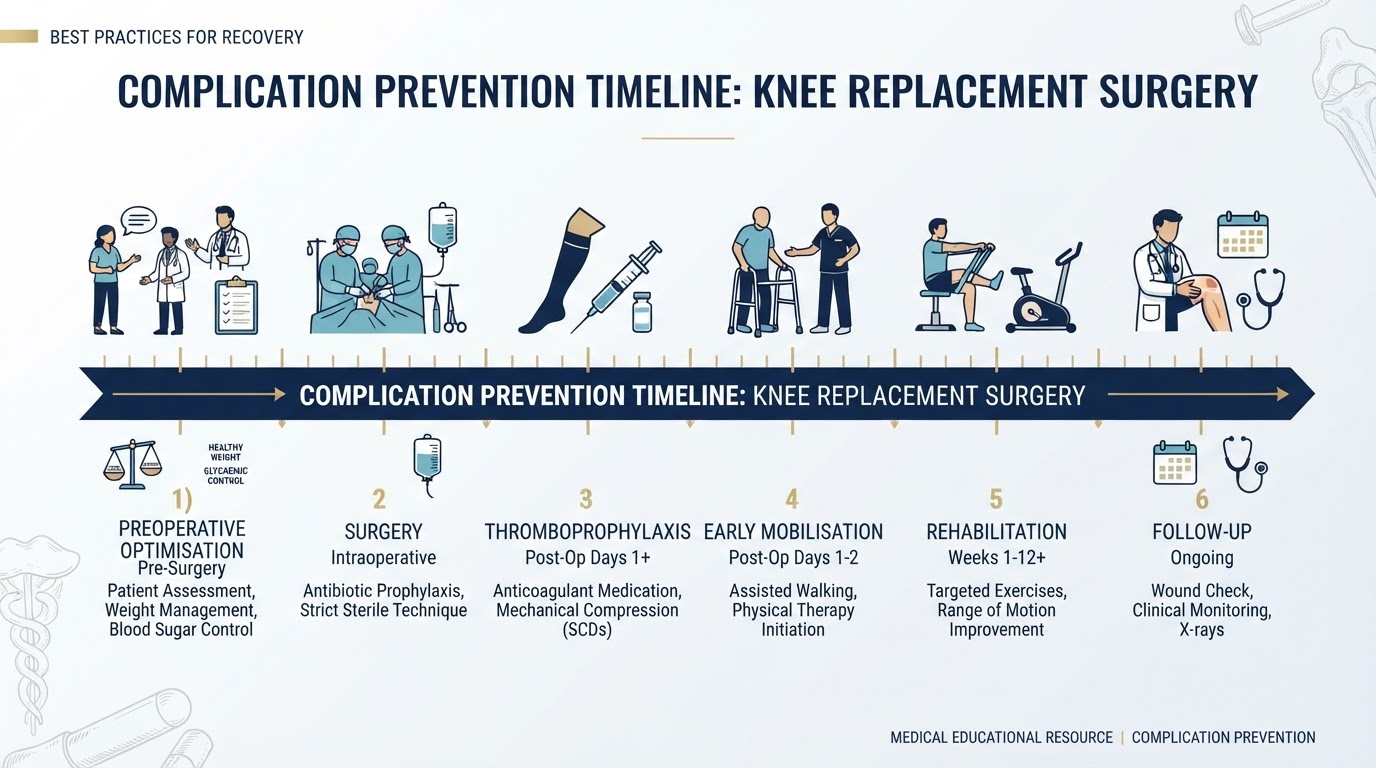
Complication reduction is a shared effort between patient and surgical team. Evidence-based measures include: * Preoperative optimisation: assessing and improving glycaemic control, weight where appropriate, nutrition, smoking cessation and medication review before the date of surgery. * Appropriate infection prevention: screening where indicated, preoperative skin preparation, perioperative antibiotic prophylaxis, ultraclean airflow theatre environment and careful sterile technique. * Thromboprophylaxis tailored to individual risk: combining early mobilisation, mechanical compression and pharmacological prophylaxis as guided by NICE/AAOS recommendations. * Early mobilisation and structured rehabilitation: getting moving safely soon after surgery reduces VTE risk, helps restore range of motion and supports functional recovery. * Follow-up and monitoring: scheduled wound checks, early recognition of warning signs and long-term radiographic surveillance to detect loosening or wear before they become severe. No strategy can guarantee a complication-free result — complications can occur even with excellent technique and preparation — but these measures meaningfully reduce risk and improve outcomes.
Warning signs after surgery: when to seek urgent medical attention
During normal recovery some swelling, bruising, warmth and aching are expected, and they gradually settle over weeks. Certain symptoms, however, should not be ignored and warrant prompt assessment: * Increasing wound redness, spreading redness, discharge or opening of the incision. * Fever, chills or feeling increasingly unwell. * Pain that is worsening rather than gradually improving, especially after an initial period of improvement. * Significant new calf pain, tenderness or one-sided leg swelling (possible DVT). * Sudden shortness of breath, chest pain or coughing blood — emergency assessment for pulmonary embolism. * Sudden loss of function, giving way or marked new deformity. The distinction between an ordinary, manageable symptom and a genuine emergency can be subtle. When in doubt, contact your surgical team or seek urgent assessment; the safe approach is to be reassured by a clinician rather than to wait and see.
Questions patients should ask their orthopaedic surgeon
An informed conversation before surgery helps you understand and weigh your individual risk. Useful questions include: * Given my general health, weight and medications, what are the most relevant risks for me? * How do you and your team reduce the risk of infection and blood clots? * What anaesthetic and pain-control plan do you recommend and why? * What rehabilitation protocol will I follow, and for how long will I need walking aids and physiotherapy? * What wound-care and warning-sign guidance will I be given at discharge? * If a complication such as infection or stiffness were to occur, how is it managed at your centre? * What is your follow-up schedule, and how will the implant be monitored over the coming years? These questions help align expectations and ensure your plan is tailored to your situation rather than a generic protocol.
Conclusion and consultation CTA
Knee replacement is a highly successful operation for the large majority of patients, and serious complications are uncommon with modern surgical, anaesthetic and rehabilitation care. However, risks exist and should be understood honestly: infection, thromboembolism, stiffness, persistent pain, loosening, instability and — rarely — nerve, vascular or fracture problems. The right approach is not to fear the operation but to be informed, prepared and proactive: optimise your health beforehand, follow your perioperative and rehabilitation plan, and recognise the warning signs that require urgent attention. For residents and visitors across the Costa Blanca — Alicante, Torrevieja and Orihuela Costa — Dr Pablo Banchero offers individualised, evidence-based assessment of knee replacement risk and recovery, whether you are considering surgery, in the early postoperative period, or seeking a second opinion about persistent symptoms from a previous operation.
Understanding risk is part of good care
Modern knee replacement is safe and effective for most patients, and complications are uncommon. The realistic goal is not a guaranteed complication-free outcome but a well-informed, well-prepared patient and a surgical team that prevents what it can, recognises what it cannot, and treats problems promptly. For patients across Alicante, Torrevieja and Orihuela Costa, Dr Pablo Banchero provides individualised orthopaedic assessment of knee replacement risk, recovery and revision.
References & scientific evidence
- National Institute for Health and Care Excellence (NICE). Joint replacement (primary): hip, knee and shoulder. NICE guideline NG157.. NICE Clinical Guidelines, 2020.Clinical guidelineView source
- National Institute for Health and Care Excellence (NICE). Reducing risk of venous thromboembolism (deep vein thrombosis and pulmonary embolism) in patients going to hospital. NICE guideline NG89.. NICE Clinical Guidelines, 2018.Clinical guidelineView source
- American Academy of Orthopaedic Surgeons (AAOS). Surgical Management of Osteoarthritis of the Knee — Evidence-Based Clinical Practice Guideline (SMOAK2).. AAOS Clinical Practice Guidelines, 2022.Clinical guidelineView source
- National Joint Registry (NJR) for England, Wales, Northern Ireland and the Isle of Man. National Joint Registry 21st Annual Report — Hip, Knee, Ankle, Elbow and Shoulder Arthroplasty: Outcomes and Survivorship.. National Joint Registry, 2024.Observational studyView source
- Australian Orthopaedic Association National Joint Replacement Registry (AOANJRR). Hip, Knee & Shoulder Arthroplasty Annual Report 2024.. AOA NJRR, 2024.Observational studyView source
- Evans JT, Walker RW, Evans JP, Blom AW, Sayers A, Whitehouse MR. How long does a knee replacement last? A systematic review and meta-analysis of case series and national registry reports.. The Lancet, 2019.Meta-analysisDOI: 10.1016/S0140-6736(18)32531-5View source
- Lenguerrand E, Wylde V, Beswick AD, Gunne KP, Goodberman-Hill R. Risk factors for chronic pain after total knee arthroplasty: a systematic review and meta-analysis.. BMJ Open, 2020.Systematic reviewDOI: 10.1136/bmjopen-2019-034268View source
- Riaz O, Aqil A, Husain A, Chishti I, Hill JP, Nicholl A. Periprosthetic fractures around total knee arthroplasty — a review.. Annals of Medicine and Surgery, 2021.Systematic reviewDOI: 10.1016/j.amsu.2021.102598View source
- Kurtz SM, Ong KL, Lau E, Bozic KJ. Impact of the economic downturn on total joint arthroplasty in the United States: a population-based study.. Journal of Bone and Joint Surgery (Am), 2014.Observational studyDOI: 10.2106/JBJS.M.00285View source
- Zimmerli W, Trampuz A, Ochsner PE. Prosthetic-joint infections.. New England Journal of Medicine, 2004.Systematic reviewDOI: 10.1056/NEJMra040168View source
Frequently asked questions

Dr. Pablo Banchero Lasalvia
Orthopaedic Surgeon · Traumatology Team
- Author:
- Dr. Pablo Banchero Lasalvia
- Medical reviewer:
- Dr. Pablo Banchero Lasalvia
- Published:
- 2 November 2026
- Medical review date:
- 2 November 2026
- ·
- 20 min read
Book Your Consultation via WhatsApp
Request a private orthopaedic assessment with Dr Pablo Banchero to discuss knee replacement risks, your recovery, persistent symptoms after a previous operation, or an expert second opinion on the Costa Blanca.
Official number: +34 602 99 22 22