
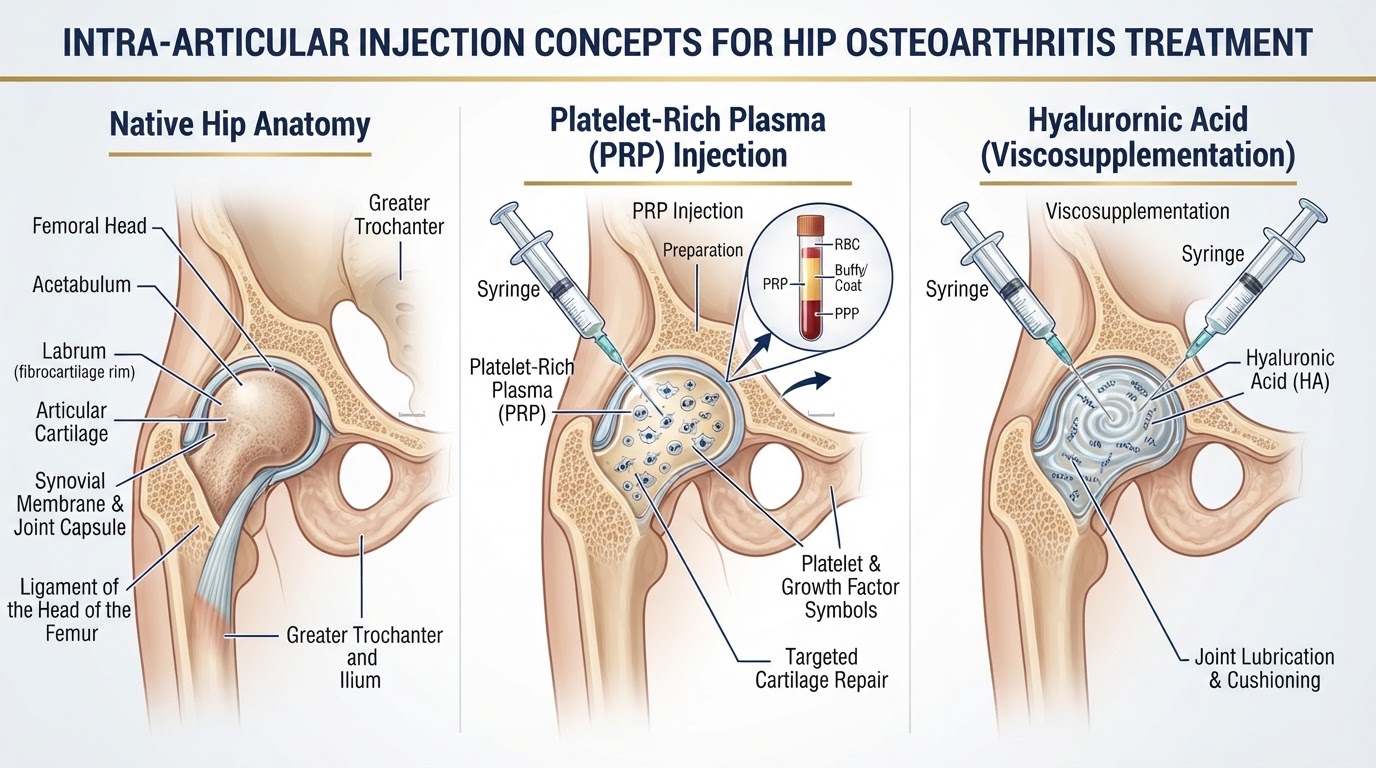
Many patients with hip osteoarthritis hope to relieve pain, preserve the joint and delay or avoid hip replacement. Intra-articular platelet-rich plasma (PRP/PRGF), hyaluronic acid and radiofrequency treatment of the hip's sensory articular branches are widely offered for these goals — but the evidence behind them is uneven, sometimes conflicting, and often poorly explained. This article examines what the scientific evidence really shows: which patients may benefit, what results can reasonably be expected, how long any benefit may last, and when these treatments are no longer a reasonable alternative to hip replacement. It is written for residents and visitors on the Costa Blanca — including patients in Alicante, Torrevieja and Orihuela Costa — and for international patients seeking an honest, evidence-based second opinion. The central message is that these treatments may provide symptomatic improvement in selected patients, particularly with less advanced disease, but they do not regenerate lost cartilage, reverse advanced osteoarthritis or replace the need for a hip replacement when the joint is severely degenerated. The aim is to inform, not to promote.
Introduction: can hip osteoarthritis be treated without surgery?
Yes — many patients with hip osteoarthritis can be helped without surgery, especially in the early and moderate stages. Conservative management (exercise, physiotherapy, weight management, activity modification and appropriate medication) remains the foundation of care, and selected image-guided injections or radiofrequency can play a role for some patients. The honest question is not whether non-surgical treatment works, but for whom it works, how much it helps, how long the benefit lasts, and at what point a joint that is severely degenerated is better served by a hip replacement. This article separates symptomatic improvement (feeling less pain) from functional improvement (moving better) and from actual modification of joint degeneration (changing the structure of the joint) — because these are very different claims, and the evidence supports them to very different degrees.
Understanding hip osteoarthritis and its progression
Hip osteoarthritis is the progressive loss of articular cartilage in the hip joint, accompanied by changes in the underlying bone, the joint capsule and the surrounding tissues. As cartilage thins, the joint-space narrows on radiographs, the bone beneath the cartilage becomes sclerotic and may form cysts, and osteophytes (bone spurs) develop at the joint margins. Symptoms typically begin as activity-related groin pain and stiffness and progress toward pain at rest, night pain and increasing loss of movement and function. The Kellgren-Lawrence and Tönnis grading systems describe the radiographic severity. Understanding the stage matters because the same treatment can produce very different results in an early joint with preserved space than in an advanced joint with bone-on-bone contact.
Why treatment results depend on disease severity
The single most important factor in how a patient responds to PRP, hyaluronic acid or radiofrequency is the severity of the osteoarthritis. In early disease, where cartilage is largely preserved and inflammation is a prominent component of pain, a treatment that modulates inflammation or joint fluid may produce meaningful symptomatic relief. In advanced disease, where pain is driven largely by mechanical bone-on-bone contact, subchondral bone change and structural deformity, no injection or nerve treatment can correct the underlying mechanics — so symptomatic benefit, if any, tends to be limited and short-lived. This is why the same product can look promising in a trial of early-to-moderate hips and disappointing in a population of advanced hips. Severity, more than the choice between PRP and hyaluronic acid, often determines the outcome.
Patient selection: early, moderate and advanced osteoarthritis
Sensible patient selection matches the treatment to the stage. In early osteoarthritis, conservative measures are first-line, and selected image-guided PRP/PRGF or hyaluronic acid may be considered after discussing the evidence and its limitations. In moderate osteoarthritis, individualised conservative management remains the core; PRP/PRGF or hyaluronic acid may be considered selectively, and radiofrequency may have a role for persistent pain in patients who are not surgical candidates or wish to defer surgery. In advanced osteoarthritis — severe joint-space narrowing, full-thickness cartilage loss, subchondral changes, osteophytes and persistent rest or night pain — biological injections and radiofrequency may offer limited symptomatic benefit but cannot correct the structural degeneration, and total hip replacement becomes the more appropriate treatment. Selection is individualised; no single X-ray grade alone dictates the decision.
PRP and PRGF: what are they?
Platelet-rich plasma (PRP) is a concentrate of platelets prepared from a small sample of the patient's own blood by centrifugation. Platelets contain growth factors and other bioactive proteins involved in the body's healing and inflammatory responses. PRGF (plasma rich in growth factors) is a specific, standardised preparation of PRP. The prepared concentrate is injected into the joint, usually under ultrasound or fluoroscopic guidance. It is important to be clear about what PRP/PRGF is not: it is not a guaranteed treatment, it is not the same in every preparation, and there is no established clinical proof that it regenerates lost hip cartilage or reverses advanced osteoarthritis. The plausible mechanism in osteoarthritis is modulation of joint inflammation and the synovial environment, which may translate into symptomatic improvement in some patients — not structural reconstruction of a destroyed joint.
How platelet-rich plasma may influence joint inflammation and pain
The proposed mechanism by which PRP might help an osteoarthritic hip is biological rather than mechanical. Growth factors released from platelets may influence synovial cells, modulate inflammatory mediators and affect the joint environment in ways that could reduce pain and improve symptoms. This is a symptomatic, anti-inflammatory rationale, not a cartilage-rebuilding one. It helps explain why some patients report improvement for a period after injection, and also why the effect is variable, may be temporary, and does not restore joint space or reverse structural damage. Understanding the mechanism is important because it sets realistic expectations: a treatment that modulates inflammation can make a symptomatic difference, but it cannot re-create cartilage that has been lost or correct the mechanical consequences of advanced degeneration.
Scientific evidence for PRP in hip osteoarthritis
The evidence for PRP in hip osteoarthritis is limited, heterogeneous and dominated by small randomised trials and systematic reviews of those trials. A 2026 systematic review and meta-analysis (Zhang et al., Pain Research and Management) pooled seven randomised trials and 465 patients comparing intra-articular PRP with hyaluronic acid. It found a statistically significant advantage for PRP in some pain outcomes — notably VAS pain at six months and WOMAC-pain at six and twelve months — but no significant difference in hip function measured by the Harris Hip Score or WOMAC-function. The effect sizes were moderate, the certainty of evidence ranged from moderate to very low, and the authors cautioned that statistical significance does not necessarily translate into a clinically meaningful benefit. A 2022 systematic review and meta-analysis (Lim et al., American Journal of Sports Medicine) similarly concluded that PRP may reduce pain compared with baseline at several time points, with the greatest effect around one to two months, but that evidence of superiority over comparators was limited. The honest reading is that PRP may provide symptomatic improvement in selected patients, particularly with less advanced disease, but the evidence does not establish cartilage regeneration or reversal of advanced osteoarthritis.
PRP formulations: leukocyte-rich versus leukocyte-poor
Not all PRP is the same. A key distinction is between leukocyte-rich PRP (LR-PRP), which contains higher numbers of white blood cells, and leukocyte-poor PRP (LP-PRP), which has fewer. The 2026 meta-analysis by Zhang et al. found in subgroup analysis that leukocyte-poor PRP showed a statistically significant improvement in pain whereas leukocyte-rich PRP did not, suggesting that the leukocyte content may influence the inflammatory effect. Platelet concentration, the use of an activator, and the precise preparation method also vary between studies and products, which is a major source of heterogeneity. This means that results obtained with one PRP formulation cannot automatically be assumed for another, and that there is no single 'optimal' PRP formulation established for hip osteoarthritis. We do not invent a preferred formulation, concentration or protocol.
Single versus multiple PRP injections
Protocols vary, and the evidence does not establish a single correct number of injections. Some trials used a single injection, others a course of two or three injections spaced over weeks. The 2026 meta-analysis by Zhang et al. found in subgroup analysis that multiple injections showed a statistically significant advantage in pain over hyaluronic acid whereas a single injection did not — but this does not prove that multiple injections are universally better, because the trials differ in formulation, severity and design. We do not prescribe a fixed number of sessions, a fixed interval, or a fixed volume; these decisions are individualised and should be discussed openly, including the limitations of the evidence and the fact that more injections are not automatically better.
PRP compared with hyaluronic acid
Several randomised trials have directly compared PRP and hyaluronic acid for hip osteoarthritis, including Battaglia et al. (Orthopedics, 2013), Dallari et al. (American Journal of Sports Medicine, 2016) and Doria et al. (Joints, 2017). Their findings are not uniform: some reported short-term symptomatic benefit for PRP, others found similar short-term outcomes between PRP and hyaluronic acid, and results varied with formulation, severity and follow-up. The 2026 meta-analysis by Zhang et al. suggested a statistical advantage for PRP in some pain outcomes, particularly at six months, but not a consistent improvement in hip function. The balanced conclusion is that PRP and hyaluronic acid may both provide short-term symptomatic relief in selected patients, that PRP may have an edge in some pain outcomes at certain time points, but that the evidence is not strong or consistent enough to declare a universal winner — and neither regenerates cartilage.
Combined PRP and hyaluronic acid: does the combination offer an advantage?
The combination of PRP with hyaluronic acid has been studied on the premise that the two might act synergistically. A 2025 systematic review and meta-analysis (Santiago et al., Frontiers in Bioengineering and Biotechnology) included two randomised trials and one cohort study with 190 patients and examined PRP with versus without hyaluronic acid for hip osteoarthritis. It found that the addition of hyaluronic acid to PRP did not demonstrate a consistent functional advantage and produced less favourable pain findings at some follow-up points. This does not mean combined treatment is universally harmful — the evidence base is small and the trials heterogeneous — but it does mean there is currently no strong evidence that adding hyaluronic acid to PRP improves outcomes. We do not present combination treatment as superior, and we do not invent protocols or success rates for it.
Hyaluronic acid: mechanism, clinical evidence and limitations
Hyaluronic acid is a component of synovial fluid and cartilage matrix. Intra-articular injection (viscosupplementation) aims to restore the viscoelastic properties of synovial fluid, reduce friction and modulate inflammation. Products differ in molecular weight and whether they are cross-linked, and these differences are not trivial — different viscosupplementation products are not necessarily clinically equivalent. The evidence for hyaluronic acid in hip osteoarthritis is conflicting. The American Academy of Orthopaedic Surgeons (AAOS) Clinical Practice Guideline on Management of Osteoarthritis of the Hip gives a strong recommendation that intra-articular hyaluronic acid should not be considered for symptomatic hip osteoarthritis, as it does not improve function or reduce pain better than placebo. In contrast, the EUROVISCO 2026 recommendations support the selected use of hyaluronic acid in hip osteoarthritis, emphasising that only viscosupplements demonstrated effective and safe in clinical trials should be used, and that injection should be image-guided. NICE NG226 advises against offering intra-articular hyaluronic acid injections for osteoarthritis. These recommendations are not uniform, which is itself important information for patients. Hyaluronic acid is not a cartilage-regenerating treatment; any benefit is symptomatic and of variable duration.
Radiofrequency for chronic hip pain
Radiofrequency treatment of the hip targets the sensory articular branches that carry pain signals from the joint, with the aim of reducing pain for a period. It is a pain-management intervention, not a disease-modifying one: it does not regenerate cartilage, restore joint space or reverse mechanical degeneration. It may be considered for patients with persistent hip pain despite conservative management who are not good candidates for surgery, who wish to defer arthroplasty after informed discussion, or who have persistent pain following hip surgery in selected cases. The evidence is promising but limited and predominantly observational, and it is essential not to confuse the evidence for knee genicular radiofrequency with the evidence for hip articular branch radiofrequency — they are different nerves, different anatomy and different evidence bases, and knee results cannot be extrapolated to the hip.
Anatomy of the sensory articular branches of the hip
The hip joint receives sensory innervation from several articular branches. The most frequently targeted are the articular branches of the femoral nerve (supplying the anterior capsule), the articular branches of the obturator nerve (supplying the inferomedial capsule), and the accessory obturator nerve when anatomically present and relevant. Some approaches also consider posterior innervation where supported by evidence. Understanding this anatomy matters because accurate targeting under imaging is what makes a diagnostic block or a radiofrequency lesion meaningful, and because the safety of the procedure depends on the relationship of these nerves to adjacent structures. The anatomy is more variable and less standardised than the knee genicular nerves, which is part of why the hip evidence is less mature.
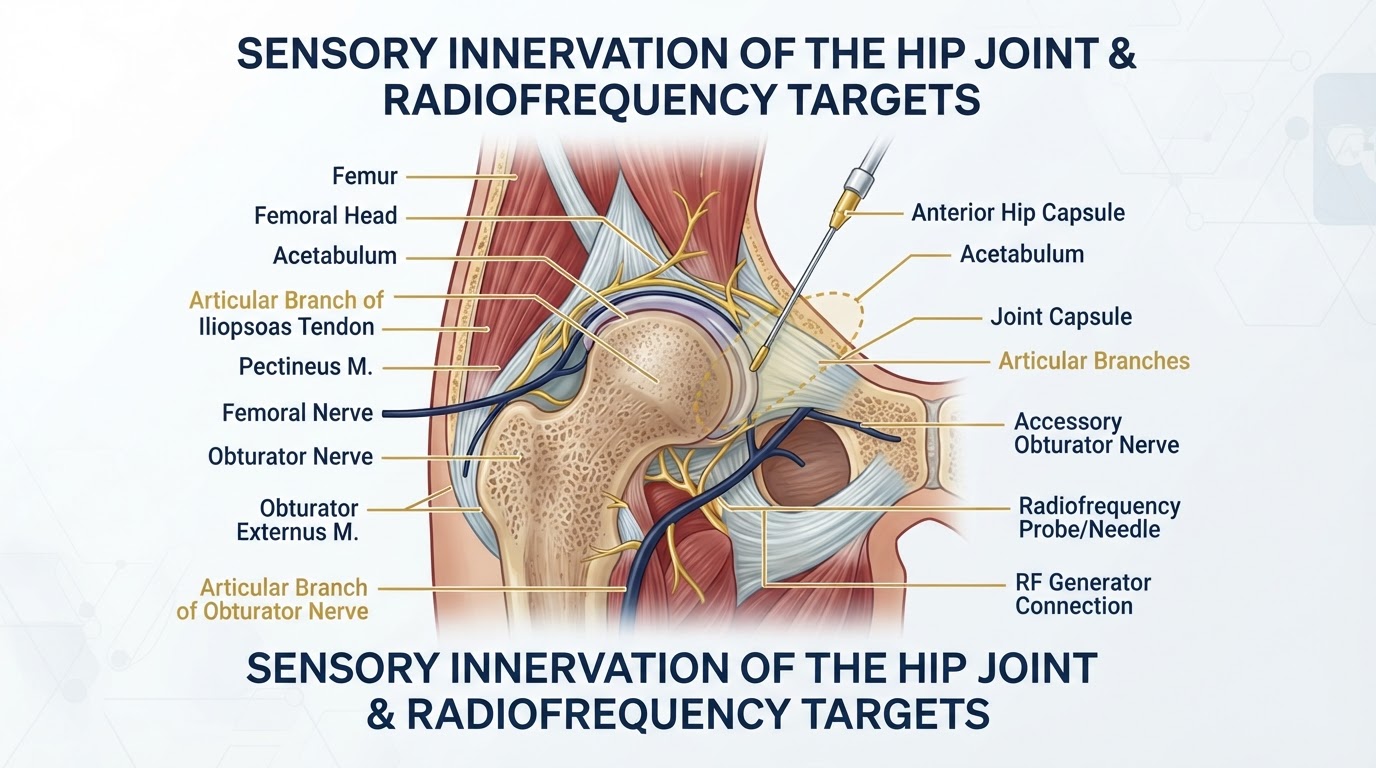
Conventional, cooled and pulsed radiofrequency
Several radiofrequency techniques exist. Conventional thermal radiofrequency creates a discrete heat lesion at the nerve target. Cooled radiofrequency uses active probe cooling to create a larger, more reproducible lesion, which can be useful for nerves that are difficult to reach or variable in position. Pulsed radiofrequency delivers energy in short pulses, reaching lower temperatures and producing a non-destructive neuromodulatory effect rather than a thermal lesion. Each technique has different proposed mechanisms, evidence and practical considerations. No single technique is established as universally superior for hip pain; the choice depends on the target, the anatomy, the available evidence and the operator. We do not claim one technique is best, and we do not promise a particular degree or duration of pain relief.
Diagnostic blocks and selection of suitable patients
A diagnostic block — injecting local anaesthetic onto the targeted articular branches under imaging — is commonly used to identify patients whose pain is mediated by those nerves and who might therefore respond to radiofrequency. A positive response to a diagnostic block (meaningful, ideally substantial pain relief for the expected duration of the anaesthetic) is generally used to select patients for radiofrequency, because treating patients without a positive block is less likely to help. Patient selection also considers the severity of osteoarthritis, the failure of conservative management, surgical fitness and the patient's goals. Radiofrequency is not appropriate for every patient with hip pain, and a diagnostic block that does not produce relief is useful information that steers treatment elsewhere — it is not a failure, it is a diagnostic result.
Expected pain relief and duration of benefit
The evidence on how much relief radiofrequency provides, and for how long, is limited and predominantly observational. A 2024 review (Pressler et al., Annals of Palliative Medicine) concluded that hip radiofrequency ablation is an effective treatment, citing a retrospective series in which a majority of patients reported substantial pain relief at six months. A 2024 prospective clinical study (Karaoğlu et al., Pain Medicine) found that conventional radiofrequency thermocoagulation of the femoral and obturator articular branches reduced chronic hip pain and improved function. A 2026 systematic review (Son et al., Journal of ISAKOS) of nerve-targeted interventions for refractory hip pain included ten studies and 358 patients and reported meaningful short-term improvements in pain, function and analgesic use, but noted that the evidence was largely observational and that sufficient high-quality randomised trials are lacking. Reported benefit is typically in the short-to-medium term; repeat treatment is sometimes considered when benefit recurs, but durable, long-term relief is not guaranteed. We do not quote a single success rate, because the studies differ too much to support one.
Can biological and interventional treatments delay hip replacement?
This is one of the most important and most misunderstood questions. PRP, hyaluronic acid and radiofrequency may reduce pain and improve function for a period in selected patients, and in that sense they may help some patients defer hip replacement. But 'deferring' is not the same as 'preventing', and there is no reliable evidence that these treatments alter the long-term trajectory of advanced osteoarthritis or remove the eventual need for a replacement when the joint is severely degenerated. A patient who is a good surgical candidate with advanced symptomatic disease should not be encouraged to pursue repeated injections indefinitely in the hope of avoiding an operation that is clearly indicated. The honest framing is that these treatments may buy symptomatic time in suitable patients, while the decision about replacement should be based on symptoms, function, imaging and shared decision-making — not on whether enough injections have been tried.
When do these treatments stop being reasonable?
Conservative and interventional treatments stop being a reasonable primary strategy when there is no meaningful improvement despite adequate trials, when functional capacity continues to deteriorate, when pain substantially limits sleep, walking or daily life, when imaging shows advanced structural disease, or when the patient has already exhausted reasonable non-operative options. Continuing to repeat injections that are not helping, or pursuing nerve treatments in a joint that is structurally destroyed, can delay appropriate definitive treatment — and that delay is not always harmless, because it prolongs pain, disability and loss of conditioning. We do not set arbitrary injection limits or rigid timelines unsupported by evidence; the decision is clinical and individual, but it must be honest about diminishing returns.
Comparison table: PRP, PRGF, hyaluronic acid and radiofrequency
A balanced comparison helps frame the options. PRP/PRGF: main objective symptomatic relief via modulation of the joint environment; best-supported indication early-to-moderate hip osteoarthritis in selected patients; evidence quality moderate-to-low (small RCTs and meta-analyses); expected duration variable, with some pain benefit reported up to around six to twelve months in selected studies; main limitation no proof of cartilage regeneration, heterogeneous formulations, no established optimal protocol. Hyaluronic acid: main objective symptomatic relief via viscosupplementation; best-supported indication selected patients, with conflicting guideline recommendations; evidence quality conflicting (AAOS recommends against, EUROVISCO supports selected use); expected duration short-to-medium term symptomatic benefit where it occurs; main limitation not a cartilage-regenerating treatment, products not equivalent. PRP plus hyaluronic acid: main objective combined symptomatic effect; best-supported indication not established; evidence quality limited (small meta-analysis showing no consistent advantage); expected duration not established; main limitation no evidence of superiority over PRP alone. Conventional radiofrequency: main objective pain reduction via thermal neurotomy of articular branches; best-supported indication refractory hip pain in non-surgical candidates; evidence quality observational and prospective studies; expected duration short-to-medium term; main limitation does not treat the arthritis, evidence limited. Cooled radiofrequency: main objective larger reproducible lesion; best-supported indication selected cases; evidence quality limited; expected duration short-to-medium term; main limitation same as conventional, equipment-dependent. Pulsed radiofrequency: main objective non-destructive neuromodulation; best-supported indication selected cases; evidence quality limited; expected duration variable; main limitation limited evidence. Total hip replacement: definitive surgical option for advanced symptomatic disease; best-supported indication advanced osteoarthritis with persistent pain and disability; evidence quality high (registry data); expected duration long-term; main limitation surgical procedure with its own risks. This table is a summary, not a substitute for individual assessment.
Individualised treatment selection
No single treatment is right for every hip. Selection depends on the stage of osteoarthritis, the patient's symptoms and functional goals, their general fitness, the response to previous treatments, and a shared discussion about the evidence and its limitations. In early disease, conservative management is the core and selected injections may be considered. In moderate disease, individualised conservative care, selective PRP/PRGF or hyaluronic acid, and radiofrequency for suitable persistent pain all have a place. In advanced disease, the role of repeated injections and nerve treatments is limited, and total hip replacement is usually the more appropriate option. The decision is not about choosing the most 'advanced' treatment, but about matching the treatment to the joint, the patient and the evidence.
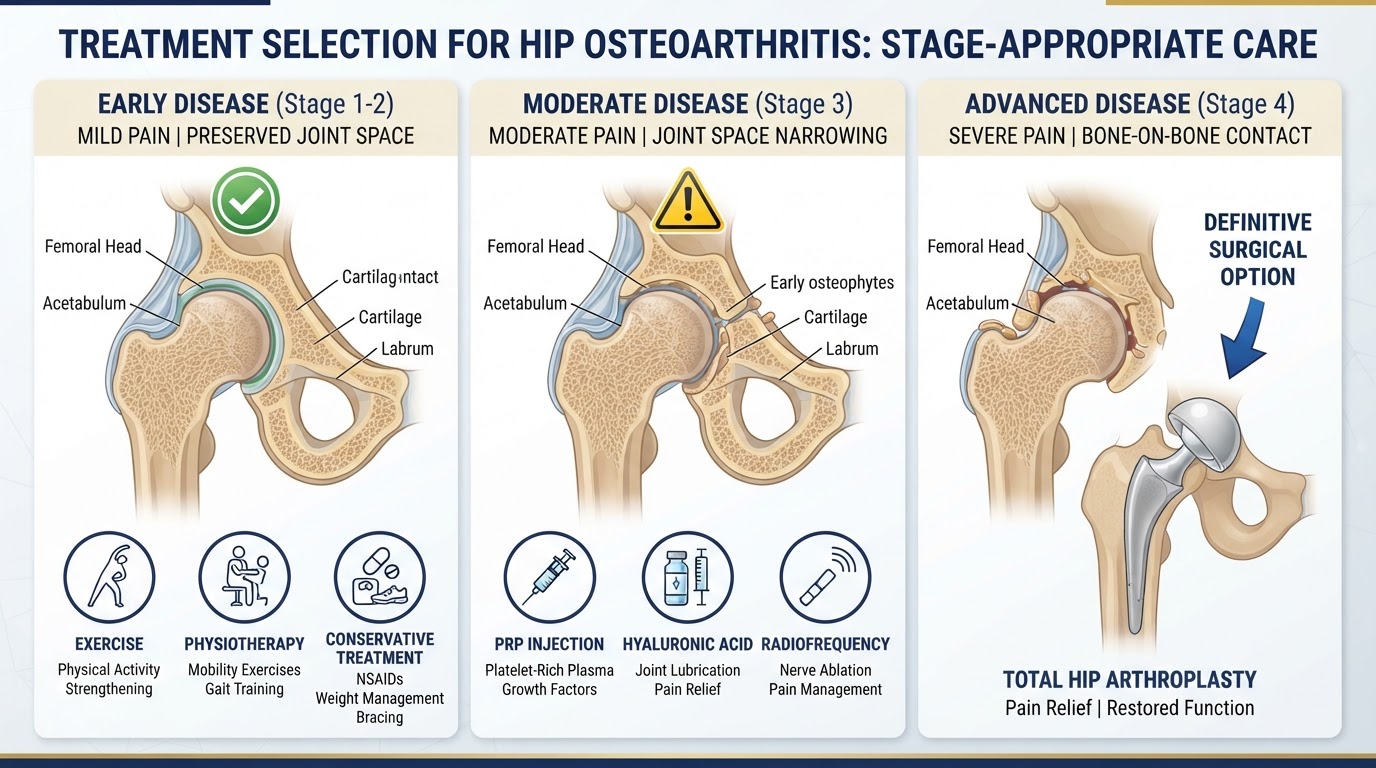
Conclusions and consultation CTA
PRP, PRGF, hyaluronic acid and hip articular branch radiofrequency may all provide symptomatic benefit in carefully selected patients with hip osteoarthritis, particularly when disease is not advanced. The evidence supports symptomatic and sometimes functional improvement of variable duration; it does not support cartilage regeneration, reversal of advanced osteoarthritis, or a guaranteed delay of hip replacement. Hyaluronic acid recommendations differ between professional bodies, PRP formulations and protocols vary widely, and hip radiofrequency evidence remains predominantly observational and must not be confused with knee genicular evidence. When osteoarthritis is advanced and conservative options have been exhausted, total hip replacement remains the definitive, evidence-based option. For residents and visitors across the Costa Blanca — Alicante, Torrevieja and Orihuela Costa — Dr Pablo Banchero offers an individualised, evidence-based assessment and an honest second opinion on whether PRP, hyaluronic acid, radiofrequency, conservative care or hip replacement is the right path for your hip.
Realistic expectations, individualised decisions
PRP, PRGF, hyaluronic acid and hip radiofrequency may relieve symptoms in selected patients with hip osteoarthritis, but the evidence does not show that they regenerate cartilage or reverse advanced disease. Hyaluronic acid recommendations are not uniform across professional bodies, PRP evidence is heterogeneous and limited, and hip radiofrequency evidence is promising but largely observational and distinct from knee genicular evidence. Treatment selection must be individualised to disease severity, symptoms and patient goals, and total hip replacement remains the definitive option for advanced symptomatic osteoarthritis. On the Costa Blanca — Alicante, Torrevieja and Orihuela Costa — Dr Pablo Banchero provides evidence-based assessment and second opinions to help you choose the right treatment for your hip.
References & scientific evidence
- Zhang D, Ma SH, Wang HL, et al.. Comparison of Clinical Efficiency and Safety Between Intra-Articular Injection of Platelet-Rich Plasma and Hyaluronic Acid for Hip Osteoarthritis: A Systematic Review and Meta-Analysis.. Pain Research and Management, 2026.Meta-analysisDOI: 10.1155/prm/6521682PMID: 42287090View source
- Santiago MS, Doria FM, Morais Sirqueira Neto J, et al.. Platelet-rich plasma with versus without hyaluronic acid for hip osteoarthritis: a systematic review and meta-analysis.. Frontiers in Bioengineering and Biotechnology, 2025.Meta-analysisDOI: 10.3389/fbioe.2025.1545431View source
- Lim A, Zhu JB, Khanduja V.. The Use of Intra-articular Platelet-Rich Plasma as a Therapeutic Intervention for Hip Osteoarthritis: A Systematic Review and Meta-analysis.. American Journal of Sports Medicine, 2022.Systematic reviewDOI: 10.1177/03635465221095563View source
- Dallari D, Stagni C, Rani N, et al.. Ultrasound-Guided Injection of Platelet-Rich Plasma and Hyaluronic Acid, Separately and in Combination, for Hip Osteoarthritis: A Randomized Controlled Study.. American Journal of Sports Medicine, 2016.Randomised controlled trialDOI: 10.1177/0363546515620383View source
- Doria C, Mosele G, Caggiari G, et al.. Treatment of Early Hip Osteoarthritis: Ultrasound-Guided Platelet Rich Plasma versus Hyaluronic Acid Injections in a Randomized Clinical Trial.. Joints, 2017.Randomised controlled trialDOI: 10.1055/s-0037-1605584View source
- Battaglia M, Guaraldi F, Vannini F, et al.. Efficacy of Ultrasound-guided Intra-articular Injections of Platelet-rich Plasma Versus Hyaluronic Acid for Hip Osteoarthritis.. Orthopedics, 2013.Randomised controlled trialDOI: 10.3928/01477447-20131120-13View source
- American Academy of Orthopaedic Surgeons (AAOS). Management of Osteoarthritis of the Hip — Evidence-Based Clinical Practice Guideline.. AAOS Clinical Practice Guidelines, 2023.Clinical guidelineView source
- National Institute for Health and Care Excellence (NICE). Osteoarthritis in over 16s: diagnosis and management (NG226).. NICE Guideline NG226, 2022.Clinical guidelineView source
- Migliore A, Raman R, Diraçoglù D, et al.. EUROVISCO Recommendations for the Use of Viscosupplementation with Hyaluronic Acid in the Management of Hip Osteoarthritis.. Cartilage, 2026.Clinical guidelineDOI: 10.1177/19476035251408602View source
- U.S. Department of Veterans Affairs and Department of Defense (VA/DoD). VA/DoD Clinical Practice Guideline for the Non-Surgical Management of Hip and Knee Osteoarthritis.. VA/DoD Clinical Practice Guidelines, 2026.Clinical guidelineView source
- Pressler MP, Renwick C, Lawson A, et al.. Radiofrequency ablation of the hip: review.. Annals of Palliative Medicine, 2024.Systematic reviewDOI: 10.21037/apm-23-470View source
- Karaoğlu SŞ, Sari S, Ekin Y, et al.. The effect of conventional radiofrequency thermocoagulation of femoral and obturator nerves' articular branches on chronic hip pain: a prospective clinical study.. Pain Medicine, 2024.Observational studyDOI: 10.1093/pm/pnae016View source
- Son H, Satheesh A, Cohen D, et al.. Nerve-Targeted Interventions Provide Meaningful Short-Term Pain and Functional Improvement in Refractory Hip Pain: A Systematic Review.. Journal of ISAKOS, 2026.Systematic reviewDOI: 10.1016/j.jisako.2026.101115PMID: 41985844View source
- Griffin DR, Dickenson EJ, O'Donnell J, et al.. The Warwick Agreement on femoroacetabular impingement syndrome (FAI syndrome): an international consensus statement.. British Journal of Sports Medicine, 2016.Clinical guidelineDOI: 10.1136/bjsports-2016-096743View source
- National Joint Registry (NJR) for England, Wales, Northern Ireland and the Isle of Man. National Joint Registry 21st Annual Report — Hip, Knee, Ankle, Elbow and Shoulder Arthroplasty: Outcomes and Survivorship.. National Joint Registry, 2024.Observational studyView source
Frequently asked questions

Dr. Pablo Banchero Lasalvia
Orthopaedic Surgeon · Traumatology Team
- Author:
- Dr. Pablo Banchero Lasalvia
- Medical reviewer:
- Dr. Pablo Banchero Lasalvia
- Published:
- 2 November 2026
- Medical review date:
- 2 November 2026
- ·
- 22 min read
Book Your Consultation via WhatsApp
Request a private, evidence-based orthopaedic assessment with Dr Pablo Banchero to discuss PRP or PRGF, hyaluronic acid, radiofrequency for persistent hip pain, whether conservative treatment remains appropriate, or a second opinion before hip replacement on the Costa Blanca.
Official number: +34 602 99 22 22