
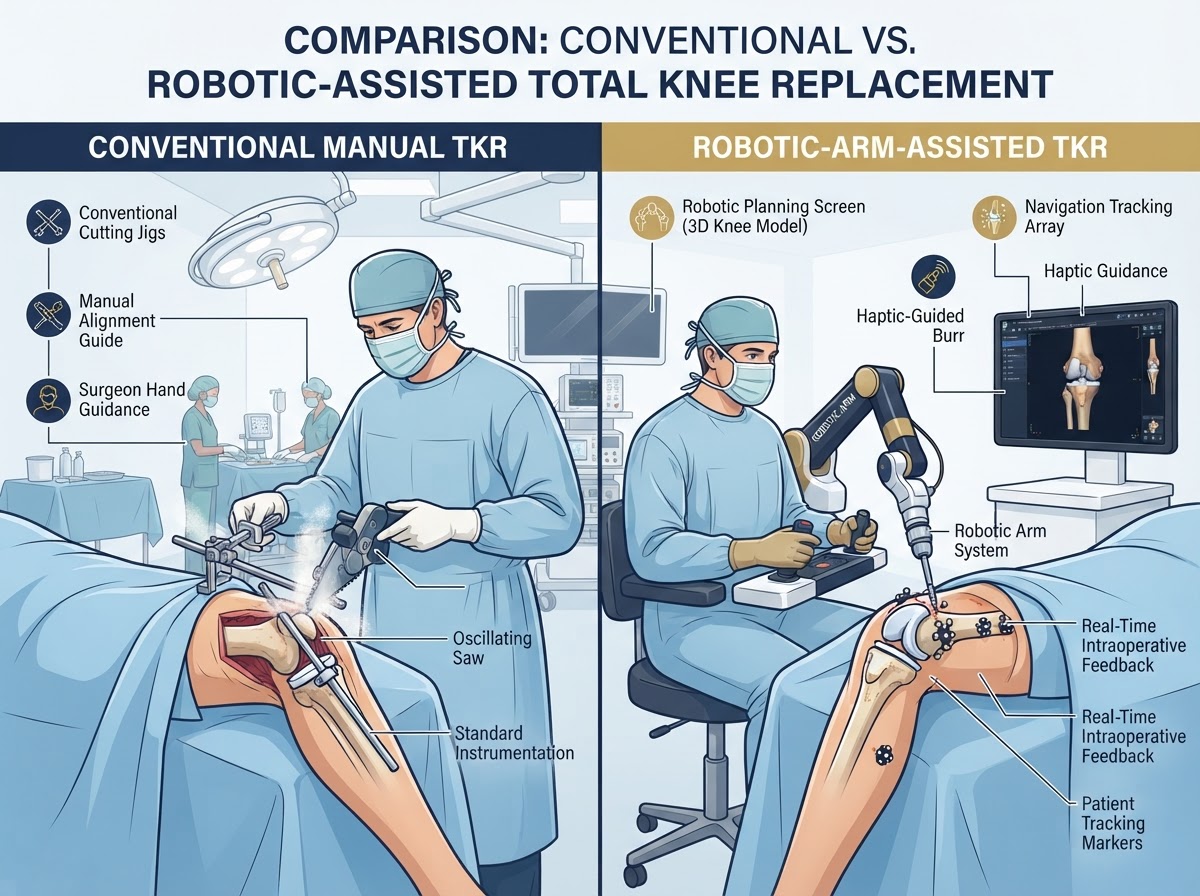
Robotic-assisted knee replacement is one of the most discussed advances in orthopaedic surgery, and it is also one of the most heavily marketed. The promise is appealing — greater precision, better alignment, a more personalised operation — but the relationship between technical precision and a patient actually feeling and functioning better is more complex than the marketing suggests. This article explains, in plain language, what robotic assistance actually does during a knee replacement, what the surgeon continues to do, how the main platforms (MAKO, ROSA, CORI and VELYS) differ, and — most importantly — what the current scientific evidence, including the 2026 RACER-Knee randomised trial in The Lancet, actually shows about benefits, recovery, safety, cost and implant longevity. It is written for residents and visitors on the Costa Blanca — including patients in Alicante, Torrevieja and Orihuela Costa — and for international patients comparing conventional and robotic knee replacement. The aim is to help you ask the right questions, not to sell you a technology.
Introduction: what is robotic-assisted knee replacement?
Robotic-assisted knee replacement is a total or partial knee replacement in which a computerised robotic system helps the surgeon plan and execute the operation with greater spatial precision than conventional, manually guided surgery. The word 'robotic' often causes confusion: in current orthopaedic practice the robot does not perform the operation on its own. The surgeon remains in control of every decision and every cut; the robotic system provides preoperative three-dimensional planning, intraoperative anatomical mapping, real-time feedback and, in some platforms, a robotic arm that guides or constrains the cutting instruments within defined boundaries. The goal is to improve the accuracy of component positioning, alignment and soft-tissue balance. Whether that improved accuracy translates into meaningfully better pain, function and implant survival for patients is the central question this article examines honestly.
How conventional knee replacement surgery works
In a conventional knee replacement, the surgeon removes the damaged joint surfaces and fixes metal and plastic components to the bone using a system of cutting guides (jigs), measurement blocks and intramedullary or extramedullary rods. Alignment is determined from anatomical landmarks, the mechanical axis is estimated, and bone cuts are made with hand-guided power saws. Ligament balancing is assessed and adjusted by feel and by testing the knee through its range of motion. Conventional knee replacement is a mature, reliable operation: registry data show that the large majority of patients do well and that modern implants have excellent long-term survival. Its limitation is variability — the accuracy of cuts and alignment depends on the surgeon's experience, the patient's anatomy and the quality of the landmarks, and a proportion of components fall outside the desired alignment range. Robotic assistance was developed primarily to reduce that variability.
How robotic-assisted knee replacement works
Robotic-assisted knee replacement adds a layer of digital planning and intraoperative guidance to the same surgical goal. The process typically has three stages. First, preoperative planning: some platforms use a CT scan to build a three-dimensional model of the patient's knee and plan component size, position and alignment before surgery; image-free platforms build this model intraoperatively. Second, intraoperative registration: the surgeon maps the patient's actual anatomy using a tracked probe, so the system knows exactly where the bone and ligaments are. Third, execution: the system guides bone preparation — through a robotic arm with haptic boundaries that prevents cutting outside a planned zone, or through handheld robotic-assisted instruments — while providing real-time feedback on component position, alignment and ligament balance. Throughout, the surgeon makes the clinical decisions; the technology executes them more precisely and provides data to support those decisions.
What the robot actually does — and what the surgeon continues to do
It is essential to be clear about the division of roles. The robotic system plans, maps, guides and constrains; it does not decide. The surgeon selects the implant, determines the alignment strategy, performs the surgical exposure, makes the bone cuts (within the system's guidance), manages the soft tissues and ligaments, fixes the components, closes the wound and manages the patient throughout. The robot cannot judge the quality of bone, the tension of a ligament, the suitability of an implant for a particular deformity, or whether a patient is a good candidate for surgery — these are clinical judgements that depend on training and experience. Robotic technology is a precision tool that supports surgical judgement; it does not replace it. A robot used by an inexperienced surgeon does not guarantee a good result, and a highly experienced surgeon can achieve excellent results with conventional techniques. This is why surgeon experience and conventional surgical competence remain central, regardless of the technology used.
Preoperative planning and three-dimensional models
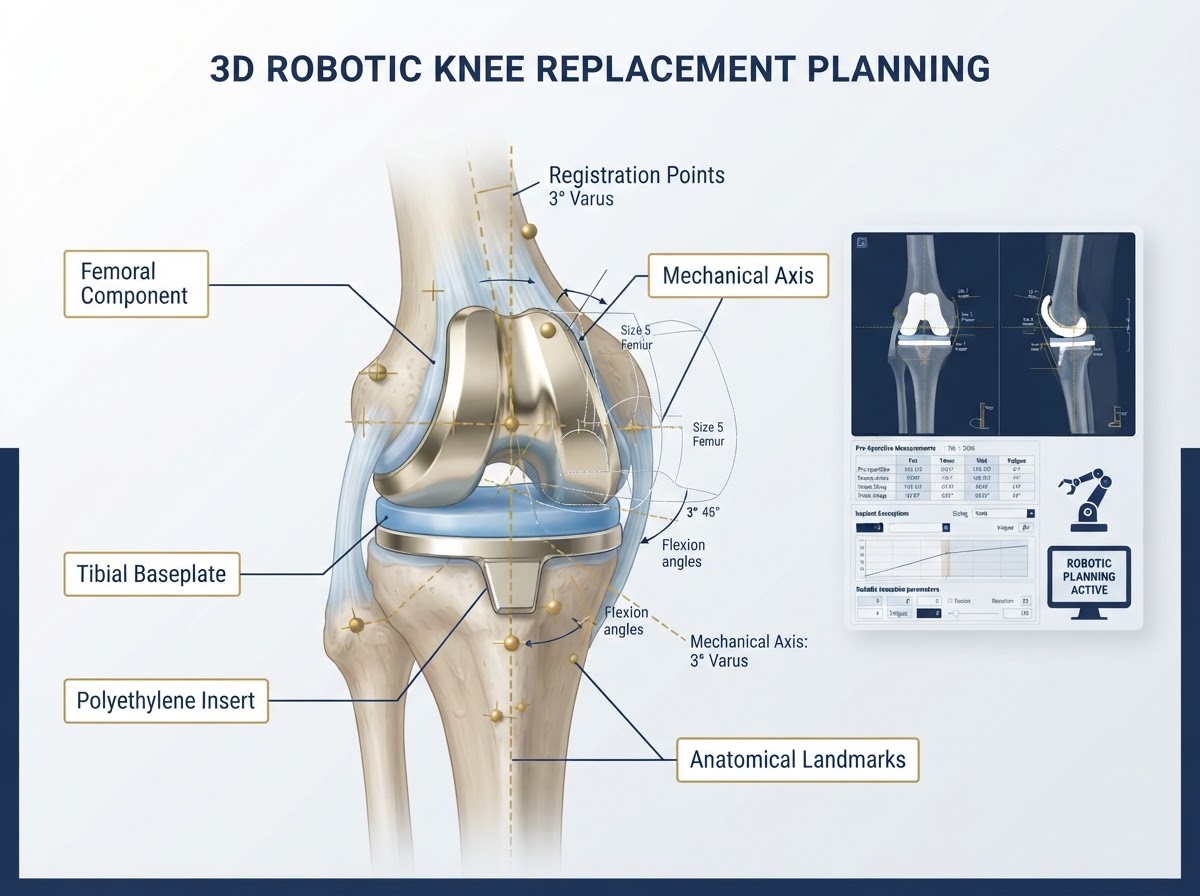
A defining feature of several robotic platforms is three-dimensional preoperative planning. When a CT scan is used, the system reconstructs a 3D model of the patient's femur, tibia and (where relevant) patella, and the surgeon plans the ideal component size, position, rotation and alignment on that model before the operation begins. This allows the plan to be tailored to the individual anatomy rather than chosen from standard intraoperative measurements. Image-free platforms achieve a similar intraoperative model by mapping the anatomy during surgery, without a preoperative CT. The advantage of 3D planning is that it makes the intended component position explicit and reproducible; the limitation is that a plan is only as good as the anatomy it is based on and the judgement behind it, and a CT-based plan adds radiation exposure and cost. Planning does not, by itself, guarantee a better clinical outcome — it improves the precision with which a chosen plan is executed.
Intraoperative registration and anatomical mapping
Registration is the step that links the digital plan to the patient's actual knee on the operating table. Using a tracked probe, the surgeon touches defined anatomical points and surfaces, and the system builds a map of the real joint. This map is what allows the robot to know where the bone is and to guide instruments to the planned position. Registration is a critical step: its accuracy determines the accuracy of everything that follows, and it is one of the elements that requires training and care. In image-based systems the registration matches the intraoperative anatomy to the preoperative CT model; in image-free systems the model is built entirely from the mapped points. Both approaches can be accurate when performed well; the choice between them is a platform and workflow decision rather than a guarantee of superiority.
Bone cuts and component positioning
Once registered, the system guides bone preparation. In robotic-arm platforms, the surgeon controls a saw or burr mounted on a robotic arm that allows movement only within a predefined haptic boundary — the cut can be made in the planned zone and is resisted outside it, which protects soft tissues and helps achieve the planned cut exactly. In handheld robotic-assisted platforms, a robotic-assisted cutting instrument provides feedback or correction to keep the cut on plan. The result, consistently shown across studies, is that robotic assistance reduces the variability of bone cuts and improves the accuracy of component positioning relative to the preoperative plan, with fewer components falling outside the desired alignment range. This is a genuine and well-demonstrated technical advantage. What it does not automatically provide is a better clinical result — a question examined in detail later in this article.
Ligament balancing and soft-tissue assessment
Beyond bone cuts, several robotic platforms provide intraoperative data on ligament balance and joint kinematics — the tension in the medial and lateral compartments through the range of motion, before and after component placement. This allows the surgeon to assess and adjust soft-tissue balance quantitatively rather than only by feel, and to refine component position to achieve a balanced knee. Good ligament balance is associated with stability, comfort and function, and the ability to measure it objectively is a meaningful technical advance. However, soft-tissue balance is also influenced by surgical technique, implant design, deformity and patient factors, and the relationship between measured balance and patient-reported outcome is not fully understood. Robotic balancing data supports the surgeon's judgement; it does not replace the need for experience in managing complex soft tissues.
Mechanical alignment versus kinematic and functional alignment
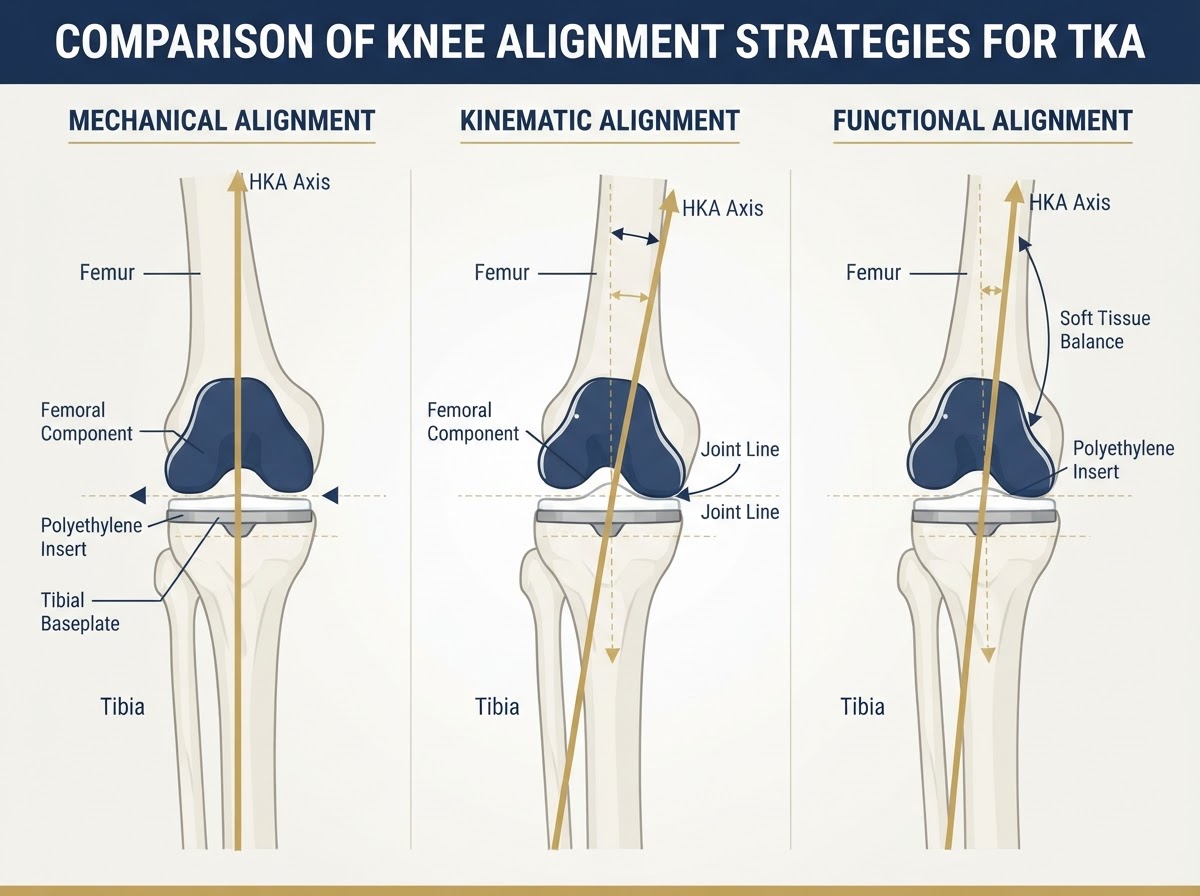
Alignment strategy is a separate concept from robotic assistance, but the two are related because robotic systems can help measure and execute a chosen strategy. Mechanical alignment aims to position components so that the hip-knee-ankle axis is a straight line, distributing load evenly; it is the traditional and most widely studied approach. Kinematic alignment aims to restore the patient's native, pre-arthritic joint line and component orientation, respecting individual anatomy. Restricted kinematic alignment applies kinematic principles within safe limits. Functional alignment is a newer concept that targets a balanced knee adjusted to soft-tissue tension and patient anatomy rather than a fixed geometric target. No single strategy has been definitively proven superior for all patients; selection depends on anatomy, deformity, ligament balance, implant design and surgeon judgement. Robotic assistance can help execute any of these strategies precisely, but it does not automatically produce 'personalised' or 'optimal' alignment — the strategy is still chosen by the surgeon.
Main robotic platforms currently available
Several robotic platforms are in clinical use, and they are not interchangeable. They differ in whether they require imaging, whether they use a robotic arm or handheld instruments, and how they plan and execute. MAKO SmartRobotics (Stryker) uses CT-based preoperative planning with a 3D anatomical model, a robotic-arm-assisted technique with haptic boundaries, and intraoperative planning of component position. ROSA Knee (Zimmer Biomet) offers image-based and imageless workflow options depending on configuration, with anatomical registration, alignment and soft-tissue assessment, and intraoperative planning and guidance. CORI Surgical System (Smith+Nephew) is an image-free platform using handheld robotic-assisted technology for intraoperative modelling, bone preparation and component positioning, with applications in total and partial knee replacement according to the applicable system and regulatory approval. VELYS Robotic-Assisted Solution (DePuy Synthes) is an image-free platform with intraoperative anatomical registration, real-time information and guidance, and robotic-assisted bone preparation. Other platforms such as ApolloKnee/OMNIBotics and SkyWalker are also in use in selected settings. It is important not to imply that all platforms work identically, and to verify current indications and regulatory status, which can change.
Robotic versus conventional knee replacement: technical comparison
The clearest way to compare the two approaches is across specific dimensions. Planning: conventional uses intraoperative jigs and landmarks; robotic uses 3D preoperative or intraoperative planning. Imaging: conventional needs none beyond standard radiographs; some robotic platforms require a CT, others are image-free. Bone cuts: conventional are hand-guided; robotic are guided or constrained by the system. Alignment accuracy: robotic consistently reduces outliers and improves adherence to plan. Ligament balance: conventional is assessed by feel; robotic offers quantitative intraoperative data. Operative time: robotic is generally longer, especially during adoption. Cost: robotic involves higher capital, maintenance, disposable and (where required) CT costs. Surgeon role: identical — the surgeon remains in control in both. Clinical outcome: this is the key question, and the evidence is examined in the next section. The comparison table summarises the main robotic platforms across manufacturer, imaging, configuration, planning, bone preparation, characteristics, potential advantages and limitations. Platform comparison — manufacturer, imaging, configuration, planning, bone preparation, characteristics, potential advantages, limitations: * MAKO (Stryker) — CT-based — robotic arm with haptic boundaries — 3D preoperative planning — robotic-arm-assisted saw/burr — haptic boundaries, intraoperative planning — precise component positioning, soft-tissue protection — requires CT, capital cost, longer setup. * ROSA Knee (Zimmer Biomet) — image-based or imageless (configuration-dependent) — robotic arm — anatomical registration, intraoperative planning — robotic-assisted guidance — alignment and soft-tissue assessment — flexible workflow — platform-specific training, cost. * CORI (Smith+Nephew) — image-free — handheld robotic-assisted — intraoperative modelling — handheld robotic-assisted bone preparation — no CT required, compact — depends on surgeon technique, cost. * VELYS (DePuy Synthes) — image-free — robotic-assisted — intraoperative registration — robotic-assisted bone preparation — real-time guidance, no CT — platform-specific workflow, cost. * ApolloKnee/OMNIBotics, SkyWalker and others — variable — variable — variable — variable — additional options in selected settings — availability and regulatory status vary by region.
Clinical evidence: does robotic surgery improve patient outcomes?
This is the most important question, and the evidence must be read carefully. A clear distinction has to be made between technical precision and clinical outcomes. Technical precision — component positioning, alignment accuracy, reduction in radiographic outliers, reproducibility of the plan, intraoperative balance data — is consistently improved by robotic assistance, and this is well established across randomised trials and systematic reviews. Clinical outcomes — pain, range of motion, functional scores, patient satisfaction, recovery time, complications, implant survival, revision surgery — are what matter to patients, and here the evidence is more nuanced. Better radiographic precision does not automatically translate into better clinical outcomes, and several high-quality studies have found no clinically meaningful difference in patient-reported outcomes between robotic and conventional surgery at medium-term follow-up. The two most important recent sources are summarised below.
The RACER-Knee randomised controlled trial (The Lancet, 2026)
The RACER-Knee trial (Parsons H et al., The Lancet, 2026; DOI 10.1016/S0140-6736(26)00986-4) is a pragmatic, multicentre, participant-masked and assessor-masked, superiority randomised controlled trial comparing robotic-arm-assisted (MAKO) with conventional total knee replacement. It randomised 339 patients. Its findings, reported accurately, are important and balanced: there was no clinically meaningful difference in the primary patient-reported outcome at 12 months between the robotic-arm-assisted and conventional groups; the serious adverse event profiles were similar; and robotic surgery was associated with higher costs. Long-term follow-up remains relevant, because implant survival and revision are outcomes that take years to manifest. The trial does not show that robotic surgery is harmful, nor that it lacks technical precision — it shows that, in this rigorous head-to-head comparison, the technical advantages of robotic assistance did not translate into a clinically meaningful improvement in the primary patient-reported outcome at one year. This is a key piece of evidence and is reported here without omitting its neutral finding.
The 2026 systematic review and meta-analysis (Mosleh et al.)
The updated systematic review and meta-analysis by Mosleh M et al. (Journal of Orthopaedic Surgery and Research, 2026; DOI 10.1186/s13018-026-07227-y) pooled randomised controlled trials comparing robotic-assisted and conventional total knee arthroplasty with a GRADE assessment of certainty. Its findings, summarised accurately, are: robotic assistance showed better accuracy in selected alignment parameters and fewer alignment outliers; there was no consistent broad clinical superiority in patient-reported outcomes; operative time was longer on average with robotic surgery; and the certainty of evidence was variable across outcomes. Together with RACER-Knee, this paints an honest picture: robotic knee replacement is a more precise technique that does not yet have consistent evidence of broadly superior clinical outcomes. Negative and neutral findings are not omitted here — they are central to a balanced assessment.
Precision, alignment and implant positioning
Across the evidence, the technical advantages of robotic assistance are the most consistently demonstrated. Studies and meta-analyses report improved accuracy of component positioning, better adherence to the planned alignment, fewer radiographic outliers, and more reproducible execution of the surgical plan. These are real benefits and they are the reason robotic technology has been adopted. The honest caveat is that the link between these radiographic improvements and patient-reported benefit is weak or inconsistent in the current literature — most patients do well with either technique, and the marginal precision gain has not yet been shown to produce a marginal clinical gain for the average patient. Precision is a means, not an end, and its value depends on whether it changes outcomes that matter to patients.
Pain, recovery, mobility and patient satisfaction
Some early and observational studies suggested potential benefits in early pain, early mobility or length of stay with robotic surgery, but these findings are not consistent across higher-quality randomised trials, and any early differences tend to be small and not clearly clinically meaningful. The RACER-Knee trial found no clinically meaningful difference in the primary patient-reported outcome at 12 months. Patient satisfaction and functional scores at medium-term follow-up are generally similar between robotic and conventional groups in the pooled evidence. This does not mean robotic surgery offers no patient benefit — it means that, on average and in the best available trials, the patient-reported benefits have not been shown to be clearly superior. Individual patients and surgeons may still value the technology for specific reasons, but patients should not be promised faster recovery or less pain as established outcomes.
Complications, safety and possible limitations
Robotic knee replacement is not associated with a clearly higher overall complication rate than conventional surgery in the available evidence, and the serious adverse event profile in RACER-Knee was similar between groups. Specific considerations include longer operative time (which can carry its own risks in some patients), the learning curve and registration errors, the need for additional pins or tracking arrays in some systems (with a small risk of pin-site complications), and the dependence on technology functioning correctly during surgery. Robotic assistance does not eliminate the standard risks of knee replacement — infection, blood clots, stiffness, persistent pain and implant-related problems — which are covered in detail in our dedicated article on risks and complications. Robotic technology is a tool that changes how precisely the operation is performed; it does not change the fundamental risks of major joint surgery.
Learning curve and surgeon experience
Every robotic platform has a learning curve. Surgeons and operating-room teams need platform-specific training in planning, registration, workflow and troubleshooting, and operative time typically increases during adoption before settling. The number of procedures required to become proficient varies by platform, surgeon background and case mix, and there is no universal number that applies — it would be misleading to state one. Team training matters as much as surgeon training, because robotic workflow involves the whole theatre team. Maintaining conventional surgical competence is important: technology can fail, and the surgeon must be able to complete the operation safely without the robot if needed. Most importantly, robotic technology does not replace surgical judgement or experience — it amplifies the precision of an experienced surgeon but cannot compensate for poor decision-making. Choosing a surgeon should never be reduced to choosing a robot.
Implant longevity and revision rates
Whether robotic assistance improves long-term implant survival is not yet established. The reasoning is plausible — better alignment and component positioning might reduce wear, loosening and instability, and therefore reduce revision — but plausibility is not proof. Long-term revision rates depend on many factors beyond alignment, including implant design, patient activity, weight, bone quality and surgical technique, and revision is a long-term outcome that takes many years to measure reliably. Current registry data and trials have not yet demonstrated a definitive reduction in long-term revision with robotic assistance. Patients should not be promised that a robotic implant will last longer than a conventionally implanted one. The honest position is that improved precision may contribute to longevity, but definitive evidence of improved long-term survival is not yet available.
Which patients may benefit from robotic assistance?
Robotic assistance may be considered for primary total knee replacement, for selected partial (unicompartmental) knee replacement where precise component positioning is particularly important, and for some cases of complex anatomy or deformity where detailed intraoperative planning and balancing may be useful — depending on the platform and the surgeon's experience. It is not necessary for every patient. Many patients achieve excellent, durable results with conventional knee replacement, and conventional surgery remains an entirely appropriate, evidence-based option for the majority. The decision to use robotic assistance should be individualised, based on the patient's anatomy and needs, the surgeon's experience with the specific platform, and the available technology — not on the assumption that 'more technology is always better'. No artificial indication is created here, and robotic surgery is not presented as required for any particular patient.
Cost, value and patient decision-making
Robotic surgery involves additional costs that are real and should be discussed transparently. These include platform acquisition, lease or rental; maintenance and service contracts; disposable instruments and consumables; a preoperative CT when required; training; additional operating-room resources; and the impact of longer operative time and workflow changes. It is important to distinguish the cost of the technology, the additional cost per operation, the price charged to the patient, and the clinical value of the procedure. A higher price does not automatically mean a better clinical outcome — the RACER-Knee trial found higher costs without a clinically meaningful improvement in the primary outcome. No specific prices are invented here, because actual costs vary widely by centre, country, insurer and platform. Robotic surgery is best understood as an advanced surgical option that may be selected according to the patient's needs, the surgeon's experience and the available technology, with the cost weighed against evidence of benefit rather than assumed superiority.
Questions patients should ask their surgeon
A well-informed patient asks specific questions. Useful questions include: What robotic platform do you use, and what are its specific features? Is a CT scan required, and why? What does the robot do during my operation, and what will you do? What is your experience with this platform and with conventional knee replacement? What does the current evidence say about patient outcomes, not just precision? What are the costs, and what do they cover? What are the risks, and how do they compare with conventional surgery? Why do you recommend robotic assistance for me specifically, or why not? What is the expected recovery? How is my long-term follow-up managed? These questions help separate evidence-based recommendations from marketing, and they are entirely reasonable to ask before any decision.
Conclusion and consultation CTA
Robotic-assisted knee replacement is a genuinely more precise way to perform a knee replacement, and that precision is well demonstrated. What is not yet demonstrated is that this precision consistently produces better clinical outcomes for patients — the best current evidence, including the 2026 RACER-Knee trial and the Mosleh et al. meta-analysis, shows no clinically meaningful superiority in patient-reported outcomes at medium-term follow-up, alongside higher costs and longer operative time. Robotic surgery is an advanced option that may be right for some patients and some surgeons, but it is not necessary for everyone, and conventional knee replacement remains an excellent, evidence-based choice for the majority. The right decision depends on your anatomy, your surgeon's experience, the available technology and an honest discussion of benefits, costs and evidence — not on marketing. For residents and visitors across the Costa Blanca — Alicante, Torrevieja and Orihuela Costa — Dr Pablo Banchero offers individualised, evidence-based advice on conventional and robotic knee replacement, and a frank second opinion if you are weighing your options.
Precision is proven; clinical superiority is not yet
Robotic knee replacement improves the precision of component positioning and alignment, and that is a real technical advance. The current best evidence, including the 2026 RACER-Knee Lancet trial and the Mosleh et al. meta-analysis, does not show a clinically meaningful improvement in patient-reported outcomes at medium-term follow-up, and robotic surgery is associated with higher costs and longer operative time. It is an advanced option to be chosen individually — not a universally superior treatment. On the Costa Blanca — Alicante, Torrevieja and Orihuela Costa — Dr Pablo Banchero provides evidence-based advice and second opinions on conventional and robotic knee replacement.
References & scientific evidence
- Parsons H, Paling R, McMenamin J, Barksfield H, Mhango D, Dawson-Bowling S, et al.. Robotic-arm-assisted versus conventional total knee replacement (RACER-Knee): a pragmatic, multicentre, participant-masked and assessor-masked, superiority, randomised controlled trial.. The Lancet, 2026.Randomised controlled trialDOI: 10.1016/S0140-6736(26)00986-4PMID: 42624811View source
- Mosleh M, Amer AR, Al-Ahaideb A, Al-Otaibi M, Al-Sayed M, Alharbi J, et al.. Robotic-assisted versus conventional total knee arthroplasty: an updated systematic review and meta-analysis of randomized controlled trials with grade assessment.. Journal of Orthopaedic Surgery and Research, 2026.Meta-analysisDOI: 10.1186/s13018-026-07227-yView source
- National Institute for Health and Care Excellence (NICE). Robot-assisted surgery for orthopaedic procedures. Health Technology Guidance HTG743.. NICE Health Technology Guidance, 2025.Clinical guidelineView source
- National Institute for Health and Care Excellence (NICE). Joint replacement (primary): hip, knee and shoulder. NICE guideline NG157.. NICE Clinical Guidelines, 2020.Clinical guidelineView source
- Siqueira MB, Helal A, Reich S, Peel J, Hopper RH, Klika AK, Barsoum WK. Robotic-arm-assisted total knee arthroplasty is associated with improved accuracy and patient-reported outcomes: a systematic review and meta-analysis.. Bone & Joint Journal, 2023.Meta-analysisDOI: 10.1302/0301-620X.105B7.BJJ-2022-0933.R2View source
- Zhang F, Zhang Z, Xie J, Liu Y, Hu Y, Cai X. Robotic-arm-assisted versus conventional total knee arthroplasty: a meta-analysis of randomized controlled trials.. Journal of Orthopaedic Surgery and Research, 2023.Meta-analysisDOI: 10.1186/s13018-023-04288-1View source
- Huijbregts HJT, Khan RJ, Fennema P, Waters TS, Janssen RP. Robotic-arm-assisted versus conventional total knee arthroplasty: a multicentre randomized controlled trial.. Bone & Joint Journal, 2021.Randomised controlled trialDOI: 10.1302/0301-620X.103B9.BJJ-2020-2349.R1View source
- National Joint Registry (NJR) for England, Wales, Northern Ireland and the Isle of Man. National Joint Registry 21st Annual Report — Hip, Knee, Ankle, Elbow and Shoulder Arthroplasty: Outcomes and Survivorship.. National Joint Registry, 2024.Observational studyView source
- Australian Orthopaedic Association National Joint Replacement Registry (AOANJRR). Hip, Knee & Shoulder Arthroplasty Annual Report 2024.. AOA NJRR, 2024.Observational studyView source
- American Academy of Orthopaedic Surgeons (AAOS). Surgical Management of Osteoarthritis of the Knee — Evidence-Based Clinical Practice Guideline (SMOAK2).. AAOS Clinical Practice Guidelines, 2022.Clinical guidelineView source
- Kleeblad JD, Borus TA, Coon TM, Dounchis J, Leadbetter WB, Pearle AD. Midterm survivorship and patient-reported outcomes of robotic-arm-assisted partial knee arthroplasty: a multicenter study.. Journal of Arthroplasty, 2020.Observational studyDOI: 10.1016/j.arth.2020.04.042View source
- Batailler C, Lording T, Servien E, Lustig S. Robotic-assisted versus conventional total knee arthroplasty: a systematic review of the learning curve.. SICOT-J, 2021.Systematic reviewDOI: 10.1051/sicotj/2021012View source
- Fang T, Wang X, Hu Z, Wang Y, Wang F. Robotic-assisted versus conventional total knee arthroplasty: a meta-analysis of clinical and radiological outcomes.. Journal of Orthopaedic Translation, 2023.Meta-analysisDOI: 10.1016/j.jot.2023.03.001View source
Frequently asked questions

Dr. Pablo Banchero Lasalvia
Orthopaedic Surgeon · Traumatology Team
- Author:
- Dr. Pablo Banchero Lasalvia
- Medical reviewer:
- Dr. Pablo Banchero Lasalvia
- Published:
- 2 November 2026
- Medical review date:
- 2 November 2026
- ·
- 24 min read
Book Your Consultation via WhatsApp
Request a private, evidence-based orthopaedic assessment with Dr Pablo Banchero to compare conventional and robotic knee replacement, weigh the benefits and costs, or get a specialist second opinion on the Costa Blanca.
Official number: +34 602 99 22 22